

-Submitted by David Drumm (Nal), Guest Blogger

Since polling all voters is a costly and time consuming process, a random sample of voters is selected and, based on some assumptions, one can make a probabilistic judgement regarding the outcome of an election. Polling all voters yields the “true” percentage while the random sample can only estimate the “true” value.
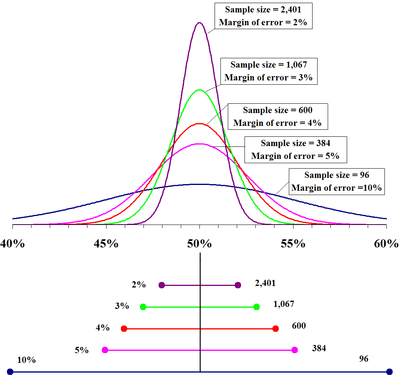
Every time a sample is taken, a different (perhaps) estimate of the “true” value is obtained. The estimate plus and minus the MOE is called the confidence interval. A 95% confidence interval says that 95% of the sample estimates will lie within that interval. Also, a 95% confidence interval says that we are 95% certain that the “true” value lies within that interval.
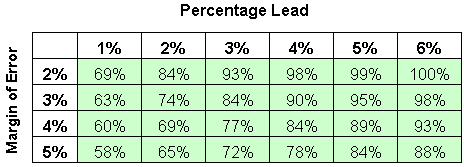
After our poll of 1067 likely voters, Smith leads Jones 49-46% with an MOE of 3%. Some would call this a “statistical tie” since the lead is within the MOE. However, the following table tells us that Smith’s lead is 84% probable.
H/T: Kevin Drum, Fritz Scheuren.