

-Submitted by David Drumm (Nal), Guest Blogger
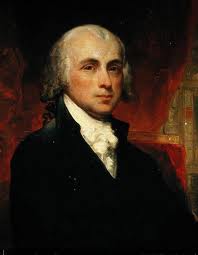

The War of 1812 was, bar none, our most unpopular war. The New England states, run by Federalists, opposed the war in both word and action. Massachusetts refused to send their militia to repel a British invasion of Maine. Vermont smugglers drove herds of cattle north to Canada to feed British soldiers.
There was open talk about secession. In 1814, New England states met at the Hartford Convention to discuss an end to the national compact. Madison made no effort to prosecute Federalist newspapers or prevent the Hartford Convention.
Had Madison cracked down on the Federalists, secession and the Civil War may have started 50 years earlier. The nascent nation of Madison’s presidency required a different approach and Madison had the right temperament and philosophy at the right time.
Madison’s record on the detention of U.S. citizens by the military is the exact opposite of what we find today. One example is the case of Samuel Stacy. Stacy was arrested by the military on July 1, 1813, as a spy and a traitor for aiding the British in their near-capture of Sackets Harbor on the New York side of Lake Ontario. Stacy petitioned the Supreme Court of New York for a writ of habeas corpus and Chief Judge James Kent issued the writ. When Major General Morgan Lewis refused to hand Stacy over to the court and sought to try him by court martial, the chief judge held Lewis in contempt, claiming that Lewis is “assuming criminal jurisdiction over a private citizen.” Madison agreed with the court that the military lacked “any color of authority” to detain Stacy and try U.S. citizens in courts martial, and on July 26, 1813, through Secretary of War Armstrong, ordered Stacy released. I find it hard to imagine Madison pushing a National Defense Authorization Act through Congress allowing for the indefinite detention of American citizens.
The late chief justice William Rehnquist, in his book All the Laws but One: Civil Liberties in Wartime, saw Madison as “too weak and inert to abridge anyone’s civil liberties.” Regardless of whether Madison acted based on reasons of principle or practicality, isn’t that the point of a republican form of government? The Revolution was fought to rid ourselves of an imperial monarchy. Great pains were taken to ensure that the presidency didn’t turn into another monarchy. George Washington stepped down after only two terms when he could have become a king. Our founders paid more than lip service to our republican form of government.
It is unlikely that Lincoln’s suspension of the writ of habeas corpus had any effect on the outcome of the Civil War. Likewise, Roosevelt’s internment of Americans of Japanese descent had zero effect on the outcome of World War II. These suspensions of civil liberties did leave a stain on the reputations of both men.
Today we still suffer from Presidents who lack a commitment to our republican form of government. Madison’s example of a successful prosecution of a war while maintaining a commitment to civil liberties has been forgotten.
H/T: Benjamin Wittes and Ritika Singh (pdf), Ingrid Brunk Wuerth (pdf).