

-Submitted by David Drumm (Nal), Guest Blogger


In a statement that drew gasps in the courtroom, J. Scalia called Section 5 a “perpetuation of racial entitlement.” Later, J. Sotomayor asked the attorney for Shelby County: “Do you think the right to vote is a racial entitlement in Section 5?” Although J. Scalia has been the reigning bully of the Supreme Court, some new Justices are more than capable of standing up to him. It is likely, however, that J. Scalia was referring to the use of Section 5 to create African-American (or Hispanic) voting districts to counteract the practice of vote dilution. J. Sotomayor also called Shelby County’s voting law record “the epitome of what caused the passage of this law to start with.”
It is Section 2 of the Voting Rights Act that prohibits the gerrymandering of election districts to dilute minorities’ voting power. Under Section 2, either the United States Department of Justice or private citizens can sue election officials. However, this would be a time-consuming process and the racial gerrymandering would continue unless injunctive relief was granted. Section 5 is a procedural 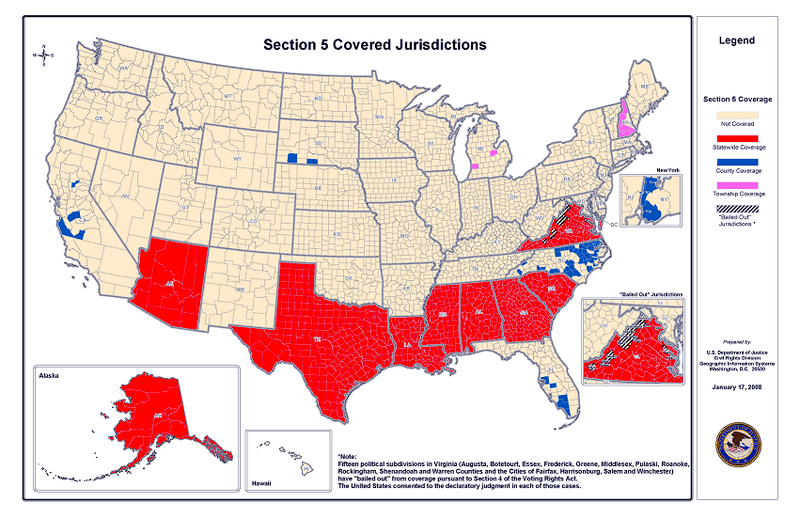
In League of United Latin American Citizens v. Perry, Chief Justice Roberts wrote that “this divvying us up by race” a “sordid business.” Unfortunately, Chief Justice Roberts wasn’t writing about the racial gerrymandering that leads to vote dilution, he was writing about the racial gerrymandering that maintains minority voting power. Chief Justice Roberts also wrote: “The way to stop discrimination on the basis of race is to stop discriminating on the basis of race.” Racial gerrymandering that leads to vote dilution is discrimination. As Joey Fishkin writes: “The way to stop Congress from discriminating on the basis of race is to stop all this discrimination on the basis of race.”
UCLA con-law professor Adam Winkler notes the irony of originalists J. Scalia and J. Thomas voting against the Voting Rights Act. Prof. Winkler finds broad agreement among legal historians that the Fifteenth Amendment’s express grant of authority to Congress to pass “appropriate legislation” was intended to ensure African-American’s right to vote.
The right to vote is more that allowing voter registration. It is more than casting ballots. It is more than having those ballots counted. It is about equal participation in the political process. Vote dilution has the same effect as not counting minority ballots.
The Court is poised to facilitate the “sordid business” of racial gerrymandering designed to exclude African-American and Hispanic participation in the political process.
H/T: Charles P. Pierce, Adam Serwer, Rick Hasen, Scott Lemieux, Roger Clegg, Adam Serwer.