

By Charlton Stanley, weekend writer

When Congress passed the FAA Modernization and Reform Act of 2012, they carved out an exemption for model airplanes and aeromodeling in general. As passed by Congress, §336 prohibits the FAA from promulgating any new rule or regulation regarding model aircraft, or an aircraft being developed as a model aircraft …” The law does specify that certain requirements must be met for an aircraft to qualify as a model airplane. However, that did not deter the FAA in its quest to amass more power over anything that can get off the ground higher than the Administrator can jump. After all, the space between the trees in your backyard, the local park, or your model flying club IS airspace, and they see their job as controlling airspace, dammit! All of it.

Some early modelers began using radio to control their model airplanes. The first radios were hand made, were heavy and not reliable. Transistors had been invented recently, and those replaced vacuum tubes. When Citizen’s Band channels opened up specific frequencies, a market opened up for more than CB radios on the highway. Specialized control boxes and receivers for model airplanes, cars and boats appeared. Radios became smaller, lighter and more reliable. Free flight and control line flying continued to have a major niche in model aviation, but radio control took center stage by the 1960s and 1970s.
Things appeared to be going along well for both model hobbyists and the FAA until a combination of 9-11 and new photographic technology appeared a few years ago. And the Internet. The FAA started eying model airplanes as another area of flight they could move in on and control. Horror of horrors, they discovered people with NO PILOTS LICENSES were making money from their aerial hobby. Contests have always had prizes, and a few sponsored fliers have likewise been around ever since Jim Walker patented his U-Reely device.
The AMA set up a special office for government relations, designed to coordinate and resolve issues associated with the possibility of airspace conflicts between models and the air traffic system. Most model airplane flying clubs are AMA chartered, meaning that each member has a million dollar insurance policy, but members also have to abide by the rules. For instance, the AMA rules say no flight over 400 feet.
Are there scofflaws? Of course. Just as there are people who speed, drive recklessly, text while driving and do truly dumb stuff in their cars. And boats. And airplanes. And motorcycles. The problem is that scofflaws create problems for everyone else who wants to do the right thing.
I wrote about First Person View flying in a previous article. Since I wrote that, use of FPV has become even more popular. Some real estate agents have used small helicopters to take cameras aloft to photograph properties for sale to use in their ads. It is unfortunate that these models have been conflated with military drones, and news reporters report on “drones” in their stories. Such as the man who was rescued recently when a model flier helped with the search for him over a remote area. If the FAA had their way, the searchers would have been acting illegally, without permits, clearance from Air Traffic Control and proper licensing. In the meantime, the lost man would have died, strangled to death by miles of bureaucratic red tape.
I reported on the tornado that devastated the small town of Mayflower, Arkansas. The reporter who used a camera-equipped model helicopter to get the striking news video I posted is now under investigation by the FAA. No one seems to know just what laws the reporter broke, but the FAA seems determined to find something, anything.
How is the FAA interpreting the new law? You know, the one that exempts model airplanes from FAA control? 14 CFR 91-131 says that no one may operate an aircraft within a Class B airspace area unless the operator/pilot is cleared by ATC (Air Traffic Control). The Federal Air Regulations say that no one may operate a civil aircraft within a Class B airspace area unless the pilot in command holds a pilot’s certificate.
To understand this, Class B airspace is a massive block of airspace shaped like an upside-down wedding cake over a controlled airport. This link takes you to an image of the various kinds of airspace, including Class B. The inner, bottom ring, extends all the way to the ground for at least five miles from the airport. Take that in for a moment. Class B airspace extends five miles in all directions from the airport. If you live within that area, the FAA says they control the airspace right down to the wheels on your backyard BBQ grill, and little junior can’t fly his toy helicopter or model airplane from Radio Shack or Walmart out there without meeting FAA requirements.
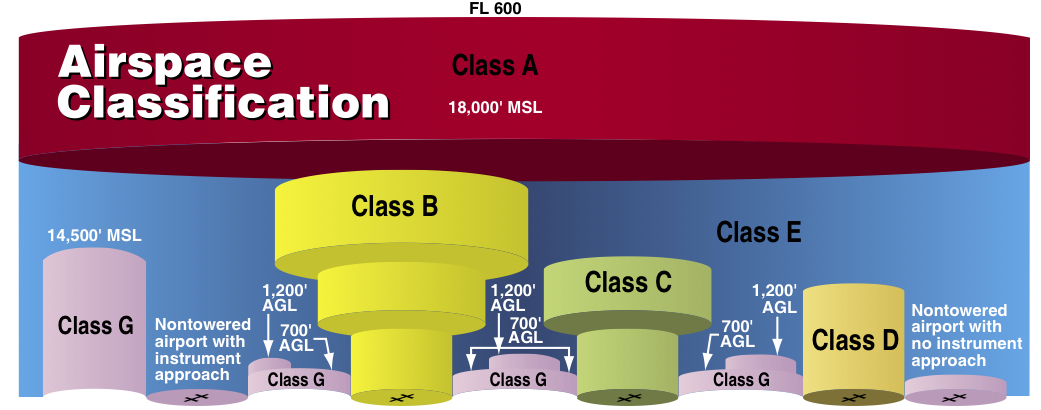
The AMA says there are approximately 100 chartered flying clubs located within Class B airspace. Members have invested years of work, and tens of thousands of dollars improving and maintaining the fields. Many of them have been in operation for decades, with no problems or conflicts with airport traffic. Since they have a 400′ ceiling rule anyway, I want to know what kind of pilot is flying under 400′ feet five miles from the nearest airport without a declared emergency? If that is the airspace conflict the FAA is worried about, they are looking at the wrong pilot to go after.
Model airplane pilots are already required to be aware of and follow NOTAMS (Notices to Airmen) regarding Temporary Flight Restrictions. For example, if the President comes to town, the no-fly zone may extend for thirty or more miles around Air Force One, the motorcade and whatever venue the President is speaking. Pilots, both licensed and modelers, who bust a TFR may find themselves having to talk to unsmiling people in dark suits. For hours. While the suits decide whether to take you to jail or just slap a hefty fine on you.
Back to the FPV flying. The pilot wears virtual reality goggles which project the image from a camera mounted on the plane. The view is similar to what the pilot of a real airplane sees out the windshield. However, the FAA doesn’t like that. The 2012 statute says that model airplanes must be kept within visual line of sight. The intent of the law is to limit how far away a person should fly the model aircraft and still see it, not the method of control. In fact, AMA rules require a “spotter” to assist the pilot using FPV goggles. The FAA says that is unacceptable; you can’t wear the goggles, which of course defeats the whole purpose of flying FPV.
The AMA believes this is a totally unprecedented attempt by the FAA to establish a precedent for controlling and limiting technology they may dislike.
The FAA is trying to make an end run around the 2012 law after losing in court at least twice. They are determined to take control of the hobby of model aviation. There are deeper and more sinister implications for this as well. If one is a licensed pilot, and does something the FAA determines is a violation of the Federal Air Regulations (FAR), their license to fly as a private or commercial pilot is in jeopardy.
The FAA, in their proposed rules, make one of the most sweeping and mind-bending statements I have ever read. The FAA claims an unknown number of aviation regulations, “…may apply to model aircraft operations, depending on the particular circumstances of the operation.”
Stop and mull that one over. If you have never seen the Federal Air Regulations/Aeronautical Information Manual, it is 1,125 pages of rules. Add to that, the 470 page Pilot’s Handbook of Aeronautical Knowledge, and you have a very large amount of stuff to memorize. The FAA, like any other government agency, is made up of fallible human beings. People who get their feelings hurt, may have anger issues, personality disorders or other problems. Some are just rigid and take the literal enforcement of every jot and tittle as their bounden duty. As they say in the south, if you “get crossways” with one of them on a bad day, they can and will come after you.
The comment period is still open until September 23, 2014. This page has some simple explanations of some of the more onerous proposals, with links to the FAA comment section.
Now, about some model flying. Here is Devin McGrath flying his indoor, electric powered foamy at E-Fest last year.

—ooOoo—