

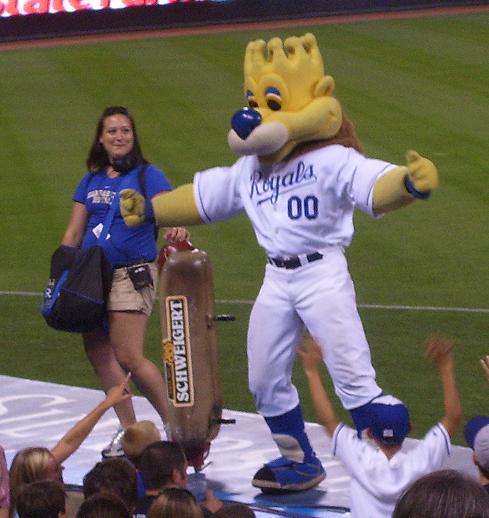
Coomer appears to have been hit by a hand-thrown hotdogs as opposed to those fired from a cannon but bubble-wrapped for the protection of the fans. Here are the facts according to the court:
At trial, Mr. Coomer testified that on September 8, 2009, he went to the Royals game with his father. To be closer to the game, instead of sitting in their ticketed seats, Mr. Coomer and his father sat in open seats six rows behind the third base dugout. Between the third and fourth innings, the Royals had a promotional event, the “Hotdog Launch.” Mr. Shores testified that the Royals had been doing the Hotdog Launch at home games since approximately the year 2000. In between innings, the Royals launched 20-30 hotdogs to the fans, either through an air gun or by a hand throw. The hotdogs shot out of the air gun were wrapped in bubble wrap and the ones Mr. Shores threw were typically wrapped in foil. Mr. Shores testified that he used a number of types of throws to entertain the fans: “overhand, over the shoulder, behind the back, . . . sidearm.” The jury was shown videos of several games, including the night of September 8, 2009, although the throw at issue had not been videotaped.
Mr. Shores had no recollection of conducting the Hotdog launch any differently on September 8, 2009. He shot hot dogs into the stands with an air gun, and then began tossing hotdogs into the stands by hand. Mr. Shores was in the third base dugout, in front of Mr. Coomer and his father, and people behind them were cheering and yelling for Mr. Shores to throw hot dogs to them. Mr. Coomer testified that he saw Mr. Shores turn his back and make a motion with his arm behind his back; Mr. Coomer looked away to the scoreboard and “a split second later” something hit him in the face. The impact knocked off his hat. Because the throw came so quickly, Mr. Coomer was convinced it was a straight-line throw rather than the soft overhand tosses Mr. Shores had previously been making.
Two mornings later, Mr. Coomer noticed a problem with his vision. A tearing and detachment of his retina was subsequently diagnosed and he underwent surgery. He lost vision in his eye for about three weeks and subsequently developed a cataract. In December 2009, Mr. Coomer had an additional surgery for the cataract and now has an artificial lens in his eye. He testified that his vision in that eye suffers more impairment than prior to the injury.
His appeal focused on the trial court’s instruction on the Royals’s defense of primary implied assumption of risk. He also alleged that the trial court erred in permitting and instructing on the Royals’s defense of comparative fault. He also alleged that trial court erred in refusing to instruct the jury on his claims for negligent supervision and training. It was the instruction that proved the error on appeal:
Primary implied assumption of risk operates to negate the negligence element of duty. Ivey, 336 S.W.3d 155, 157-58. The plaintiff’s voluntary participation in the activity serves as consent to the known, inherent, risks of the activity and relieves the defendant of the duty to protect the plaintiff from those harms. Id. at 157. Because the defendant has no duty to protect against those inherent risks, he cannot be found negligent for causing the plaintiff injury. Id. The risks assumed, however, “are not those created by a defendant’s negligence but rather by the nature of the activity itself.” Martin v. Buzan, 857 S.W.2d 366, 369 (Mo. App. E.D. 1993).
The issue is thus whether the risk Mr. Coomer encountered was one which inhered in the game, or one which would be created by the defendant’s negligence. See Ross v. Clouser, 637 S.W.2d 11, 14 (Mo. banc 1982)). Mr. Coomer argues that the trial court erred in submitting the defense to the jury because “the risks created by a mascot throwing promotional items do not arise from the inherent nature of a baseball game.” On these facts, we agree.
While the defense insists the error was harmless, I do not see how anything short of a new trial would suffice. I believe the jury was wrong originally, but the result could be the same. It is interesting that a change of venue would not be in order given the popularity of the mascot, though there is the risk of a counter prejudice of a state with an rival team. That leaves some non-team choices: Alabama, Alaska, Arkansas, Connecticut, Delaware, Hawaii, Idaho, Indiana, Iowa, Kansas, Kentucky, Louisiana, Maine, Mississippi, Montana, Nebraska, Nevada, New Hampshire, New Jersey, New Mexico, North Carolina, North Dakota, Oklahoma, Oregon, Rhode Island, South Carolina, South Dakota, Tennessee, Utah, Vermont, Virginia, West Virginia, Wyoming. However, many of these states follow nearby teams like Kansas itself which faces the indignity of having their “Kansas” team residing in Missouri.
What do you think? Should there be a change of venue for any new trial?
Sluggerrr and his counsel are considering an appeal.
Source: Kansas City
Kudos: Brendan Murphy