


As students openly murmured in confusion, Hughes then explained “In order to learn quantum mechanics, you have to strip to your raw, erase all the garbage from your brain, and start over again . . . Um, nothing you’ve learned in your life up til now is in any way going to help prepare you for this. . . . I’ve been tasked with the impossible challenge of teaching you quantum mechanics in one hour.”
It might be difficult to erase the memory of this lecture but academic freedom does produce its idiosyncrasies. While stripping in class is rather novel, it is remarkably a device used by others to concentrate the mind of an audience. Covington & Burling partner David Remes stripped in front of a shocked in Yemen to convey a point about torture. It had the same memorable impact.
The bizarre nature of the display by Hughes was tied directly to a point about discarding preconceptions or knowledge. The question comes down to the stripping and whether it crosses the line of academic freedom.
The faculty handbook at Columbia is written in generalized terms that recognizes the strong presumption in favor of academic freedom:
In conducting their classes, faculty should promote an atmosphere of mutual tolerance, respect, and civility. They should allow the free expression of opinions within the classroom that may be different from their own and should not permit any such differences to influence their evaluation of their students’ performance. They should confine their classes to the subject matter covered by their courses and not use them to advocate any political or social cause. These principles of classroom conduct help to promote a healthy learning environment, but they do not limit the authority of the faculty to determine the actual content of their courses nor do they interfere with the right of faculty to express personal political views outside of the classroom in the manner of their choosing.
Students who feel that their faculty have not abided by these principles may file a complaint according to procedures described later in this chapter of the Handbook.
Here is Hughes bio:
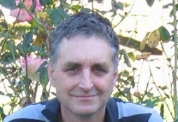
My primary research is directed at the study of new particles and new interactions using the ATLAS detector at the Large Hadron Collider at CERN. My group has been active in the commissioning of the ATLAS pixel detector, where we have participated in the development of the data acquisition system and various calibrations. Although we are broadly involved in searches for new physics, we have initially been focused on the study of jets and photons in high-energy proton-proton collisions. We are active in work pertaining to jet and photon energy calibrations as well as first QCD measurements. As the data size increases, we will continue to participate in the study of jets and missing energy that provide potential signals for the study of SUSY and the search for Dark Matter, as well as searching in the Higgs to two-photon channel.We are also pursuing R&D activities in collaboration with Brookhaven National Lab and Strasbourg (IPHC) on ultra-thin silicon detectors for future colliders. Nevis laboratory has a high intensity x-ray source, which provides a unique test facility for new detectors to be used in high radiation environments. The silicon research also will provide PhD theses for Columbia students based in New York City. A significant research investment in undergraduate education is also attached to this laboratory work.
Source: