

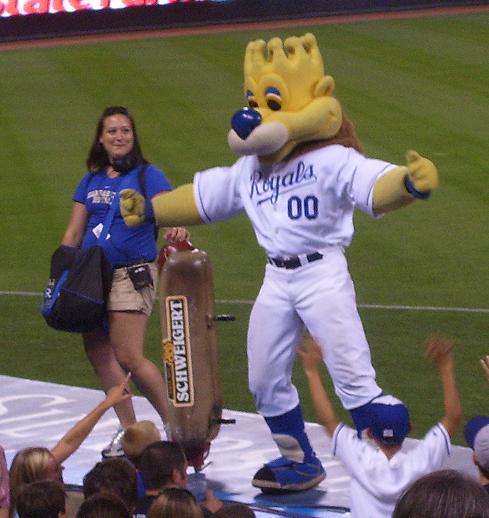
Here are the facts according to the appellate court:
At trial, Mr. Coomer testified that on September 8, 2009, he went to the Royals game with his father. To be closer to the game, instead of sitting in their ticketed seats, Mr. Coomer and his father sat in open seats six rows behind the third base dugout. Between the third and fourth innings, the Royals had a promotional event, the “Hotdog Launch.” Mr. Shores testified that the Royals had been doing the Hotdog Launch at home games since approximately the year 2000. In between innings, the Royals launched 20-30 hotdogs to the fans, either through an air gun or by a hand throw. The hotdogs shot out of the air gun were wrapped in bubble wrap and the ones Mr. Shores threw were typically wrapped in foil. Mr. Shores testified that he used a number of types of throws to entertain the fans: “overhand, over the shoulder, behind the back, . . . sidearm.” The jury was shown videos of several games, including the night of September 8, 2009, although the throw at issue had not been videotaped.
Mr. Shores had no recollection of conducting the Hotdog launch any differently on September 8, 2009. He shot hot dogs into the stands with an air gun, and then began tossing hotdogs into the stands by hand. Mr. Shores was in the third base dugout, in front of Mr. Coomer and his father, and people behind them were cheering and yelling for Mr. Shores to throw hot dogs to them. Mr. Coomer testified that he saw Mr. Shores turn his back and make a motion with his arm behind his back; Mr. Coomer looked away to the scoreboard and “a split second later” something hit him in the face. The impact knocked off his hat. Because the throw came so quickly, Mr. Coomer was convinced it was a straight-line throw rather than the soft overhand tosses Mr. Shores had previously been making.
Two mornings later, Mr. Coomer noticed a problem with his vision. A tearing and detachment of his retina was subsequently diagnosed and he underwent surgery. He lost vision in his eye for about three weeks and subsequently developed a cataract. In December 2009, Mr. Coomer had an additional surgery for the cataract and now has an artificial lens in his eye. He testified that his vision in that eye suffers more impairment than prior to the injury.
This is a great case and a great opinion for those of us who love torts. It touches on themes of assumed risk, comparative negligence, and implied warnings. The adoption of comparative risk often eliminates or curtail assumption arguments as explained by the court:
When the risk arises from the circumstances (e.g., from a condition on the defendant’s property or the inherent nature of the defendant’s activity), “implied primary assumption of the risk” completely bars recovery by a plaintiff who knowingly and voluntarily encounters that risk. Krause v. U.S. Truck Co., Inc., 787 S.W.2d 708, 711-12 (Mo. banc 1990); Reflections, 50 UCLA L. Rev. at 487-88. When the risk is created by defendant’s negligence, on the other hand, this has been identified as “implied secondary assumption of the risk.” Lewis v. Snow Creek, Inc., 6 S.W.3d 388, 395 (Mo. App. 1999); Reflections, 50 UCLA L. Rev. at 489. Understandably, courts were less willing to bar all recovery in the latter circumstance unless the plaintiff not only knowingly and voluntarily acquiesced in the risk created by the defendant’s negligence but also acted unreasonably in doing so. Id.
Accordingly, prior to the advent of comparative fault, a plaintiff’s claim was barred completely by assumption of the risk if the plaintiff (a) expressly consented to assume a known and understood risk (i.e., “express assumption of the risk”); (b) implicitly consented (based on his conduct and surrounding circumstances) to assume a known and understood risk that was not created by the defendant’s own negligence (i.e., “implied primary assumption of the risk”); or (c) implicitly consented (based on his conduct and surrounding circumstances) to assume a known and understood risk that resulted from the defendant’s own negligence, provided that the plaintiff acted unreasonably in doing so (i.e., “implied secondary assumption of the risk”). Though all three were lumped together under the heading of assumption of the risk and treated as affirmative defenses, only the latter application was properly viewed as such.
The version of comparative fault adopted by this Court in Gustafson fundamentally altered this landscape. Section 1(a) of the Uniform Comparative Fault Act (the “UCFA”) provides that “any contributory fault chargeable to the claimant diminishes proportionately the amount awarded as compensatory damages for an injury attributable to the claimant’s contributory fault, but does not bar recovery.” Gustafson, 661 S.W.2d at 18 (quoting from the UCFA, which is set forth in full in an appendix to that opinion). Section 1(b) of the UCFA defines “fault” for purposes of section 1(a) to include “unreasonable assumption of risk not constituting an enforceable express consent.” Id.
As a result, Gustafson, rejects any further application of “implied secondary assumption of the risk.”
The court then goes on to reject the notion that getting hit by a hotdog (as opposed to a baseball) is an inherent risk of attending a baseball game:
to the Royals, the risk to a spectator of being injured by Sluggerrr’s hotdog toss shares the same essential characteristics as the other risks that this Court (and many others) determined long ago were inherent in watching a baseball game in person, i.e., risks that a spectator will be injured by a flying ball or bat. The Court disagrees.
The rationale for barring recovery for injuries from risks that are inherent in watching a particular sport under implied primary assumption of the risk is that the defendant team owner cannot remove such risks without materially altering either the sport that the spectators come to see or the spectator’s enjoyment of it. No such argument applies to Sluggerrr’s hotdog toss. Millions of fans have watched the Royals (and its forebears in professional baseball) play the National Pastime for the better part of a century before Sluggerrr began tossing hotdogs, and millions more people watch professional baseball every year in stadiums all across this country without the benefit of such antics.Some fans may find Sluggerrr’s hotdog toss fun to watch between innings, and some fans may even have come to expect it, but this does not make the risk of injury from Sluggerrr’s hotdog toss an “inherent risk” of watching a Royals game. As noted above, “inherent” means “structural or involved in the constitution or essential character of something: belonging by nature or settled habit,” Webster’s Third New International Dictionary (1966), at 1163 (emphasis added). There is nothing about the risk of injury from Sluggerrr’s hotdog toss that is “structural” or involves the “constitution or essential character” of watching a Royals game at Kauffman Stadium.
It is a great read and one of the best comprehensive treatments of comparative negligence and assumption that I have read.
As for Sluggerrr, an appeal to the United States Supreme Court would be dubious since this is a matter of state law. Such an appeal would lead Sluggerrr swinging with the same purpose as the Mighty Casey:

Oh, somewhere in this favored land the sun is shining bright;
The band is playing somewhere, and somewhere hearts are light,
And somewhere men are laughing, and somewhere children shout;
But there is no joy in Mudville — mighty Casey has struck out.
Here is the latest decision: Coomer opinion