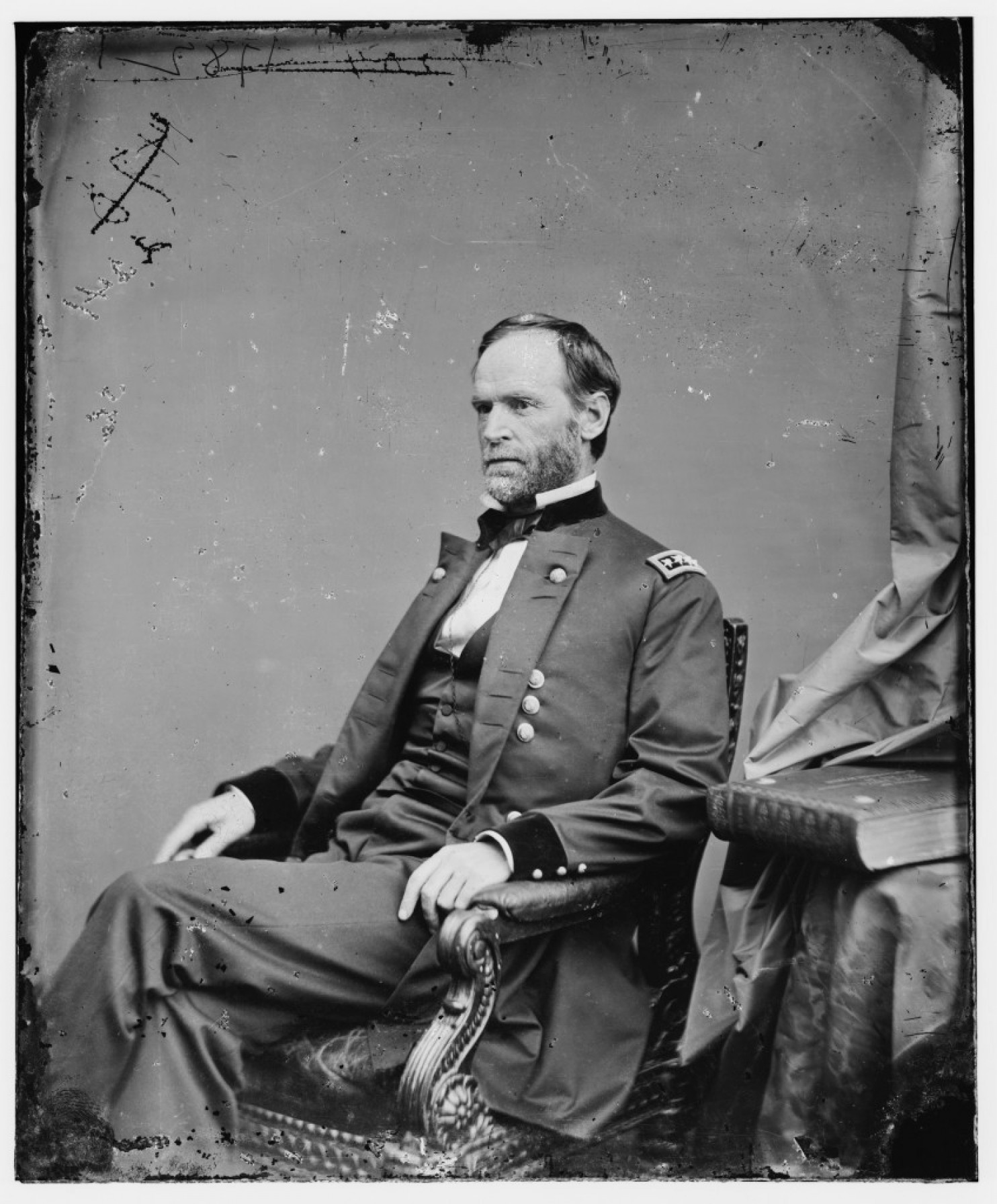
Sherman’s Spoils: Thousands of Civil War Relics Found On South Carolina Riverbed
jonathanturley
As some of you know, I am a military history nut and collect (on a small level) military historical items. That is why this story caught my eye . . . and my greedy imagination. Sitting at the muddy bottom of the Congaree River in Columbia, South Carolina appears to be the long lost munitions booty of General William T. Sherman from his Carolinas campaign. If retrieved, the find could yield thousands of saves, cartridges, scabbards and other items that would thrill civil war buffs — and flood the market for such items. In a curious way, the river find shows history repeating itself. It was the dumping of pollutants by a gas-producing plant that led to the discovery of Sherman dumping his munitions in the river.
The gas-producing plant closed in 1954 but not before dumping roughly 40,000 tons of “taffy-like” black tar in the river. The tar has to be removed in the Congaree by SCANA Corp but that will expose 15 acres of riverbed that turns out to have a two foot layer of Civil War artifacts. It was dumped there By Sherman after capturing Columbia on Feb. 17, 1865 from the Confederacy. It includes, but it not limited to 1.2 million ball cartridges, 100,000 percussion caps, 4,000 bayonet scabbards, 3,100 sabers, and 1,100 knapsacks.
What would be poetic justice is for South Carolina to hold an auction for the equipment for nerds like me and use the money for historical preservation of the area. It would be equally interesting to see the elasticity of prices in Civil War artifacts and whether the price of things like sabers plummets with the infusion of so many new items.
The battle was not the proudest moment for the North. After a failed attempt to hold off the right wing of Sherman’s forces at the crossing of the Salkehatchie River, Union Maj. Gen. Francis P. Blair (Howard’s army) crossed the river and slammed into the flank of Confederate Maj. Gen. Lafayette McLaws. It forced McLaws to withdrew to Branchville and, on February 17, 1865, Columbia surrendered to Sherman. That should have spared the historic city, which was a critical political and transportation center. However, the city was soon overrun by freed Union prisoners, emancipated slaves, and Union troopers. The Union troops soon found large supplies of booze and turned into a drunken mass. Fires soon appeared all over the city and most of the city was burned to the ground. The citizens always insisted that it was intentional, but at a minimum Sherman and his commanders should shoulder the blame for an army that turned into a mob.
It turns out that this river and this area has been much abused both in war and in peace. Sherman proved prophetic when he wrote to Gen. Henry W. Halleck: “The truth is, the whole army is burning with an insatiable desire to wreak vengeance upon South Carolina. I almost tremble at her fate, but feel that she deserves all that seems in store for her.”