


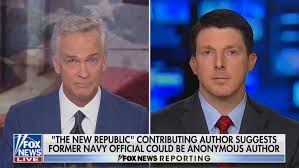
Former Pentagon aide Guy Snodgrass has finally denied that he is “Anonymous” — the author of the book “A Warning.” That was however before he milked the speculation to awkwardly hawk his own less-than-sizzling book. In a Fox interview with Trace Gallagher, Snodgrass went out of his way to tease the speculation while shamelessly pitching his book to try to generate buzz. The curious effort seemed to do little to increase book sales but it certainly generated an abundance of criticism of the previously unknown former speechwriter to former Defense Secretary James Mattis.
In the Fox interview, Snodgrass was asked a simple and honest question of whether he is Anonymous. He decided to pitch his book instead and maintained “if I was gonna make an announcement like that, I’d do it right, I’d come into the studio with you.” Snodgrass was pushed again for a simple yes or no response. Gallagher asked, “Why not just deny it outright?” Snodgrass made a vague response that this is “the latest in a long series of D.C. parlor games” and “I, like many of your viewers, read the anonymous op-ed from last year… it’s interesting.”
That allowed him to keep the buzz going but the blowback on the interview seemed to force a change the next day. “I’m not the writer. I went on to a different television show yesterday, they asked me that question, I kind of batted it away. To put it to rest, no, I’m not the author of ‘A Warning.”
If true, The New Republic’s David Kusnet got this one wrong. Kusnet once correctly guessed the anonymous author of Clinton tome Primary Colors and wrote that he found a telltale pattern in the writing with Snodgrass and Anonymous: “Having closely read ‘A Warning’ and the original op-ed, as well as ‘Holding the Line,’ Snodgrass’s recent memoir of two years with Mattis, I find that my instincts tell me that the same person wrote both books.” For the record, I was a bit surprised by Kusnet’s prediction because a speechwriter for Mattis hardly seems the type of “high-ranking officials” described in stories. At most, such a staffer would seem to have second-hand information on the White House.
For his part, Mattis appears unhappy with his former aide and his decision to write a tell-all book. Mattis appears to question the integrity of Snodgrass in writing such a book based on their private conversations as a violation of trust. Mattis himself declined to make his own memoir a tell-all work despite the potential for windfall sales.