


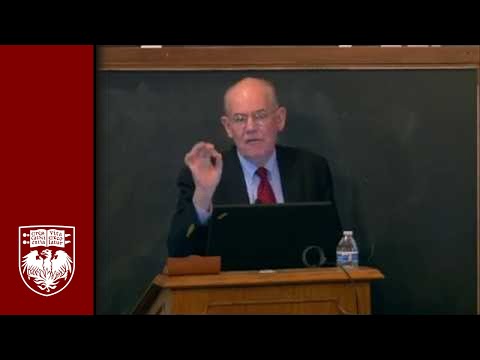
Mearsheimer has objected to the overthrow of what he viewed as a democratically elected president in Ukraine and American policies that were pushing that country toward an inevitable conflict with Russia. He has been largely supported in his predictions of how those tensions would explode with Russia. That does not make him a Putin apologist.
However, even if Mearsheimer did espouse pro-Russian or even pro-Putin views, he has every right to do so as an individual and as an academic. The question is whether UChicago should take an official position on this debate or remain neutral as a forum for research and debate. Despite my support for Ukraine in this war, I am concerned about universities taking such official positions.
The students, Daryna Safarian, Edita Kuberka, Iryna Irkliyenko, Darya Kolesnichenko and Sergiy Kuchko, wrote that they were “pained” by Mearsheimer’s references to a “civil war” and his calling the 2014 removal of Yanukovych a “coup.” What was most notable is the assertion that his views are “not substantiated by any meaningful historical or scholarly evidence.”
One can certainly disagree with his conclusions but it is bizarre to claim that it is without meaningful scholarly or historical basis. It is a common attack on those with dissenting views to declare their views as devoid of intellectual value. We have discussed a crackdown on academics who offered opposing views on World War II, Black Lives Matter, reparations, indigenous land, diversity programs, and other subjects.
We have also seen Russian artists and athletes blackballed for failing to publicly denounce the invasion or Putin.
The students are demanding disclosures of the funding sources of Mearsheimer and a university statement to denounce “anti-Ukrainian ideology on campus.”
UChicago has long been a global leader in protecting free speech and academic freedom, even as peer schools yield to the pressure of conformity and orthodoxy. It should publicly decline such invitations to stand against what some views as “anti-Ukrainian ideology.”
The Mearsheimer controversy should not be difficult for the university. A more difficult question is how universities should address Ukraine. There is a difference between labeling viewpoints and research as unacceptable “ideology” and labeling this attack on Ukraine as a violation of international law.
The problem for the university is that it is a global institution that has a myriad contacts with both Russia and Ukraine. Some of those contacts could be assisting Russia in its attack on Ukraine, particularly in access to research and resources at UChicago. As companies from Mastercard to McDonald’s have suspended dealings with Russia, universities face the same dilemma. I believe that it is appropriate to sever some of those ties.
Universities took such a stand against South Africa during apartheid, though calls to boycott Israel has led to deep and ongoing divisions on our campuses.
There is a distinction that can be drawn between intellectual discourse and institutional support vis-a-vis Russia. Students and faculty should feel entirely protected in espousing views supportive of the Russian position. However, universities should suspend programs in Russia and limit some research collaborations that may support this invasion. That includes grants and programs funded by the Russian government or its proxies.
Where to draw that line is obviously difficult. For example, there is a call from some like Rep. Eric Swalwell to expel Russian students and academics. That, however, would reduce exposure of students and their families to opposing viewpoints and unregulated news. They are the least likely to support this war. Moreover, American academics need to support our colleagues in Russia who oppose the invasion. Putin has long had problems with students and academics who oppose his blood-soaked rule. There is a reason why Putin has shutdown media and closed social media access. He is afraid of interactions with the outside world and access to alternative viewpoints.
As a general matter, I prefer that universities focus on maintaining a fair and open forum for the discussion and research of such contemporary controversies. The invasion forces the hand of universities since they cannot support the violation of international law and the devastation of this sovereign nation. However, we should strive to protect not just access to our universities but the freedom to express dissenting viewpoints.
This position was laid out in the famous Kalven Committee Report at the University of Chicago. I have included it below. It stated in part that the university must protect its core intellectual mission and resist pressure to take political positions on contemporary controversies:
Since the university is a community only for these limited and distinctive purposes, it is a community which cannot take collective action on the issues of the day without endangering the conditions for its existence and effectiveness. There is no mechanism by which it can reach a collective position without inhibiting that full freedom of dissent on which it thrives. It cannot insist that all of its members favor a given view of social policy; if it takes collective action, therefore, it does so at the price of censuring any minority who do not agree with the view adopted. In brief, it is a community which cannot resort to majority vote to reach positions on public issues.
The neutrality of the university as an institution arises then not from a lack of courage nor out of indifference and insensitivity. It arises out of respect for free inquiry and the obligation to cherish a diversity of viewpoints. And this neutrality as an institution has its complement in the fullest freedom for its faculty and students as individuals to participate in political action and social protest. It finds its complement, too, in the obligation of the university to provide a forum for the most searching and candid discussion of public issues.
I understand the passion and sense of offense of these students. Indeed, I share their views on the invasion. They have every right to denounce Professor Mearsheimer, who I expect would be the first to defend that right. However, he also has a right to hold opposing views without being singled out by the university or officially denounced for what some view to be unacceptable “ideology.”