


Steve Vladeck
✔@steve_vladeck
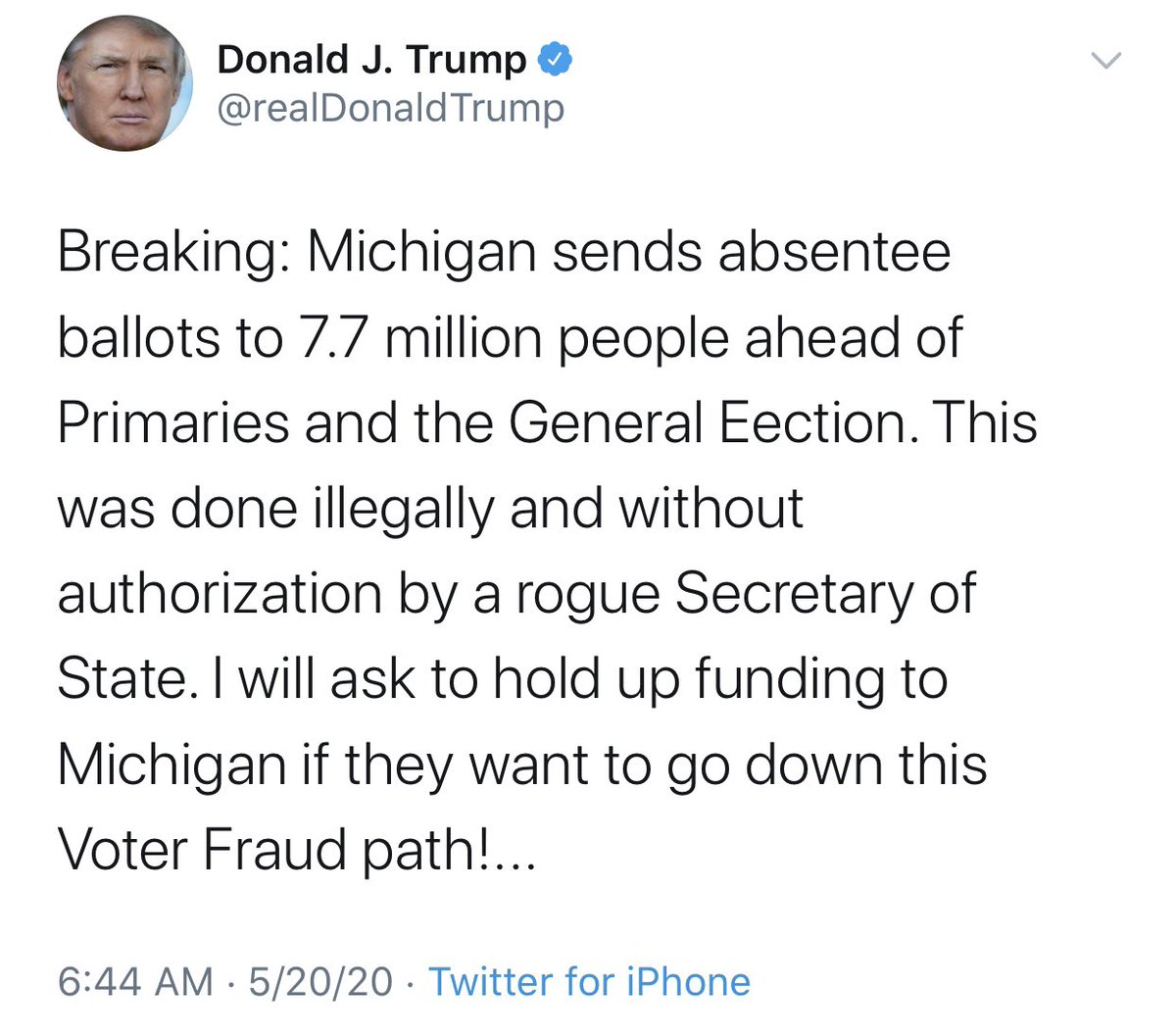
In a single tweet, the President:
1) Lies (that’s not what MI is doing);
2) Asserts without support that someone else is breaking the law;
3) Threatens action that would itself be unconstitutional; &
4) All in service of an unsubstantiated conspiracy theory about voter fraud. https://twitter.com/realdonaldtrump/status/1263074783673102337 …


Vladeck later added that the tweet was not just unconstitutional but illegal.
Steve Vladeck
✔@steve_vladeck
Except that withholding federal funds over (unrelated) policy disagreements is itself “illegal[] and without authorization.”

Once again, the statement could be entirely legal if the funds were discretionary or Trump asked for the restrictions from Congress. Such things appear to matter little. Simply declaring a tweet a crime is instantly accepted and repeated on networks like CNN and MSNBC.
Then there is former Director of the Office of Government Ethics Walter Shaub, who also declared this a crime in the making. Shaub has also been one of the most reliable sources for declaring tweets and comments to be criminal or impeachable matters against Trump.
Shaub was relying on 18 U.S. Code § 598, which states:
Whoever uses any part of any appropriation made by Congress for work relief, relief, or for increasing employment by providing loans and grants for public-works projects, or exercises or administers any authority conferred by any Appropriation Act for the purpose of interfering with, restraining, or coercing any individual in the exercise of his right to vote at any election, shall be fined under this title or imprisoned not more than one year, or both.
Again, the analysis leaps to a conclusion without any factual foundation. Trump could have been referring to asking Congress for such restrictions. Moreover, if the funds were discretionary, it would be distributed according to the congressional design. Finally, even if funds were restricted in conflict with congressional intent, one would have to prove that it was done “for the purpose of interfering with, restraining, or coercing any individual in the exercise of his right to vote.” Trump is arguing that mail voting increases fraud in voting. Instead, he is advocating the use of in person voting. He is not denying the ability to vote per se.
Of course, there is legitimate objection that, in a pandemic, the denial of this option would deter voting. However, that is a matter that would turn on the specific facts of any restriction. For example, mail voting might be allowed subject to added anti-fraud guarantees. The tweet says nothing on such specifics. Indeed, the law does not state that any limitation affecting voting is a crime. It must restrain, coerce, or interfere with the act of voting. Again, we would need to know the specifics before declaring that the tweet is clearly contemplating a crime.
Then there is former federal prosecutor Richard Signorelli, who declared the tweet to be extortion and not just criminal but impeachable. Yes, a new impeachment.
.@realDonaldTrump committing once again the crime of extortion in plain sight, now against the State of Michigan. Unfortunately, I believe he is forcing the hand of the House to commence new impeachment hearings for his continued criminality. https://twitter.com/realDonaldTrump/status/1263074783673102337 …

UPDATE:
Two of those referenced in the both blog posting have responded and their objections should be considered as part of this discussion. I have also responded to those objections below.
SHAUB RESPONSE
Shaub has responded that I misrepresented what he said because he was only saying that “it is worth considering” whether a crime has been committed. After calling me a “political analyst”, Shaub insists that it is unfair to say that he presented this as a “crime in the making.” His point appears to be that he is better described as raising this criminal provision not as a “crime in the making” but rather “it is worth considering if this is a crime in the making.” It is a subtle distinction to be sure. Notably, the article linked on the blog also described his posting as saying “that if Trump were to follow through on his threat it would likely constitute a crime under federal law.” The point is the same. Shaub was relying, again, on a clearly frivolous foundation of this tweet for such a serious allegation.
Notably, as reported in the same article, Steve Vladeck also tweeted: “@waltshaub notes, federal law makes it a *crime* to hold out appropriations in order to intererfere with individuals’ exercise of their right to vote.”
Steve Vladeck
✔@steve_vladeck
As @waltshaub notes, federal law makes it a *crime* to hold out appropriations in order to intererfere with individuals’ exercise of their right to vote:https://www.law.cornell.edu/uscode/text/18/598 …


Shaub does not call those interpretations of his statements as misrepresentations or address the clear import that there is a serious criminal allegation to be addressed. More importantly, he does not defend the clearly sensational claim in his use of the tweet.

Replying to
Turley’s first objection is to the third point in this tweet. He claims I wrote that the suggestion in Trump’s tweet *itself* is unconstitutional—even though all I said was that Trump had “threaten[ed] *action* that would itself be unconstitutional.”
“Turley doubles down in going after a second tweet of mine, which he describes as arguing that Trump’s “tweet was not just unconstitutional but illegal.” Again, I think it’s clear I was describing the proposed *withholding of funds,* not the tweet itself.”
“This may seem like semantics, but Turley’s bottom-line is that folks like me are seeking to criminalize the President’s *speech*, and will reap the consequences in a future administration. I don’t think either of the tweets I sent can fairly be read as supporting his claim.”