


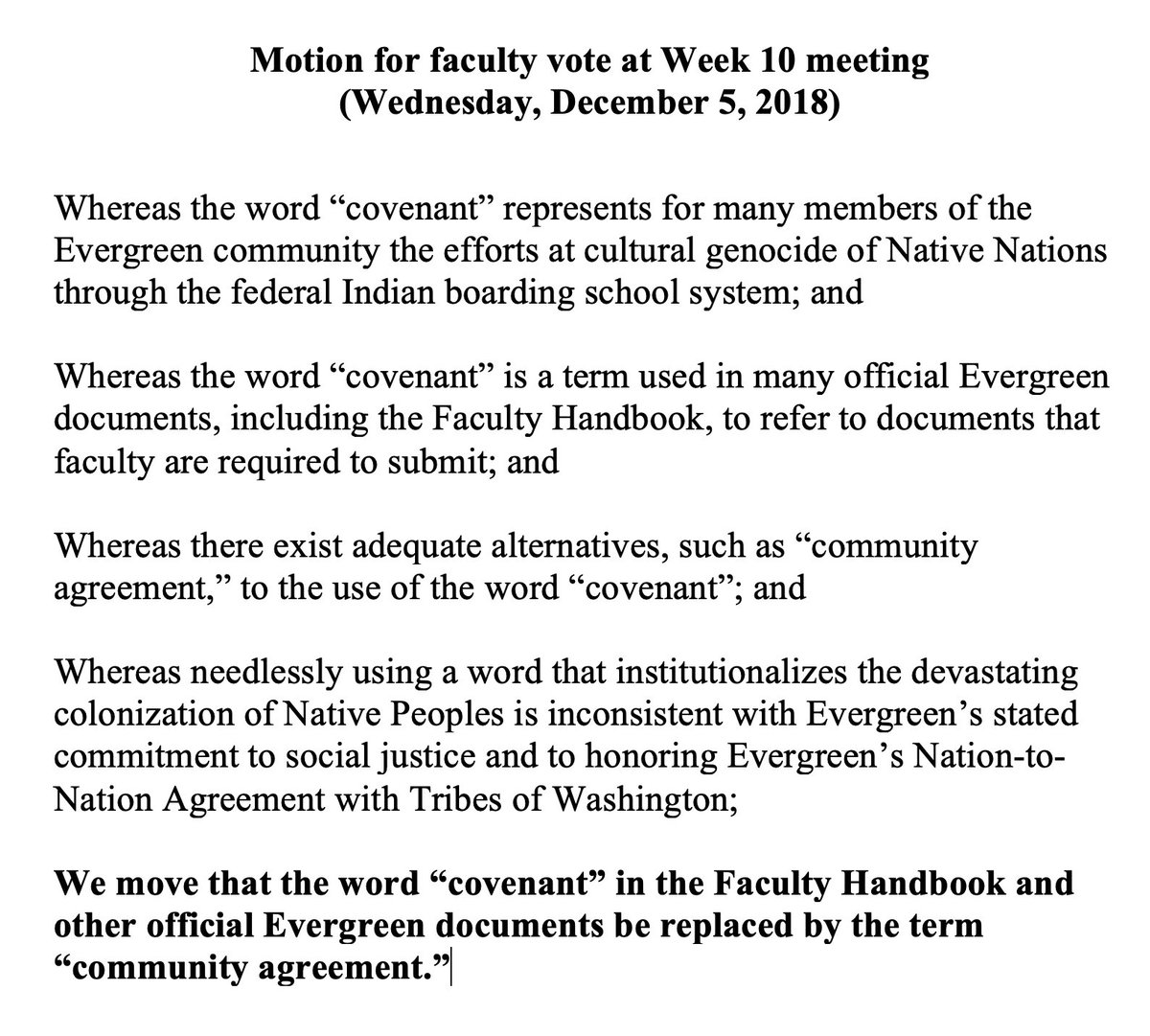
The motion below states “[T]the word ‘covenant’ represents for many members of the Evergreen community the efforts at cultural genocide of Native Nations through the federal Indian boarding school system” and “needlessly using a word that institutionalizes the devastating colonization of Native Peoples.” Instead the faculty wants to require the use of the term “community agreement.”
Putting aside the continuing harm done by the Evergreen faculty to their own school which has seen huge drops in admission and layoffs, the basis for the resolution works too hard to find a reason for outrage against this noun. Covenant has conventional, religious, and legal uses as an agreement or contract based on an exchange of promises. It can be used to signify a moral covenant with God or a covenant tied to property. The word has been used at the college to reflect an agreement among students and the college for example. The school defines the term on its website:
“‘COVENANT’ (an agreement, a coming-together) Covenants at Evergreen serve as learning agreements between faculty and students in lieu of conventional grading arrangements. Covenants spell out program policies and expectations for earning credit. Good faith compliance with this covenant is an academic requirement.”
The effort to assign this one meaning is contrived and artificial. The effort to ban the use of a noun like covenant reflects an increasingly common desire by some to control the speech and even words of others.

ǝɔʎoq@BenjaminABoyce The @EvergreenStCol faculty, faced with plummeting enrollment and successive layoffs, have rallied their collective energies to… banish a word because it reminds someone, somewhere, of cultural genocide.


And on his YouTube page Monday, Boyce dissected the resolution phrase by phrase, calling the proposed motion “virtue signaling” and pointing out the term that faculty should be referencing regarding historic Native American alliances is actually “Covenant Chain.”