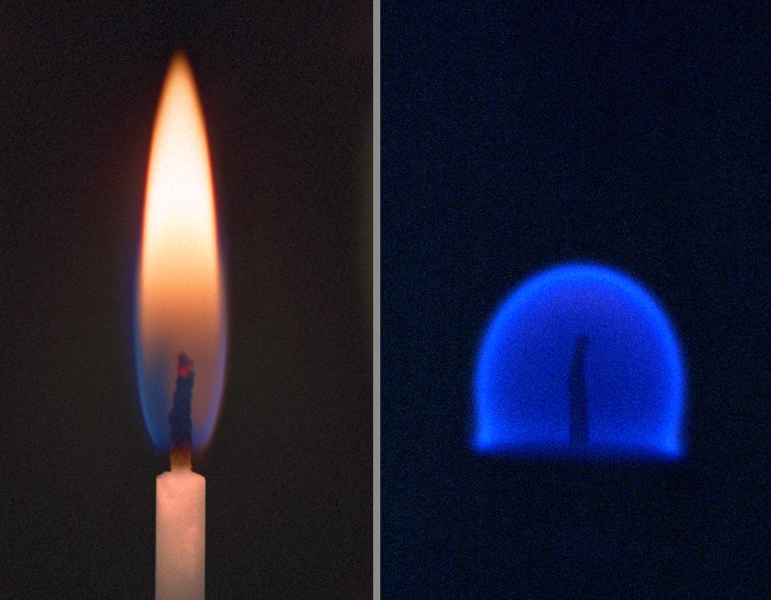
 I find this fascinating. This is a flame in zero gravity.
This also means that blowing out candles in space is four times easier than on Earth — a finding that more than justifies the Shuttle flights.
Here is the explanation from some smart people:
[A] candle can burn in zero gravity. However, the flame is quite a bit different. Fire behaves differently in space and microgravity than on Earth.
A microgravity flame forms a sphere surrounding the wick. Diffusion feeds the flame with oxygen and allows carbon dioxide to move away from the point of combustion, so the rate of burning is slowed. The flame of a candle burned in microgravity is an almost invisible blue color (video cameras on Mir could not detect the blue color). Experiments on Skylab and Mir indicate the temperature of the flame is too low for the yellow color seen on Earth.
I doubt there would be much (if any) measurable difference in a flame based on the depth of water. The earth’s crust is pretty thin compared with the mass of the earth and distance to the center of mass from the crust.
Nothing more than air cleaners that recycle stale air. Devices make sure the air is free of particulates that might be harmful or gum up the works of machinery or electronics–or make astronauts sick. They use them in submarines too, for the same reason. Also can replace oxygen that has been depleted and remove excess carbon dioxide from exhaled air.
You don’t really want to know what they do about the sewage water, do you?
IF I were to take that candle in a submarine and go to the deepest point in the ocean, it should burn higher and brighter, because gravity would be stronger? Regarding sewage – they recycle the water and dispose of the solids.
there’s air-scrubbers? really? air-scrubbers……
A flame is tall because heat rises. Hold you hand over a candle and you feel the heat but little heat beside the candle flame. That would not happen in zero gravity. Heat would radiate outward in all directions. Gravity is required so the flame will “know” which way is up. If you had a balloon full of hot air, it will rise when in gravity. In microgravity it has no way to orient to up, so it will drift if moved by a draft, or just hang motionless if not disturbed. In a microgravity situation, the flame assumes a ball shape because there is no “up.”
Air we breath at ground level is composed of a multitude of different gasses and dirt particles, that have an effect on how the flame is produced, much like when welding with oxygen and acetylene. I am suggesting that the “air” in space being used for the experiment is not the same, but is a mixture of chosen gases and no “dirt” particles (dust) mixed into the flame. Also, I would think the gravity would logically pull the flame down, when near the ground, but less gravity would not pull the flame, and thus it should burn a taller flame. Maybe my logic is not logical?
badflame, I don’t know how I am gong to break the news to you, but clean scrubbed air is still air, with the appropriate mix of gases. It has nothing to do with the flame as long as there is enough oxygen present to sustain combustion. The only precaution is that there be no open flame in the presence air with a high percentage of oxygen, especially pure oxygen. That can get one killed. In microgravity, there is no “up” so heat does not “rise” as it does on the surface of the earth.
Is the air on earth the same as the air in a space vehicle in near zero gravity? I think not. I believe that the scrubbed air has a lot more to do with the candle flame than gravity.
Thanks for the Astronomy tip buddha, always nice to get updated in cosmology. I’m going to enjoy the article.
AY: WOW
I second that- just beautiful isn’t it.
From linked article:
“Smoke and soot production is different for candles and other forms of fire in space or zero gravity compared to candles on earth. Unless air flow is available, the slower gas exchange from diffusion can produce a soot-free flame. … Soot and smoke production depends on the fuel flow rate. …
It isn’t true that candles burn for a shorter length of time in space. Dr. Shannon Lucid (Mir), found that candles that burn for 10 minutes or less on Earth produced a flame for up to 45 minutes.”
That’s kind of a ‘WOW’ also. I wonder if that has application for clean energy. Could we burn dirty coal in a near vacuum and do it more cheaply than attempting (or actually holding out false hope for a red-herring like carbon sequestration) other coal burning methods?
It looks cool but it snuffs itself out. I’d like to see what a flame does in a high gravity environment like the surface of the sun which is above 20g.
This. The planet that rains rock. And Saturn has a newly discovered ring (it’s really big).
http://news.bbc.co.uk/2/hi/science/nature/8291905.stm
It has been a busy week in science news.
WOW!!!!
But, what about the flame of love in space? Is it spaced-out or does it flame-out?
Wow, cool.
I hope the witch burners never get into space. They may conclude that they are turning the witches into angels.