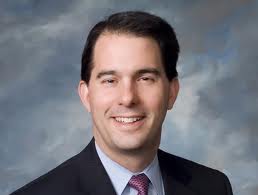
 Submitted by Elaine Magliaro, Guest Blogger
I have already written three posts about Governor Scott Walker, his budget repair bill, and the protesters in Wisconsin. People have been interested in the Wisconsin story and have left nearly 1,800 comments at my three posts. I’ve even received requests to write up another post so that we could continue the discussion on the subject. I think there are others like me who believe the Wisconsin/Walker story is not over yet.
As I did last week, I’m posting links to some articles on the subject for you—as well as excerpts from some of the articles.
Democrats immediately file suit to halt challenges (Journal Sentinel)
By Jason Stein, Don Walker, and Patrick Marley
Excerpt: Wisconsin is now among the vanguard of Midwestern states embarking on a new era with their rules for public unions. Indiana Gov. Mitch Daniels, a Republican, signed an executive order in 2005 to eliminate collective bargaining for state employees. Ohio is working on a measure to rewrite its collective bargaining law with public-sector unions.
But the fight in Wisconsin isn’t over – Democrats and unions are already filing lawsuits against the proposal and recall actions against GOP senators who approved it.
“It’s just the beginning,” said Sen. Bob Jauch (D-Poplar). “This is the civil rights issue of this century.”
********************
Wisconsin’s Legacy of Labor Battles (New York Times)
By Kate Zernike
Excerpt: In her book, “Radical Unionism in the Midwest, 1900-1950,” Professor Feurer recounts how companies in the electrical industry in St. Louis started a network known as the Metal Trades Association in the first part of the 20th century to fight union organizing. The association had been alarmed by union protests that erupted violently with the Haymarket Square riot in 1886 and the demands for an eight-hour day, which started with the 1894 Pullman strike in Illinois — an early effort by Eugene V. Debs, the former Indiana legislator and future Socialist Party candidate for president.
“That left a legacy of the 1930s and ’40s for employers to form deep right-wing networks,” Professor Feurer said.
That network, she argues, was the precursor to the Midwestern groups that have now been assisting the fight against the unions in Wisconsin, Ohio and Indiana: the Bradley Foundation, based in Milwaukee, and Koch Industries, based in Wichita, Kan. David H. and Charles G. Koch, the billionaire brothers behind the energy and manufacturing conglomerate that bears their name, have been large donors to Mr. Walker in Wisconsin, as has their advocacy group, Americans for Prosperity, which first opened an office in Wisconsin in 2005.
********************
By Ryan Haggerty and Michael Muskal
Excerpt: Even as Wisconsin Gov. Scott Walker on Friday signed into law a bill that sharply curbs collective bargaining for most public employees, his opponents were preparing for more demonstrations, court battles and political infighting over what has become a national test of labor’s power.
Organizers were hoping to attract tens of thousands protesters to the Capitol on Saturday for a rally featuring the return of Democratic lawmakers who fled the state on Feb. 17 in an effort to block the measure from passing. Along with the rally, Democrats are planning to ask the courts to overturn the new law and they have begun circulating petitions to recall some lawmakers. GOP supporters are circulating their own recall petitions, directed at the Democrats.
********************
Op-Ed: The GOP’s costly Wisconsin Koch binge is a wake-up call (Digital Journal)
The Big Shakedown: Wisconsin and the GOP’s Vision for America’s Future (Common Dreams)
Dane County sues state to block budget bill (The Cap Times)
Union Bill Is Law, but Debate Is Far from Over (New York Times)
My Previous Posts
Scott Walker: A Fiscally Responsible Governor or a Politician Who Is Playing Favorites?
Is the Scott Walker Story Just the Tip of the Koch Brothers’ Political Iceberg?
Wisconsin, Scott Walker, and Protesting Workers: The Story Continues
So what was that again?
Troll is as Troll does, Forest?
Busted.
ROFLOL
Kyle,
Are you the Kyle Olson who was written about in this article?
The Right’s Conspiracy Theory Attack on Frances Fox Piven (3/23/2010)
By Peter Dreier
E.P. Clapp Distinguished Professor of Politics at Occidental College
http://www.huffingtonpost.com/peter-dreier/the-rights-attack-on-fran_b_510410.html
Excerpt:
Sociologist Frances Fox Piven often gets requests from students who want to interview her about her political theories and activism. So when Kyle Olson phoned her in January, told her he was a college student in Michigan, and asked if he could videotape an interview with her about her recent book Challenging Authority: How Ordinary People Change America, Piven agreed.
Temporarily housebound and recovering from a auto accident, the 77-year old Piven invited Olson to her New York apartment. On February 1, Olson and a friend arrived from Michigan with a video camera. Piven offered them something to drink. Then, for about an hour, she and Olson sat at her round dining room table and talked about everything from the founding fathers to Fox News, while the friend taped them.
After Olson and his friend left her apartment, Piven didn’t think much about the interview. “This was so commonplace,” she said later, “that it didn’t strike me as especially important.” She recalled thinking that, “Students these days use cameras to ‘write’ term papers. It didn’t seem unusual that he wanted to use a video.”
Two weeks later, Piven, a professor at the City University of New York and former president of the American Sociological Association, learned that about eight minutes of the taped interview appeared in three segments on Big Government, Andrew Breitbart’s conservative news website. The same outlet achieved national prominence last year when it published James O’Keefe and Hannah Giles’ highly edited but hugely destructive hidden-camera recordings of ACORN employees. And the same website became infamous when O’Keefe was arrested in January for allegedly trying to tamper with the phone system in Sen. Mary Landrieu’s New Orleans office as part of another “investigation,” while on Breitbart’s payroll. Now, Olson and Breitbart have employed these same “gotcha” tactics on Piven.
Olson is not a college student. He is a 31-year-old Republican Party operative, conservative activist, and would-be journalist. He runs a Michigan-based conservative advocacy organization, the Education Action Group (EAG), which primarily attacks teachers unions.
The real reason for Olson’s interview with Piven was a 1966 article in The Nation magazine that she co-authored with Richard Cloward, “A Strategy to End Poverty,” which has become the centerpiece of a right-wing conspiracy theory. Olson no doubt hoped to trap Piven into saying something outrageous to confirm the Right’s view that the article is the blueprint for a radical takeover of American society.
Troll is as Troll does, Forest.
Bdaman:
“I know the feeling we are $75-100k upside down.”
Just say F IT and quit paying your mortgage, that is what SEIU goon Steven Lerner says to do.
http://www.newsrealblog.com/2011/03/23/organizing-for-revolution-the-final-push-to-transform-america/
“We have an entire economy that is built on debt and banks so the question would be what would happen if we organized homeowners in mass to do a mortgage strike if we get half a million people to agree it would literally cause a new finical crisis for the banks not for us we would be doing quite well we wouldn’t be paying anything…
U OK?
It sounds and smells like a troll….O ok?
Elaine M:
Since you probably missed this one I will post it:
Apparently Gov. Scott Walker knew exactly what he was doing.
Before he signed the bill limiting collective bargaining privileges, teachers unions throughout the state were slow to respond to calls for salary and benefit concessions.
They believed their members should be held harmless during a period of necessary cost-cutting. They didn’t seem to care that Wisconsin schools were operating with multi-million dollar deficits that were forcing the layoffs of younger teachers and the cancellation of student programs.
Their only answer was to raise taxes at a time when few people could afford it. They didn’t want to sacrifice anything, despite the fact that schools spend about 80 percent of their budgets on labor costs.
But now, with Walker’s legislation set to become law once it clears legal hurdles, the unions are suddenly coming to their senses. They are jumping at the chance to extend their collective bargaining agreements, in exchange for meaningful concessions that will help schools survive the financial crisis.
In Madison, the teachers union has suddenly agreed to a wage freeze and increases in health insurance and pension contributions. The concessions will save the district an estimated $15 million next year, which would almost make up for the expected cuts in state aid.
In Oshkosh, the union has agreed to a wage freeze, increased contributions toward benefits and a change in the employee insurance carrier, which will save the district more than $5 million per year.
In the Slinger district, the union has agreed to commit 5.8 percent of teacher pay to pension costs and increase contributions toward health care costs. The concessions will save the district about $1.3 million per year. What are the unions gaining by accepting concessions at the last possible minute? Plenty.
They are salvaging things like automatic annual salary increases for teachers, a generous number of paid sick and personal days off, reimbursement for unused sick days, salary and benefits for union officials who do not teach, retirement bonuses, overage pay for teachers with a few extra students, and many other items.
Those contractual perks would have gone by the wayside if local collective bargaining agreements had been allowed to expire. Under the new law, the unions will not have the power to negotiate for many of the items listed in current contracts.
So the unions will save some time-honored perks and schools will save a lot of money. This type of compromise would not have occurred without pressure from Gov. Walker and his supporters in the legislature.
Perhaps the governor knew exactly what he was doing by creating a crisis and forcing the unions to face financial reality. Nothing else seemed to be working and schools were drowning in deficits.
Ironically, the loss of collective bargaining privileges would not have been necessary if the unions would have come to their senses months ago and started offering meaningful concessions. They lost most of their privileges by remaining stubborn for too long.
Kyle Olson
I know the feeling we are $75-100k upside down.
“Keep your homestead in Florida”
I might well have to given the housing market.
Elaine M,
Thanks for keeping on top of this!
Obviously, neither Fitzgerald and Walker have a firm grasp on the legislative process is, nor do they understand what court orders because in their twisted minds they write their laws, they sign their laws, regardless of their constitutionality, while breaking existing laws. But it’s okay because they’re above the law … confirms for me that neither have any business whatsoever handling legislative affairs.
These children need to be taught that this isn’t a candy store free-for-all. I hope the judge who issued the restraining order slaps them silly, and hard, over this.
How long has it been? Keep your homestead in Florida and find a place to rent for a few months up there and test it out.
Bdaman,
I’m seriously thinking of returning to NY. A lot of craziness and corruption there, but despite the weather, Florida seems like a
horrific version of the wild west to me.
TALLAHASSEE — The Florida House delivered a major blow to public employee unions Friday, approving a bill that would ban automatic dues deduction from a government paycheck and require members to sign off on the use of their dues for political purposes.
Democrats and Republicans fought over the legislation for just under two hours. Democrats and labor unions have accused conservatives of “union-busting” and said the bill was more about political payback than public policy. Unions have typically been big backers of Democratic candidates.
Rep. Chris Dorworth, R-Lake Mary, the House sponsor of the legislation, said this was simply the state’s movement to get out of the dues deduction business and let the unions take care of it.
“It’s a bill that empowers membership of labor unions,” Dorworth said.
The measure, HB 1021, passed by a 73-40 vote, with three Republican lawmakers siding with the Democrats.
http://www.orlandosentinel.com/news/politics/fl-bill-bans-automatic-union-dues-20110325,0,1209569.story
Elaine M.,
Thank you. I think I can speak for everyone here. Your work is wonderful and it is very, very welcome……the things do not know…
Here are excerpts from and a link to Professor Cronon’s opinion piece that was published in The New York Times on March 21, 2011:
Wisconsin’s Radical Break
By WILLIAM CRONON
http://www.nytimes.com/2011/03/22/opinion/22cronon.html?_r=1&src=twrhp
Excerpts:
NOW that a Wisconsin judge has temporarily blocked a state law that would strip public employee unions of most collective bargaining rights, it’s worth stepping back to place these events in larger historical context.
Republicans in Wisconsin are seeking to reverse civic traditions that for more than a century have been among the most celebrated achievements not just of their state, but of their own party as well.
Wisconsin was at the forefront of the progressive reform movement in the early 20th century, when the policies of Gov. Robert M. La Follette prompted a fellow Republican, Theodore Roosevelt, to call the state a “laboratory of democracy.” The state pioneered many social reforms: It was the first to introduce workers’ compensation, in 1911; unemployment insurance, in 1932; and public employee bargaining, in 1959.
University of Wisconsin professors helped design Social Security and were responsible for founding the union that eventually became the American Federation of State, County and Municipal Employees. Wisconsin reformers were equally active in promoting workplace safety, and often led the nation in natural resource conservation and environmental protection.
But while Americans are aware of this progressive tradition, they probably don’t know that many of the innovations on behalf of working people were at least as much the work of Republicans as of Democrats.
**********
The policies that the current governor, Scott Walker, has sought to overturn, in other words, are legacies of his own party.
But Mr. Walker’s assault on collective bargaining rights breaks with Wisconsin history in two much deeper ways as well. Among the state’s proudest traditions is a passion for transparent government that often strikes outsiders as extreme. Its open meetings law, open records law and public comment procedures are among the strongest in the nation. Indeed, the basis for the restraining order blocking the collective bargaining law is that Republicans may have violated open meetings rules in passing it. The legislation they have enacted turns out to be radical not just in its content, but in its blunt ends-justify-the-means disregard for openness and transparency.
This in turn points to what is perhaps Mr. Walker’s greatest break from the political traditions of his state. Wisconsinites have long believed that common problems deserve common solutions, and that when something needs fixing, we should roll up our sleeves and work together — no matter what our politics — to achieve the common good.
Mr. Walker’s conduct has provoked a level of divisiveness and bitter partisan hostility the likes of which have not been seen in this state since at least the Vietnam War. Many citizens are furious at their governor and his party, not only because of profound policy differences, but because these particular Republicans have exercised power in abusively nontransparent ways that represent such a radical break from the state’s tradition of open government.
Wisconsin’s most dangerous professor
Why are Republicans desperate to see Bill Cronon’s emails? Because ideas and history matter
BY ANDREW LEONARD
Salon (3/25/2011)
http://www.salon.com/news/wisconsin/index.html?story=/tech/htww/2011/03/25/wisconsins_most_dangerous_professor
Excerpt:
I just bought two books by the University of Wisconsin historian William Cronon: “Changes in the Land: Indians, Colonists, and the Ecology of New England” and “Nature’s Metropolis: Chicago and the Great West.”
A week ago, I had never heard of Cronon. This is embarrassing, since it doesn’t take much digging around to discover that he is one of the most highly regarded historians in the United States (not to mention president-elect of the American Historical Association).
But that was before Cronon’s fascinating opinion piece in Monday’s New York Times detailing how Wisconsin Gov. Scott Walker’s political agenda flies in the face of “civic traditions that for more than a century have been among the most celebrated achievements not just of their state, but of their own party as well.” A devastating new broadside in the battle for Wisconsin, Cronon’s Op-Ed deservedly went viral.
But in today’s political climate, there are consequences for taking a stand. As surely nearly everyone who has been following developments in Wisconsin already knows, the Republican Party of Wisconsin has filed an open records request demanding access to any emails Cronon has sent or received since Jan. 1 containing the search terms “Republican, Scott Walker, recall, collective bargaining, AFSCME, WEAC, rally, union, Alberta Darling, Randy Hopper, Dan Kapanke, Rob Cowles, Scott Fitzgerald, Sheila Harsdorf, Luther Olsen, Glenn Grothman, Mary Lazich, Jeff Fitzgerald, Marty Beil, or Mary Bell.”
The obvious goal is to find something damaging or embarrassing to Cronon — although judging by Cronon’s account, smoking guns seem unlikely to be lying around in plain sight. (Eight of the names referenced in the request belong to the eight Republican state senators targeted by Democrats for recall.)
I can’t do a better, more eloquent or more profound job of summarizing the issues at stake than Cronon himself does in a lengthy blog post that the professor posted Thursday night. Everyone should read it. Nor do I want to get bogged down in a discussion of whether the Wisconsin GOP’s tactics should be properly characterized as a McCarthyite attack on academic freedom. I believe they should be, but I want to make a larger point.
Despite following events in Wisconsin fairly closely, before Cronon’s post about the open records request started rocketing around Twitter and Facebook late last night, I hadn’t realized that Cronon had published another, even more interesting post two weeks earlier, “Who’s Really Behind Recent Republican Legislation in Wisconsin and Elsewhere? (Hint: It Didn’t Start Here).”
In that post, as part of his effort to understand the historical roots of the nationally coordinated state-level legislative attack on unions, Cronon focused his spotlight on a relatively under-the-radar group called the American Legislative Exchange Council.
The most important group, I’m pretty sure, is the American Legislative Exchange Council (ALEC), which was founded in 1973 by Henry Hyde, Lou Barnett, and (surprise, surprise) Paul Weyrich. Its goal for the past forty years has been to draft “model bills” that conservative legislators can introduce in the 50 states. Its website claims that in each legislative cycle, its members introduce 1000 pieces of legislation based on its work, and claims that roughly 18 percent of these bills are enacted into law. (Among them was the controversial 2010 anti-immigrant law in Arizona.)
Cronon surmises that his efforts to highlight the role of ALEC precipitated the Republican open records response. I have no way to judge whether that is true. But what I do know is that the Republican effort to gain access to Cronon’s university emails has resulted in bringing far more attention to Cronon and to ALEC than would otherwise have been the case.
Elaine,
I would think that the judge would not look too kindly on this attempt to go around the court’s restraining order.
Wisconsin Union Law Published Despite Court Order
SCOTT BAUER 03/25/11
http://www.huffingtonpost.com/2011/03/25/wisconsin-union-law-publi_n_840870.html
Excerpt:
MADISON, Wis. — Wisconsin officials couldn’t agree Friday about whether an explosive law taking away nearly all public worker collective bargaining rights was about to take effect after a nonpartisan legislative bureau published it despite a court order blocking implementation.
The head of the Legislative Reference Bureau that made the move, as well as a nonpartisan attorney for the Legislature, said the action was merely procedural. But Republican legislative leaders, who encouraged the bureau’s action, insisted it meant law would take effect Saturday.
Gov. Scott Walker’s office, meanwhile, would issue only a vague statement saying simply that the administration planned to carry out the law as required.
The move is just the latest in a series of parliamentary and legal maneuvers employed over the past six weeks to enact a bill that prompted Senate Democrats to flee the state to block a vote and brought on waves of Capitol protests that grew larger than 85,000 people as Wisconsin became the center of a national fight over union rights.
Ultimately, the law’s fate likely will be up to the state Supreme Court to decide. A state appeals court earlier in the week asked the Supreme Court to take up one of several lawsuits challenging its approval.
The latest chaos began Friday after the Legislative Reference Bureau published the law at 3:15 p.m.
Bureau director Steve Miller said the action doesn’t mean the law takes effect Saturday. He says that won’t actually happen until Secretary of State Doug La Follette orders the law published in a newspaper, and a judge ordered last week that La Follette not do anything.
“It’s not implementation at all,” Miller said. “It’s simply a matter of forwarding an official copy to the secretary of state.”
La Follette, however, said he didn’t know what the action means – but he’s not doing anything given the court order.
“I think we’re going to have to get some legal opinion on this,” he said.
A judge last week issued a temporary restraining order blocking any further implementation of the law while the court considers the lawsuits. The order specifically blocked La Follette from publishing the law.
Scott Grosz, a staff attorney for the nonpartisan Legislative Council, agreed with Miller and said the action meets certain obligations under the law, but nothing can happen until La Follette acts.
“And at this time the secretary’s actions remain subject to the temporary restraining order,” Grosz said in a memo to Democratic Assembly Minority Leader Peter Barca.
Republican Senate Majority Leader Scott Fitzgerald, who said he went to the Reference Bureau with the idea, insisted the action means the law takes effect Saturday.
“It’s my opinion it’s published, it’s on the legislative website, it’s law,” Fitzgerald said. “It was clear to me after our discussions this morning, if it in fact it is posted and it says published and there’s a specific date on it, it would be very hard to argue this was not law.”
John Jagler, a spokesman for Republican Assembly Speaker Jeff Fitzgerald, said he also assumed the action means the law takes effect Saturday.
Rick Scott’s Medicaid Overhaul to Benefit…Rick Scott?
Florida’s governor is pushing a privatization plan that could be a major boon for health care companies. Like his.
— By Suzy Khimm
(Mother Jones, 3/25/2011)
http://motherjones.com/politics/2011/03/rick-scott-florida-medicaid-solantic
Excerpt:
Republican governor Rick Scott’s push to privatize Medicaid in Florida is highly controversial—not least because the health care business Scott handed over to his wife when he took office could reap a major profit if the legislation becomes law.
Scott and Florida Republicans are currently trying to enact a sweeping Medicaid reform bill that would give HMOs and other private health care companies unprecedented control over the government health care program for the poor. Among the companies that stand to benefit from the bill is Solantic, a chain of urgent-care clinics aimed at providing emergency services to walk-in customers. The Florida governor founded Solantic in 2001, only a few years after he resigned as the CEO of hospital giant Columbia/HCA amid a massive Medicare fraud scandal. In January, he transferred his $62 million stake in Solantic to his wife, Ann Scott, a homemaker involved in various charitable organizations.
Florida Democrats and independent legal experts say this handover hardly absolves Scott of a major conflict of interest. As part of a federally approved pilot program that began in 2005, certain Medicaid patients in Florida were allowed to start using their Medicaid dollars at private clinics like Solantic. The Medicaid bill that Scott is now pushing would expand the pilot privatization program to the entire state of Florida, offering Solantic a huge new business opportunity.
“This is a conflict of interest that raises a serious ethical issue,” says Marc Rodwin, a medical ethics professor at Suffolk University Law School in Boston. “The public should be thinking and worrying about this.”
With Scott’s blessing, the Florida statehouse is currently hammering out the final details of the Medicaid bill, with a vote expected in the upcoming weeks. In the meantime, Scott has moved forward on another front that could also bring new business to Solantic. On Tuesday, he signed an executive order requiring random drug testing of many state employees and applicants for state jobs. He’s also urged state legislators to pass a similar bill that would require drug testing of poor Floridians applying for welfare.
Among the services that Solantic offers: drug testing.
Buddha,
You could be right with the name change!
Elaine,
I think another way to describe what ALEC does is “Writing Get out off Jail cards” for their corporate masters.