
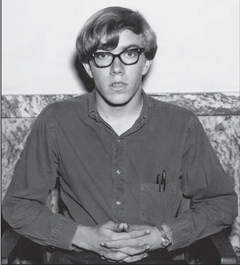
 Millikin University is facing a challenging controversy over one of its faculty, Professor James St. James. It turns out that James St. James is not his original name which was James Gordon Wolcott. The problem is that Wolcott is a former state mental patient who killed his family in 1967. St. James effectively reinvented himself with remarkable (and commendable) success — ultimately not just teaching but heading the university’s Department of Behavioral Sciences. The university is standing by him as people call for his removal from the faculty.
St. James has been teaching at Millikin since 1986. It does not appear that he revealed his history to the school since the university stated in a release that “Millikin University has only recently been made aware of Dr. St. James’ past.” Such omissions can be used for disciplinary action even termination, but such cases remain rare absent falsification of academic credentials.

 St. James is not accused of lying about his credentials or even lying about his past. He just did not tell people about his criminal acts as a teenager. St. James, who is now 61, was only 15 when he shot and killed his father, Gordon Wolcott; his mother Elizabeth Wolcott and his sister, 17-year-old Elizabeth Wolcott. He was high on sniffing glue at the time. St. James was a brilliant but disturbed teenager who grabbed a .22-caliber rifle, walked into the living room and shot his father while he was reading. He then shot his sister and then his mother.

 He was found not guilty by reason of insanity in in 1968 and sent to Rusk State Hospital. He was released six years later in 1974 and appears to have put his life together. He was given help by the fact that he could inherit his parents’ estate and even draw a monthly stipend from his father’s pension fund. He went on to earn a bachelor’s degree, a master’s degree and a PhD. As a professor, he is given high reviews for his classes.
The university has resisted calls for his resignation or termination: “Given the traumatic experiences of his childhood, Dr. St. James’ efforts to rebuild his life and obtain a successful professional career have been remarkable. The University expects Dr. St. James to teach at Millikin this fall.”
The university’s position shows great sensitivity and understanding. St. James was found not guilty of these crimes. He went on to not only be declared sane but to achieve an extraordinary level of achievement. These killings were truly horrific but they were committed by a child high on airplane glue who had a history of mental illness. His ability to turn around his life is an amazing story. It is not a happy story to be sure. It begins with the killing of a family in a blood-soaked rage. Yet, it is a story of redemption. His decision to study psychology and behavioral science is quite telling. He appears to have worked hard to understand what motivates a person, like himself, to do unspeakable things. Perhaps his academic training was part of his personal recovery.
The university could have used the failure to disclose to discipline St. James but chose to see the man as he is now rather than what he was as a child. In the end, there is no punishment to fit this crime. Yet, St. James has built a worthy and meaningful life from the ashes of tragedy in his youth. That in itself is quite a lesson.

Source: Daily Mail
blhlls 1, August 5, 2013 at 12:54 pm
Looks like it’s currently illegal in Illinois to ask about arrests, but that is an area of law which is changed in many places over the last few decades.
=============================
Chicago don’t need no stinkin’ background checks?
Arrests?
Convictions?
So when they ask “you got conviction?”
You answer, “yes I have a lot of conviction!”
When they ask “you got arrest?”
You answer, “no, my heart is still good!”
raff, Depending on the state, juvenile records are quite private. I can only speak directly about a few juvenile courts, Jackson County, Mo.[KC] being the best source since I worked there. The only way a prospective employer could have access to juvenile records is w/ a signed release from the person in question. If the person was still a juvenile @ the time of a request, then a parent/legal guardian had to sign. The employers who were often in the record dept. getting records were recruiters for the military. And, that was only because the recruiter would tell an applicant that they needed to know if they had a juvenile record, otherwise, if it was found w/o them disclosing, it would mean a dishonorable discharge. The reality, @ least back then, was if the applicant didn’t volunteer they had a record, the recruiter could never had known. The only people who had access to those records, or even the existence of a juvenile records, were court employees and LEO’s.
As blhlls stated, 1986 was before our internet age. As I look back working from the 70’s to now, there was a huge leap in access to background information w/ the internet, particularly in the last 10-15 years. Even if this guy didn’t change his name, no one would have known about the offense via a standard records check. When I was hired by companies to do a complete background check that would mean going to the different addresses the person lived and talking w/ people. I used the model for FBI background checks for prospective and current Federal employees. Back in 1986, I would have spoken w/ people in the person’s town/city village. I would also check the archives of the local newspaper[s]. If Milliken did that, there’s a very good chance they would have come up w/ this killing. Hell, if it occurred in a small town, EVERYONE would have remembered the killings. However, I seriously doubt a university would do that complete a check on a prospective professor hire. Maybe for a prospective president, but I doubt even for that position.
Darren makes an excellent observation upthread. Back when he first applied for the position in the mid-1980s, they did not do the extensive background checks done now. Remember, this was before the ubiquitous Internet, and the “War on Terror.” Inquiries were done by mail and telephone, because there was no email. The university would have looked at his credentials, his transcript, and letters of reference from his professors and dissertation adviser. If they asked anything about criminal background, it would only have been about felony convictions.
Nowadays, one has to produce an original birth certificate and multiple forms of ID. Do not be surprised if the prospective employer wants to run NCIC, NCIS and AFIS reports, and of course, there is Google. If a vet, they will want to see your DD-214 where they check the type of discharge and SPN number.
Having said all that, with a legal name change and the murders took place when he was a juvenile, there may have been no record; and even today, there may be no record. When we adopted our daughter, the State Department of Vital Records issued a brand new birth certificate. It shows the hospital and attending doctor where she was born, but it has my wife and me as her birth parents. I don’t know what they did with the original birth certificate.
Looks like it’s currently illegal in Illinois to ask about arrests, but that is an area of law which is changed in many places over the last few decades.
The man changed his life and name. he became a responsible part of society and has not been in trouble yet. the reporter who outted him did it out of malice. so heres something that reporter and all naysayers need to think about..
The gentleman has done nothing wrong for 30 yrs. but now since a nosy reporter has destroyed what this man has struggled to build it just might cause another psychotic break and who will end up on the other side of it? and there is only the reporters and naysayers to blame
i say it everyday the elites have done a darn good job of removing any human feelings from the souls of humanity how proud they are to make them all a part of satans world….. enjoy your ride
We’d have to see the employment application he completed for the university to see if he actually lied. Did it ask: “Have you ever been arrested for or charged with a felony?” if it did. He would have had to answer “yes”. If it asked only about convictions, he would have rightfully answered “no”.
It appears that the Texas Constitution has been interpreted to generally bar application of the slayer rule except where life insurance proceeds are involved. A 2008 Attorney General opinion considered a statute to prevent inheritance by parents who are convicted of murder (or various other violations) of a child to be barred by the constitutional provision. (https://www.oag.state.tx.us/opinions/opinions/50abbott/op/2008/htm/ga-0632.htm)
nick,
I agree with forgiving this person, but normally professionals working at a school are subject to a strict review of their past. Maybe the juvenile record was expunged, but I would be a bit surprised if a non-guilty for reason of insanity can be expunged.
I agree with Larry about the name change issue. Maybe his name was legally changed, I don’t know, but I don’t believe background checks and detailed job applications were as ardent as they are today, compared perhaps when the professor originally applied. I’m glad this man turned around his life so completely it seems.
I was also surprised the pension stipend and estate wasn’t nixed in probate due to the beneficiary being the slayer. Maybe it is different if the slayer is not guilty by reason of insantiy.
Here is my state’s law
http://apps.leg.wa.gov/rcw/default.aspx?cite=11.84
For myself, true stories of redemption are the most inspiring. They show we are flawed humans willing to repent, change, and turn our lives into a path of good work. My nature and profession always makes me wary of stories of redemption. Because you see, TRUE redemption is rare. And, we can all think of people in the public eye or in our personal lives that were presented to us as persons of redemption, only to learn it was false. Unlike the consensus here, I find the non disclosure of this professor’s killings troubling. I understand the man was found not guilty by reason of insanity. I assume he admits he did kill his family, but that he was not culpable because he was not aware of what he was doing. The term “self medicating” is overused in our culture, but the sniffing of glue, based on this man’s psych. history, certainly seems indicate that is indeed what he was doing.
A pure redemption would have included complete disclosure of his past. However, that’s where we need to look into our hearts. I’m not willing to forget his omission. It is a fact not in dispute. However, based on the information, I am willing to forgive it. In order for redemption to exist, there must be forgiveness. And, in my mind, forgiveness is as precious as redemption.
From blhlls comment it also occurs to me he was a juvenile at the time. Maybe the records were not findable because of his age? (And we don’t know how the information was found given the school’s statement “we became aware of”.)
People change their names over time for a variety of reasons. Here, he applied under the name in which he presumably earned the qualifications for his position. We are so used to the availability of information now, but in 1986 the chance of an Illinois University identifying him as the person who was committed 18 years earlier in Texas would have been extremely small even if they knew his prior name. I don’t know about this specific university, but in the 1980s many universities did minimal checks when hiring.
Well, we are a country of 2nd chances. However, I agree with leejcaroll and raff on this one.
There was a research study published, stating that a white person with a criminal background is more likely to be hired than a black person without one (even when the black candidate’s credentials are more ‘impressive’ than the white candidate’s).
Apparently, Dr. St. James (or Dr. Wolcott) benefited from this………
If you want to know the truth speak t the one with wisdom…. But where does one get wisdom but by learning from there mistakes….
I have to take exception to the general feeling about Dr. St. James. Had anyone else lied on their resume as to who their real name is, they would probably have been fired on the spot. If he had such a violent history, even though he was not sane during the murders, how was he allowed to teach at a university without an adequate background check? I commend his recovery, but I thought the truth of who he was and what he has done should not have been hidden from his employer.
Personally, as a forensic psychologist, I am inspired by Dr. St. James’ story. According to the records, he had a psychotic break at age fifteen after sniffing glue. He got treatment, and rebuilt his life. Any neuropsychologist will tell you that certain chemicals will trigger a psychosis, and that is apparently what happened. The person who walked out of that mental hospital six years later was not the same one who walked in.
Had his psychotic break been due to natural causes such as a major mental illness, we might be looking at quite different treatment outcomes. I worked on a case where a seventeen year old killed his family in the late 1970s. He is still locked up, and still dangerous. Dr. St. James’ case is clearly different.
I am with the University on this one. If he was a danger to society, we would have known about it long before now.
The irony is it appears had he not killed his parents and then financially benefitted from it it may well have had a very different ending.
Given that by all evidence the man has turned his life around and done remarkably well in the process what is the problem? Can his deed as a 16 year old be undone, by further punishment? Is our legal system supposed to be about revenge only?
There is free will and people can change. We are not slaves to our biology.
Give the man a break.
“Yet, it is a story of redemption. His decision to study psychology and behavioral science is quite telling. He appears to have worked hard to understand what motivates a person, like himself, to do unspeakable things. Perhaps his academic training was part of his personal recovery.”
I know of another professor involved in the study of the human mind and its impact on human behavior.
Interestingly, the professor I speak of has the genetic markers of a sociopath or even further perhaps a psychopath.
Both stories shine some light on epigenetics: