
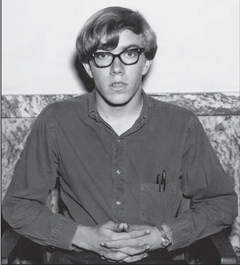
 Millikin University is facing a challenging controversy over one of its faculty, Professor James St. James. It turns out that James St. James is not his original name which was James Gordon Wolcott. The problem is that Wolcott is a former state mental patient who killed his family in 1967. St. James effectively reinvented himself with remarkable (and commendable) success — ultimately not just teaching but heading the university’s Department of Behavioral Sciences. The university is standing by him as people call for his removal from the faculty.
St. James has been teaching at Millikin since 1986. It does not appear that he revealed his history to the school since the university stated in a release that “Millikin University has only recently been made aware of Dr. St. James’ past.” Such omissions can be used for disciplinary action even termination, but such cases remain rare absent falsification of academic credentials.

 St. James is not accused of lying about his credentials or even lying about his past. He just did not tell people about his criminal acts as a teenager. St. James, who is now 61, was only 15 when he shot and killed his father, Gordon Wolcott; his mother Elizabeth Wolcott and his sister, 17-year-old Elizabeth Wolcott. He was high on sniffing glue at the time. St. James was a brilliant but disturbed teenager who grabbed a .22-caliber rifle, walked into the living room and shot his father while he was reading. He then shot his sister and then his mother.

 He was found not guilty by reason of insanity in in 1968 and sent to Rusk State Hospital. He was released six years later in 1974 and appears to have put his life together. He was given help by the fact that he could inherit his parents’ estate and even draw a monthly stipend from his father’s pension fund. He went on to earn a bachelor’s degree, a master’s degree and a PhD. As a professor, he is given high reviews for his classes.
The university has resisted calls for his resignation or termination: “Given the traumatic experiences of his childhood, Dr. St. James’ efforts to rebuild his life and obtain a successful professional career have been remarkable. The University expects Dr. St. James to teach at Millikin this fall.”
The university’s position shows great sensitivity and understanding. St. James was found not guilty of these crimes. He went on to not only be declared sane but to achieve an extraordinary level of achievement. These killings were truly horrific but they were committed by a child high on airplane glue who had a history of mental illness. His ability to turn around his life is an amazing story. It is not a happy story to be sure. It begins with the killing of a family in a blood-soaked rage. Yet, it is a story of redemption. His decision to study psychology and behavioral science is quite telling. He appears to have worked hard to understand what motivates a person, like himself, to do unspeakable things. Perhaps his academic training was part of his personal recovery.
The university could have used the failure to disclose to discipline St. James but chose to see the man as he is now rather than what he was as a child. In the end, there is no punishment to fit this crime. Yet, St. James has built a worthy and meaningful life from the ashes of tragedy in his youth. That in itself is quite a lesson.

Source: Daily Mail
David M makes a great plot for a Kellerman novel but although his is speculation, supposition, musing, I think the chances that he could have other non disclosed violent episodes would be more probable then someone without his past (not to say he has or hasn’t)
Not allowed to teach just because he had a small criminal record? Changed his name just to get by WordPress? When I was a human in a prior life I lived in the town in Missouri called Santa Luigi. They had this neighborhood set aside for Northern Italians called The Hill. You could not live there or attend Mass at the Catolic Church there if you were Sicilian. To avoid the discrimination the smart Sicilians told the rest of society that those folks living on The Hill were all Mafia. Oh, and don’t sniff any glue or allow your kids access to glue.
With few exceptions, popular song lyrics falter without the song — kudos to anyone that has heard these:
You can sing the blues in church
If you use the words right
The verses
The words
The meaning
Now,
According to what you have
On your heart
But the start of it, well
Even the bible will tell you
Blessed is the pure in heart
Some people have the blues
So hard
They go to the river
And jump in a boat
And drown themselves
And some kill the wolf
Cut each other so peculiar
Do anything
Anything,
That you get in your mind
And your mind tells you
That you can’t
Don’t try
Think twice
And speak once sometimes
This is a fantastic story. Fantastic, in the sense the of being bizarre and surreal. But there is too little information, yet, by which to draw a conclusion that James Wolcott “redeemed” himself.
How do we know that Wolcott was not a psychopath, rather than someone who managed to meet the legal definition “insane” to some people’s satisfaction after he committed his triple family murder? He could just as easily have been a person with an antisocial personality disorder, manifested in aggressive, criminal, and amoral behavior, without empathy or remorse, who knew that what he was doing was wrong.
Would he have committed the crimes if his parents did not have the amount of money that they did? There are literally hundreds and hundreds of crime cases that were cold-blooded murders and the motive in each case was to get the funds from an inheritance and/or insurance policies.
There are also many, many fictions works with this theme. In the typical crime story, the person committing such a crime is highly intelligent and he invents a clever alibi for himself, and he/she often makes it look like the murders were accidents, or, perhaps, the cunning criminal develops an elaborate scheme to frame an innocent person for his/her crimes. Here, we could just as well have the same story thread, except this particular criminal is so clever that he convinces doctors, lawyers, the public, and judges that HE is the crazy one, and because of his “insanity,” he should not be held responsible for his crimes, ultimately enabling him to BENEFIT from those crimes. Ingenious, yes?
Thus, given this limited information, we cannot determine if this is a story of “redemption” or simply an ingenious crime committed by someone without conscience. To blame the triple family murders on “glue sniffing” or use of other drugs is overly simplistic. My alternative scenario could just as well be true. If you slant to one story or the other, you are most likely projecting your own bias. Those who are “liberal” in their thinking will likely veer toward accepting the redemption theme. Those who are “conservative” may veer toward the “faked insanity” concept.
I would be very interested in learning more about the case, how Wolcott’s past was discovered, what he did immediately after the murders, how he completed his education, his relationships with others, and so forth. With much more information, perhaps the truth will emerge.
In closing, this story also reminds me of the well-done low-budget film called “The Stepfather” from the late 1980s, with Terry O’Quinn very convincingly portraying the lead character.
http://www.youtube.com/watch?v=C6dg84FhA9k
It’s not a perfect comparison, but this story reminds me of another.
I can’t recall the details, but there was a story about ten years ago of a man who had been wanted for murder for 25-30 years. He was found by accident and had been living quietly, never committing any crimes during that time. He was arrested and temporarily jailed, but never went to prison because of his age and lack of further criminal behaviour in the meantime. (Does anyone else remember that man, his name and city?)
If a man wanted for murder isn’t sent to prison because of a lack of criminal acts, I don’t see why a man who *was* punished for his actions – and did not commit any others – should be punished a second time.
davidm: I’m not sure that someone must respond to all comers about a painful past in order to be considered redeemed, or forgiven, or whatever we want to call it. He apparently confessed quickly and presumably underwent years of therapy. Does he really owe more to random members of the public who might enquire?
blhlls wrote: “I’m not sure that someone must respond to all comers about a painful past in order to be considered redeemed, or forgiven, or whatever we want to call it. He apparently confessed quickly and presumably underwent years of therapy. Does he really owe more to random members of the public who might enquire?”
No, not sure he owes it at all. I was just expressing my skepticism and doubt. When I read the details of what actually happened, that he had planned the murders a week prior to committing them, I felt more reserved about concluding what actually happened. I guess I have never liked the “not guilty by reason of insanity” defense anyway, so maybe I’m a little biased in that regard too. I guess the only thing my comments might convey is that *IF* he wants wide acceptance for the idea that he is not the same person he was when he was 15, he might consider engaging others about the incident. I don’t think he owes it to me, but when faced with a “no comment” response, I probably would not be comfortable having him be alone with my wife and kids. I doubt that such would ever happen anyway, so for me, it doesn’t really matter. However, there might be others in the community who have doubts like me.
Just desserts Past catches up after 46 years. His career is over
Davidm2575,
“. . . I would like to hear it from him first. From what I have read, he is considered somewhat narcissistic . . .”
And did you read about his narcissism from him first? If not, why the opinion? Or is this a reflection of your own verbose narcissism? You really don’t sound all that open to, “hear[ing] it from him first.”
“People say he has done nothing wrong since then, but how do we know?”
How do “we” know anyone hasn’t done something wrong, David? Really, how do “we” know.
“He could just be a smart serial killer now with the cover of being a professor.”
Much the same could be said for anyone, David. You might just be a smart serial killer with the cover of future redemption guising your acts of social intolerance.
“His field of study is behavioral psychology. That can be a really great way for a killer to hide his tracks.”
Another great way to hide one’s tracks is to claim to know what god wants.
“I’m not saying that’s what he is doing . . . ”
Of course not, neither am I.
GBK,
You just nailed DavidM perfectly.
good thing he wasn’t charged with possession of marijuana. he would have never gotten that job.
David,
Are you the person to be confessed to…. Or are something best kept private…. Lets hear about your indiscretions…. No really don’t…. That was a joke…. I’m sure you walk on water… Ever read the lost books of the bible and the forgotten books of Eden….. Might open your eyes….
Fascinating story. While I am always ready to give a man a second chance in life, I would like to hear it from him first. From what I have read, he is considered somewhat narcissistic and will not talk about his past at all. Forgiveness should be offered to someone who confesses and asks for it, but what about for someone who has not asked, but has simply been found not guilty by reason of insanity? People say he has done nothing wrong since then, but how do we know? He could just be a smart serial killer now with the cover of being a professor. His field of study is behavioral psychology. That can be a really great way for a killer to hide his tracks. I’m not saying that’s what he is doing, but I would not assume otherwise without hearing from him about his past.
Following is the account of the murders from the woman who broke this story, Ann Marie Gardner:
The Murders
In 1967, fifteen-year old James Wolcott lived with his family near Southwestern University in Georgetown, Texas. By all accounts, he was brilliant; he was an accomplished musician and had a voracious appetite for reading. His father, Dr. Gordon Wolcott came from a prominent New Jersey family and was the respected head of the Biology department at Southwestern. His mother Elizabeth was a vivacious woman from South Carolina, known for her participation in church circles around town. The fourth member of the Wolcott family was seventeen-year old Libby, a Georgetown High School class officer with a bright mind and a love of music. They were exceptional people living what seemed to be a typical suburban life.
On the evening of Thursday, August 4, 1967, James joined Libby and some friends on a trip to Austin to see a show. They returned home about 10 pm and life in the Wolcott house appeared to be normal. By midnight Libby and Elizabeth had retired to their respective bedrooms, while Gordon read in the living room. Inexplicably, just after midnight, James, by his own account, sniffed some airplane glue “to give him a boost,” loaded a .22 long-barrel rifle, walked to the living room and shot his father twice in the chest. He then walked to Libby’s bedroom and shot her once in the chest, and when she fell he shot her in the face.
Awakened by the blasts from the rifle, his mother Elizabeth called out from her bedroom. James then shot her twice in the head and once in the chest. He later admitted that he had decided to kill them a week prior and had made a plan the night before. Next, he hid the rifle in the attic crawlspace above the closet in his bedroom and ran out of the house toward University Avenue. Three college students traveling from Houston to Eden, Texas saw him there at about 1 am. James flagged down their car, crying that he needed help because someone had just shot and killed his entire family. Reluctantly, the three returned with James to the house to assess the situation. While James waited outside, the college students entered the grisly scene to find Gordon and Libby dead where they lay and Elizabeth barely breathing on her bed. According to police interviews, the students repositioned Elizabeth on the bed to make her more comfortable, called for an ambulance and the police, then waited outside with James. Later, in court, one of the students described James’ demeanor as “hysterical, pounding on the porch and wondering how this could happen.” None of the college students were entirely comfortable with the situation and they were hesitant to commit to any kind of empathy or reaction. Oddly enough, when they realized there might still be someone in the house with a weapon, they “high-tailed it out of there.” James, however, did not hesitate to go into the house with them.
At approximately 3 am, Williamson County Sheriff Henry Matysak arrived on the scene, and was joined shortly thereafter by Texas Ranger Jim Riddles from Austin, and Williamson County Attorney Timothy Maresh. A family friend took a very distraught James to the hospital where his mother was fighting for her life. They were soon joined by another family friend, Reverend Wallace Chappell, pastor of First Methodist Church of Georgetown. Witness reports indicate that James was very anxious at the hospital and the Reverend asked the doctor to provide him with a tranquilizer, believing him to have been traumatized by the event. Upon receiving the news that his mother had died from her wounds, James simply said, “Thank you.” Reverend Chappell, a neighbor of the Wolcott family, took James back to the parsonage while the authorities processed the crime scene. Ranger Riddles and Reverend Chappell began reviewing the evening’s events with James who still maintained that “someone” had shot his family. According to his report, Ranger Riddles idly chatted with James about his activities with his father. Then he asked James directly, “Did you kill your parents, son?” With only a brief hesitation and a sigh, James replied “Yes, sir,” and went on to describe each of the shootings in detail. Although there are variations of the subsequent exchange, court and police reports agree that James indicated that he hated his parents, giving motive to his actions. After he was informed of his Miranda Rights, James stated he did not want a lawyer and was willing to show the investigators where he hid the rifle.
James Wolcott was held in the Williamson County Jail in Georgetown until his trial.
http://wilcoonline.com/GeorgetownAdvocate-158.htm
I also had St. James while at Millikin. To say I was shocked by this news would be an understatement. He was a great instructor, and really had a way of drawing my interest. He was funny and kept every class entertaining and informative. The guy is brilliant. I have thought about this story quite a bit for the last few days.
I believe that St. James should keep his job, and I am actually proud that Millikin did not take the easy way out. He has worked incredibly hard to turn his past into something positive. The people that did all of this research to bring up his past are just attention seeking jerks, who want their fifteen minutes of fame. Well, congrats…
Millikin alumn, I’m sorry you didn’t include something more substantive in your comment. As someone who would have been affected had he not been hired, I would be interested in your views on this issue.
If you are going to write a “creditable” article, the least you can do is spell the name of the university correctly. Especially if you are going to use the name in the title of your article.
raff, I totally agree w/ you. In a perfect world an employer put into a trust w/ children should do a complete background check, like the FBI does for security clearance. In your case, the school probably did a criminal background check w/ the State of Illinois. That’s bare bones but it costs money to do more extensive checks. I believe you’ve always lived in Illinois? So, in your case it’s more complete than someone who has lived in different states. An NCIS check would pick up criminal in other states, but I bet they didn’t do that for you. I’ve actually thought of volunteering my services to do background checks. There’s a community center I volunteer to tutor at risk kids. They did a Wi. state criminal check on me as they do w/ all volunteers and paid staff. That costs them $25. However, I’ve spoken w/ the director and she is uncomfortable w/ that limited background check. My trepidation is liability. Since I’m ~85% retired I have minimal coverage. I wouldn’t want to expose myself w/o higher limits. And higher limits cost a lot more. The director has hinted she would like some help on this, but to date I’ve not offered.
blhlls,
As I mentioned to nick, I had to go through background checks just to coach at a catholic grade school in Cook County in the 1980’s and again in the 1990’s in McHenry County. I would imagine that the teachers are scrutinized even closer, but that is an uneducated guess.
nick,
When I coached at a couple of different catholic grade schools, they did a background check on me and all the other coaches. I don’t know how deep they dug, but when students are involved, I think the duty on the employer is greater.
raff, I’ve never done background checks for a university, but have for private companies and the govt.. Even private companies don’t do follow-up backgrounds on employees unless some red flag arises. Maybe if a person is in a sensitive position, but not that I’m aware. For people in the Federal govt. working jobs that require security clearances[ that’s many], there are follow-up backgrounds required every 5-10 years[last time I did one anyway]. A few require more frequent follow-ups. A friend I have in Santa Fe is a retired FBI agent and he did backgrounds on Los Alamos employees as a private contractor. For some positions I think it was annual follow-ups. Even a DUI was to be reported by the employee and there was an investigation focused on substance abuse. When 9/11 hit, the FBI fell WAY BEHIND in doing follow-ups and now it’s mostly private contractors, like the guy in Santa Fe I know.
Your point about teachers and students is a good one. Although, I doubt many school districts do routine follow-ups. Again, if a red flag appears they might follow-up on an employee. Maybe follow-ups are now required in some school districts? I’ve only had an initial one done on me when I was teaching, I’ve never done one on a teacher. Of course we’re talking about sexual predators, pedophiles, etc. It’s different w/ a university since the students are of age. I wrote here previously about a Catholic diocese who had a pedophile priest working @ a high school. They sent him for treatment and then sent him back to college to get his Phd. They realized the guy was incorrigible so their thinking was put him in a college setting where the students are all the age of consent. I know, it’s sick and twisted. The priest found victims in a parish church and the diocese paid big time dollars to the victims.
Rafflaw: I really doubt there would have been any kind of check since he was hired, if then. In my state at that time even elementary school districts relied on the existence of a credential and reference checks. Once hired, no additional checks would be done in the absence of some suspicion. It would be very unusual to have a legal requirement for checks for teaching at a university. The only time I’ve ever heard of an institution “updating” pre-employment type checks involved a particular university after a scandal related to a total failure to even confirm degrees prior to hiring.
nick,
I understand that when he first applied for the position they may not have had ready access to all the records and juvenile records may be sealed, but I would be surprised if the background checks were not routinely updated as the years went by because the rules and regs concerning the hiring of teachers and staff that will come in contact with students has gotten stricter.