 Submitted by Elaine Magliaro, Guest Blogger

There’s been a lot going on in Wisconsin in the past week. I hope most Americans are aware of the reason why so many Wisconsinites have converged on the state capital to hold demonstrations.
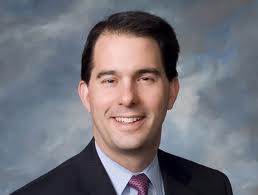
Wisconsin Governor Scott Walker, a Republican, claims that the state is in financial trouble. He’s asking teachers, plow drivers, janitors, nurses, garbage collectors, and other public sector workers to contribute more to their pensions and to pay a larger amount of their health premiums. It appears many of those workers are willing to negotiate with the governor and to consider having more money taken out of their paychecks for their pensions and health insurance. What those employees are not willing to do is relinquish their right to collective bargaining.
I can understand why Governor Walker is asking public employees to have more deductions taken from their paychecks during these fiscally difficult times. What I question is his budget-repair bill that would strip public employees of their right to collective bargaining. If the governor believes that taking away that right will help with the state budget shortfall, why isn’t he demanding that police, firefighters, and state troopers give up their right to collective bargaining too? Could it be political payback? Does that sound like a possibility to you?
Here is an excerpt from an article that Todd Richmond wrote for Bloomberg:
Walker has introduced a bill that would strip public employees across the board — from teachers to snowplow drivers — of their right to collectively bargain for sick leave, vacation, even the hours they work. But absolutely nothing would change for local police, fire departments and the State Patrol.
The bill smacks of political favoritism for public safety unions that supported Walker’s election bid last year and sets up new haves and have-nots in Wisconsin government, said Paul Secunda, a Marquette University professor who specializes in labor law.
“That’s called ‘thank you, I got your back,'” Secunda said. “There’s no surprise there. This is the worst type of favoritism there could be.”
Well, Wisconsin firefighters are showing their solidarity with their fellow public employees. There’s a post at Mother Jones about an interview that Uptake’s Oliver Dykstra had with Mahlon Mitchell, president of the Professional Firefighters of Wisconsin. (Mother Jones also posted a video of the interview.)
Here are some of the highlights of that interview—which I’ve taken from Mother Jones:
- “The reason that we are here is because it’s important that labor sticks together. There was a message from the governor’s office to conquer and divide…collective bargaining is not just for us, police and fire, it’s good for all involved. It’s a middle-class upbringing.”
- “When firefighters see an emergency, one thing we do is respond. And we see an emergency in the house of labor, so that’s why we’re here.”
- “Every day, if you notice, we lead the AFSCME employees, the SEIU employees, all the public sector employees into the building, because we are here to fight with them.”
- “Collective bargaining is not about union rights; it’s about rights of workers…We ask Gov. Walker to come back and negotiate with the people, negotiatie with the state workers’ unions, and get things worked out, as opposed to just putting out this bill and we don’t hear from him again.”
- “Us as firefighters, we have been exempted from this bill…There’s a 5.8 percent pay into the pension, there’s a 12.4 percent pay into the health care premium benefits…For the betterment of the government, for the betterment of the state, we don’t mind helping to pay for that. We don’t want to price ourselves out of a job. Ever. What we want to do is have a fair and equitable treatment among our members.”
I have great respect for the Wisconsin firefighters who are supporting their fellow public employees—even though they have nothing to gain politically or financially by doing so.
“We must, indeed, all hang together, or most assuredly we shall all hang separately.” ~Benjamin Franklin
Sources
Of course, that last comment didn’t help matters any. 🙂
Elaine, we’re going to need another Walker post. This one is loading very slowly.
CREW: WI Governor Violated State Law by Sending Troopers After Missing Legislator
“Governor Walker has many tools at his disposal to fight the state’s public employees, but using troopers to track down a political opponent crosses the line,” said CREW Executive Director Melanie Sloan. Sloan continued, “The governor’s conduct is especially egregious in light of a Wisconsin law specifically barring troopers from taking part in any dispute between an employer and employee over wages, hours, labor, or working conditions — the subject of the governor’s bill.”
In post #20 I wrote: “Elaine is doing us a great service in concentrating on this issue.”
It is now post #336 and I’m going to repeat myself: “Elaine is doing us a great service in concentrating on this issue.”
Elaine,
Well done, very well done!
My guess would be that Gov. Walker of Wisconsin–like some other right-wing politicians popular with the tea party–is a Koch addict.
lOTTAKATZ:
maybe what you think is obfuscation is actually uncertainty? I am for private unions and the right of the members to collectively bargain. What I am uncertain of is the right of government workers to engage in collective bargaining. I ha vent really seen a good argument for it yet.
I do not think a rank and file union member is going to be able to speak with the governor. Maybe the local or state boss but not the rank and file. That is wishful thinking.
I don’t know about anyone else, but this seems like a budget that says, “Shared sacrifice”:
Malloy announces budget plan
Gov. Dannel P. Malloy unveiled his biennial budget Feb. 16, covering fiscal years 2012 and 2013. The budget includes investments in job creation, as well as cuts in spending, concessions from state employees and tax increases in approximately equal measures, while keeping the safety net intact and supporting business and industry as they create jobs.
“This budget’s main focus is job creation,” Malloy said. “It’s balanced honestly, with no gimmicks and there is no new overall spending in the general fund. Moreover, it preserves the safety net and protects local services by actually increasing aid to cities and towns. I’ve spoken at length about shared sacrifice, and I think this budget explains what that means – I’m asking for a little from everyone to avoid overburdening any one group. And I refuse to balance the budget on the backs of local taxpayers.”
The governor put forward a balanced budget for both fiscal years that establishes a commitment to Generally Accepted Accounting PrinciplesThe budget funds operating expenses using existing revenue and limits borrowing for long-term capital investments, such as transportation infrastructure improvements.
The budget illustrates Malloy’s continued efforts to make government less costly and more efficient. As promised, Governor Malloy has already decreased the size of his executive staff by 15 percent, and he has proposed reducing the number of budgeted state agencies from 81 to 57 – a 30 percent cut.
With a focus on creating and retaining Connecticut jobs, Malloy proposed a new “First Five” program which will offer incentives for companies that are creating at least 200 jobs in the state. To help repair and refurbish the state’s aging transportation infrastructure, Malloy is also proposing over a billion dollars in capital investments, as well as an additional $130 million for affordable and supportive housing and $15 million for tourism marketing to help attract visitors to our state.
Malloy’s budget will protect local services—cities and towns will receive the same level of Education Cost Sharing funding this year as they did last year, and they will further benefit from receiving a portion of tax revenue from local sales. This will enable cities and towns to achieve additional revenue without raising property taxes.
The budget also protects the most vulnerable Connecticut residents by avoiding major service reductions in safety net programs, funding caseload growth for Medicaid, the Department of Children and Families, the Department of Developmental Services and the Department of Mental Health and Addiction Services.
Malloy also proposed an additional $1.5 billion in new revenue, 81 percent of which is paid for by individuals, and 19 percent of which is paid for by businesses. For filers who qualify for the federal Earned Income Tax Credit, a new state EITC at 30 percent of the federal level will help reduce the overall tax burden incurred through state taxes and the sales tax.
Additionally, Malloy is proposing $758 million in spending reductions; for example, the elimination of the unit that regulates charitable gaming as well as the elimination of outside management contracts for CT Transit. In addition, risk reduction credits for inmates will help save the state $3.8 million. State employees are also being asked to find $1 billion in savings and concessions annually.
Earlier this week, Malloy announced a series of 17 town hall meetings which will allow him to speak directly with Connecticut citizens who have concerns, ideas and suggestions.
If passed by both Chambers, the budget will go into effect on July 1.
http://southington.ctcitizens.com/story/malloy-announces-budget-plan
Blouise,
Lol – thanks!
Re: Cox – great minds think alike at roughly the same time??
Indiana A.G. fires deputy Jeff Cox over blog posts
That was quick.
Stamford Liberal,
I was referring to the Cox matter in my post at 5:32 … you’re just burnin’ up the keyboard!
Stamford Liberal,
Great follow-up … this could have been a hour segment on one of television’s “Law” shows.
Scott Walker’s “dire consequences”
Bad day in Wisconsin: The governor brushes off his prank call while warning of thousands of state worker layoffs
By Andrew Leonard
AP
Gov. Scott WalkerWisconsin Gov. Scott Walker can be excused for looking pale and a little nervous in his Wednesday afternoon news conference. It’s not every day that a governor at the heart of the biggest political story in the United States is humiliated by the revelation that he managed to fall for a prank-call from a blogger pretending to be a libertarian billionaire. But like a good soldier, he ploughed straight ahead — in the 20 minutes of the conference broadcast by MSNBC, Walker unleashed a cascade of fearful numbers outlining Wisconsin’s budget situation and warned of “dire consequences” if the 14 renegade Democratic state senators don’t return immediately and allow a vote on the bill to proceed.
If the Democrats do not allow the “budget repair bill” to pass, the state will be forced to lay off thousands of workers, declared Walker. All he was asking for, he repeated several times, was for state workers to “make shared sacrifices.”
But state workers have already agreed to make the sacrifices that would have a direct impact on the Wisconsin budget — the public sector unions are not fighting Walker’s demand that they contribute to their pension funds and health plans. What they are balking at is the surprise attack on their collective bargaining rights. Notably, Walker did not mention the words “collective bargaining rights” during the first 20 minutes of his press conference.
If Walker dropped his attempt to break the unions, he could end the Wisconsin standoff instantly. But he is refusing to bend. It’s a strategy that doesn’t seem to be working, at least so far. Maybe the real reason why Walker looked so pale stems from a growing realization that his hardline stance has put him in a ever-weaker position. As each day passes, elements of the budget repair bill that might never have received any serious public attention are getting wider and wider play. First there was the revelation that the bill authorizes the state to sell off power plants to anyone it pleases, at any price, without public oversight. Then came the details of a plan to allow the state department of health to arbitrarily decide who gets covered by Medicaid, regardless of what state law mandates.
Walker could probably have gotten nearly everything he wanted in his bill if he hadn’t sought to strip public sector unions of their collective bargaining rights, or if he had made a good faith effort to negotiate with state workers. But he didn’t. Now he is reduced to threatening layoff blackmail, and his bill has been exposed as a raw political power grab, rather than a sincere effort to balance the budget.
As for the call — Walker put a brave face on the prank, asserting that “the things I said are the things I’ve said publicly all the time.”
Maybe he’s right. The first thing that comes to mind is Walker’s declaration that “this is our moment,” right after the David Koch impersonator tells him “you’re the first domino” — meaning, the first in a wave of aggressive Republican governors aiming to take down public sector unions. The funny thing is, the unions would tell you the same thing. It’s everybody’s moment. One way or another, what happens in Wisconsin will have a strong impact on the future course of politics in the entire nation.
It’s enough to make any governor pale.
Andrew Leonard is a staff writer at Salon. On Twitter, @koxinga21. More: Andrew Leonard
http://www.salon.com/news/budget_showdown/index.html?story=/tech/htww/2011/02/23/walker_press_conference
Lottakatz,
Yep … overplaying the hand seems to be a pitfall seldom avoided … time is usually the great revealer
“I guess they didnt care enough about their bottom line. Maybe now other companies will learn a lesson.”
So Sam,
Let me get this straight. I write a long post and this is all you got out of it and even in this case you answer me rather cavalierly. The point is that today almost all bosses and executives care mainly about themselves. Their company viability and future is only important if it makes them money, the same for their workers. your boss will get rid of you the minute he can find someone cheaper to replace you and in many instances that someone won’t be as competent as you. This is today’s world of management. The proof that most American executives aren’t very bright is that we have fallen so far in the world’s economy.
The tip-off to this is that for America to prosper we must be a consumer driven society. If the people are poor they can’t buy product and yet corporations support policies that make people poor. Circuit City isn’t the exception, it’s the rule. Even the vaunted Wal-Mart is finding that out as they lose market share.
Looks like someone in Indiana is out of a job …
Indiana official fired for tweets about protests
By Justin Elliott
Another week, another reminder that public figures should tread carefully on Twitter.
The Indiana Attorney General’s Office announced today that Deputy AG Jeffrey Cox is “no longer employed” by the office following a colloquy between Cox and Mother Jones journalist Adam Weinstein on Twitter over the weekend.
It started when Cox, who is known as “JCCentCom” on Twitter, responded to a Mother Jones tweet about the possibility that riot police would be dispatched to clear protesters Wisconsin with the exhortation to “use live ammunition.”
Weinstein, who at that point did not know the identity of JCCentCom, explains what happened next:
From my own Twitter account, I confronted the user, JCCentCom. He tweeted back that the demonstrators were “political enemies” and “thugs” who were “physically threatening legally elected officials.” In response to such behavior, he said, “You’re damned right I advocate deadly force.” He later called me a “typical leftist,” adding, “liberals hate police.”
Mother Jones subsequently discovered that Cox maintained a blog, Pro Cynic, that contained regular Nazi analogies and the like.
Following the publication of the magazine’s article, the AG’s office reviewed Cox’s statements and found them too much to handle.
“Civility and courtesy toward all members of the public are very important to the Indiana Attorney General’s Office. We respect individuals’ First Amendment right to express their personal views on private online forums, but as public servants we are held by the public to a higher standard, and we should strive for civility,” the office said in a statement
http://www.salon.com/news/the_labor_movement/index.html?story=/politics/war_room/2011/02/23/indiana_ag_tweet_fired
Blouise to Sam, ‘why aren’t you working?’
—
He may very well be.
++++++++
Sam: “The only thing that chaps my ass is that a rich guy can call him up and talk with him like that. I couldn’t, they would put me on hold and tell me to send it in a letter.”
—
If you belonged to some big organization that had the muscle and money to get his attention maybe you could get your concerns addressed, hmmmm, some big organization of like-minded people … like a union.
You know, to post something so patently ironic that it virtually proves the falsehood of your arguments and feigned ignorance is an insult to the people talking to you. You overplayed your hand (IMO) some time ago with your obtuseness but you’ve devolved into self parody with this last remark.
Can I add a C.S.N &Y song,as the stage for **Woodstock** is being built,just a taste:
eniobob,
“I understand that Lawrence O,Donnell will have the caller on his show tonight At MSNBC 8:00 est.”
Must see TV!
I understand that Lawrence O,Donnell will have the caller on his show tonight At MSNBC 8:00 est.
Wisconsin Gov. Scott Walker gets punked.
Elaine,
I thihnk you should change your name to “Maya” M. ! Great poem.