-Submitted by David Drumm (Nal), Guest Blogger

 With the recent appearance of Gretchen Morgenson and Joshua Rosner’s Reckless Endangerment, the focus on the financial meltdown turns to Government Sponsored Enterprise (GSEs) such as Fannie Mae and Freddie Mac (F&F). The claim is that the role of F&F in the meltdown is being marginalized or ignored. Some claim that this book fills an important void.
However, the role of F&F has been well researched and documented.
The GSEs, by charter, are intended to facilitate mortgage finance to lower-income homeowners. These lower-income borrowers, with no political support structure, are the perfect patsies for those looking to shift the blame for the financial crisis. Republicans have used the “affordability” aspect of the GSEs mission to blame F&F for the financial crisis. The facts just don’t bear them out.
In Raj Date’s presentation, he notes that GSEs $100 billion of private-label subprime Mortgage Backed Securities (MBS) in their portfolio is only 2% of their $5 trillion credit exposure. He writes:
Moreover, the very worst performing GSE loans (that is, the loans where losses are the greatest multiple of original forecasts) were made to prime borrowers, not subprime.
As shown in the graph below, it is the prime mortgages that make up the vast majority of serious delinquencies.
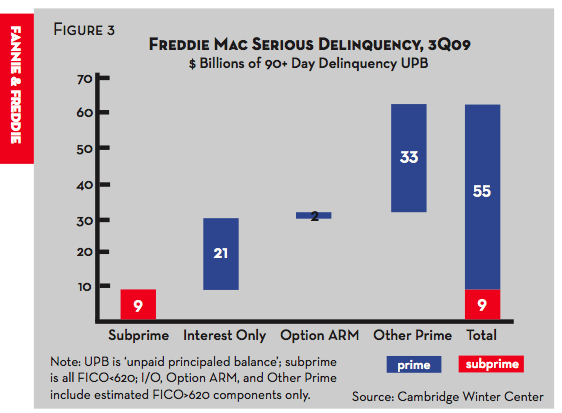
As Raj Date points out, the serious delinquencies came from “Alt-A” and “Interest Only”, which had average borrower FICO scores of 722 and 720, respectively, solidly within the “prime” category.
Between 2004 and 2006 the volume of subprime and the riskier (than conventional) Alt-A mortgages ballooned. In 2005 and 2006, conventional, conforming mortgages accounted for one-third of all mortgages originated.

From early 2004 to late 2007, it was the private-label insurers that played a large role in securitizing (pooling contractual debt into bonds) the higher-risk mortgages.

As Barry Ritholtz points out in his review of the Final Report of the National Commission on the Causes of the Financial and Economic Crisis in the United States:
They focus blame largely on the so-called “private label” mortgage market. These are bank and non-bank, brokers, lenders, and securitizers.
If F&F had accepted their lower market share and not tried to stay competitive with the private-label insurers during the bubble, their losses would have been substantially less. The F&F blame game is a desperate attempt, not borne out by facts, to shift the focus of the financial crisis away from the private-label insurers.
H/T: Mike Konczal, Karl Smith, Conservator’s Report.
.
Reagan’s Legacy: Homelessness in America
By Peter Dreier
NHI, May/June 2004
http://www.nhi.org/online/issues/135/reagan.html
Excerpt:
Reagan also presided over the dramatic deregulation of the nation’s savings and loan industry allowing S&Ls to end their reliance on home mortgages and engage in an orgy of commercial real estate speculation. The result was widespread corruption, mismanagement and the collapse of hundreds of thrift institutions that ultimately led to a taxpayer bailout that cost hundreds of billions of dollars.
Reagan Did It
By PAUL KRUGMAN
Published: May 31, 2009
http://www.nytimes.com/2009/06/01/opinion/01krugman.html
Excerpt:
“This bill is the most important legislation for financial institutions in the last 50 years. It provides a long-term solution for troubled thrift institutions. … All in all, I think we hit the jackpot.” So declared Ronald Reagan in 1982, as he signed the Garn-St. Germain Depository Institutions Act.
He was, as it happened, wrong about solving the problems of the thrifts. On the contrary, the bill turned the modest-sized troubles of savings-and-loan institutions into an utter catastrophe. But he was right about the legislation’s significance. And as for that jackpot — well, it finally came more than 25 years later, in the form of the worst economic crisis since the Great Depression.
For the more one looks into the origins of the current disaster, the clearer it becomes that the key wrong turn — the turn that made crisis inevitable — took place in the early 1980s, during the Reagan years.
Attacks on Reaganomics usually focus on rising inequality and fiscal irresponsibility. Indeed, Reagan ushered in an era in which a small minority grew vastly rich, while working families saw only meager gains. He also broke with longstanding rules of fiscal prudence.
On the latter point: traditionally, the U.S. government ran significant budget deficits only in times of war or economic emergency. Federal debt as a percentage of G.D.P. fell steadily from the end of World War II until 1980. But indebtedness began rising under Reagan; it fell again in the Clinton years, but resumed its rise under the Bush administration, leaving us ill prepared for the emergency now upon us.
The increase in public debt was, however, dwarfed by the rise in private debt, made possible by financial deregulation. The change in America’s financial rules was Reagan’s biggest legacy. And it’s the gift that keeps on taking.
The immediate effect of Garn-St. Germain, as I said, was to turn the thrifts from a problem into a catastrophe. The S.& L. crisis has been written out of the Reagan hagiography, but the fact is that deregulation in effect gave the industry — whose deposits were federally insured — a license to gamble with taxpayers’ money, at best, or simply to loot it, at worst. By the time the government closed the books on the affair, taxpayers had lost $130 billion, back when that was a lot of money.
But there was also a longer-term effect. Reagan-era legislative changes essentially ended New Deal restrictions on mortgage lending — restrictions that, in particular, limited the ability of families to buy homes without putting a significant amount of money down.
Swarthmore,
Really? Thats what wrong with america? Some jackass senator using the senate’s own beaucratic rules to delay the appointment of yet more beauracrats in retaliation for a snubbed funding bid? Cause hiring ever more beauracrats is whats going to save america?
Think whatever you want to think. You are entitled to be wrong.
OS,
Carter was the deregulator, not Reagan. Of course, that’s not how it’s taught by public school catechists.
Carter deregulated:
1. Airlines 1978
2. Oil prices 1979
3. Trucking 1980
4. Railroads 1980
5. Interest Rates 1980
And as for PATCO, preparation for the illegal strike and sourcing of replacement workers was done by Carter’s Management Strike Contingency Force.
Reagan was a master of small government, laissez-faire messaging while doing the opposite. Obama’s eloquent progressive positioning is equally perverse.
http://www.theatlantic.com/politics/archive/2011/06/whats-wrong-with-america-chapter-817-sen-richard-shelby/239967/
Bud:
that sounds like a good idea.
True Cost of Fannie, Freddie Bailouts: $317 Billion, CBO Says
http://www.cnsnews.com/news/article/true-cost-fannie-freddie-bailouts-317-bi
No, Roco, that controller was not fired. He was a “supervisor” and they had to keep every warm body they could. Every pilot I know had similar experiences. It was not a testament to the skill of the controllers that we did not have more “deals” but to the skill, situational awareness and quick reflexes of thousands of pilots.
OS,
As I recall also he replaced a lot of the controllers with military controllers at half the hourly wages.
It was a sad sad day when PATCO struck and even sadder that
they were all fired.
It is absolutely amazing how Canada has privatized their entire air traffic system, and modernized it..
Doesn’t/didn’t cost the taxpayers a penny.
As I understand it, the Canadian system is a not-for-profit system, and every dollar that is collected from the airlines must be plowed back into wages and system improvements.
“he vectored me into a collision course with another airplane”. Was that controller fired?
AY, yes, he fired all the PATCO air traffic controllers. They were on strike for better working conditions and requesting some serious equipment upgrades. ATC is probably one of the two or three most stressful jobs in the world of work. The outmoded equipment was accidents waiting for a place to happen and was increasing the stress on the controllers. I worked on one case where an air traffic controller hung himself in his garage, and the cause was stress, pure and simple.
After Reagan fired the controllers and replaced them with supervisors and temps of his choosing, the safety factor went down dramatically. It made me very nervous flying, especially when, on two separate occasions, the new replacement controller vectored me into a collision course with another airplane. In the last incident, I had to roll inverted and dive away to avoid a head-on mid-air. He was willing to play games with the safety of the flying public to enforce his ideology.
OS,
One area that he cut was actual number of federal employees….they just hired temps and paid the agency fees…so the number was initially decreased…but the monetary amount increased for payments….seems ludicrous to me…
Then they did actually fire all of the FAA employee that went on strike….something about Union busting if I recall….
Looking to a right wing blogger for credible data is hardly a definitive way to look at the history of any presidential administration.
Google “deregulation under Reagan” and take a look at the million plus hits. Some are valid, some vacuous and some not on point, but the main thing is that deregulation under Reagan started the ball rolling downhill. I don’t know how old you are, but his concentrated efforts at deregulation all over the news during the Reagan administration, and some of it affected me personally.
OS,
“It’s high time we dispel once and for all the absurd myth that Ronald Reagan was somehow for deregulation.
Statistically speaking, the size of bureaucracy, in terms of sheer civilian manpower, increased dramatically under Reagan, so that by the time he was finished, there were well over 200,000 more government workers than in 1980, when he took office.
In fact, the size of government under Ronald Reagan grew astronomically in virtually every way.”
http://rayharvey.org/index.php/2009/12/ronald-reagan-and-the-myth-of-deregulation/
Are you sure you werent watching a movie where he pretended to deregulate?
Looks like there was enough blame to go around, Elaine. I have been watching this, and the deregulation mania after the election of Ronnie Raygun was what started the ball rolling downhill. Then the next four Presidents following St. Ronnie have either done nothing or made the problem worse (see Bush II).
In aviation, there is something called the “graveyard spiral,” in which the airplane starts a diving turn. This typically happens when the horizon is not visible. If the pilot is not aware and takes immediate corrective action, a point will be reached where the dive cannot be recovered from without pulling the wings off the airplane. At which point it augers in at high speed with fatal results. That is, IMHO, a perfect analogy to what is happening to the economy. And when I was in grade school we made fun of Nero for fiddling while Rome burned.
Financial crisis was avoidable: FCIC
CNN
By Ben Rooney, staff reporterJanuary 27, 2011
http://money.cnn.com/2011/01/27/news/economy/fcic_crisis_avoidable/index.htm
Excerpts:
NEW YORK (CNNMoney) — The financial crisis, which wreaked havoc on the economy and sparked a painful recession, could have been avoided, according to a federal commission.
The Financial Crisis Inquiry Commission, in its final report on the causes of the crisis, said Thursday that federal authorities, who failed to curb reckless behavior on Wall Street, bear much of the blame for the turmoil that erupted in 2008 and 2009.
*****
The crisis was the result of “human action and inaction,” the chairman said, warning that it could happen again “if we do not learn from history.”
*****
The crisis was also the product of “dramatic failures of corporate governance and risk management at many systemically important financial institutions,” according to one of the report’s nine conclusions.
The commission faults policies under both Presidents Bush and Obama, as well as actions taken by the Federal Reserve under Alan Greenspan and the current chairman, Ben Bernanke. Tim Geithner, the current Treasury Secretary who was president of the New York Fed during the crisis, and his predecessor, Henry Paulson, were also named in the report.
“As our report shows, key policy makers — the Treasury Department, the Federal Reserve Board, and the Federal Reserve Bank of New York — who were best positioned to watch over our markets were ill prepared for the events of 2007 and 2008,” the commission states.
The report also cites “a systemic breakdown in accountability and ethics” as a factor in the crisis. However, it states that “to pin the crisis on mortal flaws like greed and hubris would be simplistic.”
“It was the failure to account for human weakness that is relevant to the crisis,” the report reads.
*****
The commission tells a familiar story of banks churning out trillions of dollars worth of poor quality home loans that were bundled into mortgage-backed securities, rubber-stamped by ratings agencies, and sold to unsuspecting investors around the world. As the housing market soured, those assets became worthless, leading to massive losses for banks and giving rise to a severe liquidity crisis.
The crisis was driven by the proliferation of “synthetic” securities, such as collaterized debt obligations, and the excessive use of leverage at many financial firms, the report finds. These and other practices were carried out in a “shadow banking system” the report says, which was almost entirely unregulated.
Some of the major operators in the shadow banking system included Lehman Brothers and Bear Stearns, which didn’t survive the crisis, as well as heavyweights Goldman Sachs (GS, Fortune 500), Merrill Lynch and Citibank (C, Fortune 500). The commission also faults the lending practices of commercial banks such as Countrywide, now owned by Bank of America (BAC, Fortune 500), Wachovia and JPMorgan Chase (JPM, Fortune 500).
*****
Fannie Mae and Freddie Mac, two government-sponsored enterprises, were “the kings of leverage,” the report says. By the end of 2007, according to the report, the companies had a combined leverage ratio of 75 to 1.
The report faults government officials for encouraging Fannie and Freddie to increase their exposure to the mortgage market. The firms were placed under government control in 2008, and many analysts worry that their liabilities will be borne by taxpayers.
AIG, the bailed out insurance giant, also features prominently in the report for its role in the crisis. AIG had to be rescued by the government in 2008 after it sold $79 billion worth of insurance contracts on mortgage-backed securities.
The report also criticizes the three main credit rating agencies — Moody’s, S&P and Fitch — as “essential cogs in the wheel of financial destruction.”
“Their ratings helped the market soar and their down-grades through 2007 and 2008 wreaked havoc across markets and firms,” the report reads.
http://www.nytimes.com/2011/06/06/opinion/06diamond.html?_r=1 Nobel prize winner and fed nominee,Peter Diamond,who favors policies that are beneficial to the unemployed, pulls name out because republican voted in lockstep against him.
Origins of an American Kleptocracy
“It takes only a cursory examination to suspect that misdirection plays a key part in the latest act of the ongoing crisis theater of the absurd. Misdirection to distract attention from the key complicity of GSEs in the crisis. Misdirection to deflect scrutiny away from the political personalities from both sides of the aisle responsible. Misdirection to conceal what could only be described as the most damaging acts of accounting and securities fraud in the history of accounting, securities or fraud.
Precious few assumptions are required to come to conclusions laying responsibility for the largest economic disaster in recent memory at the feet of the GSEs.
First, that the GSEs had substantial influence over the mortgage market.
This is a no-brainer with the GSEs either holding or guaranteeing 51% of outstanding home mortgage debt in 2003. To put this in perspective, that figure was around 33% of the GDP of the entire United States in 2003. Read that last line again. Anyone wishing to play in the market had to compete with the rates set by Fannie and Freddie.
Second, that the GSEs artificially depressed rates (read: underpriced risk).
This is equally trivial to find given that this precise mandate has been the express purpose of the GSEs since at least 1993. The GSEs were not tasked with increasing the capacity for mortgage lending. They were tasked with making loans “affordable.” They used a number of tools to do so, but the key elements were acting as a proxy for quasi-government guarantees and bundling mortgages into risk tiers to act as a sort of clearing house for securitization pools. It is often said that providing a guarantee (particularly governmental) reduces risk. This is, of course, a fantasy. All that explicitly or implicitly tax dollar backed guarantees do is socialize risk. However, they manage to do so without requiring consolidation of the resulting liabilities on the government’s balance sheet. Convenient that, yes? A guarantee is a subsidy. Period. Failing to understand this is what permitted the political class to mislead the American public into thinking that cheap loans for everything from housing to small businesses to education (the next fiscal disaster on the horizon) come with no cost. (Or that cheap debt wouldn’t pump up the price of everything from education to housing). Today’s pundits seem to enjoy blaming “moral hazard” (by which they mean “corporate moral hazard”) for the crisis. Oddly, government guarantees, particularly those that everyone assumes will be costless, are not typically part of this definition.”
http://www.zerohedge.com/article/origins-american-kleptocracy
Back on topic:
“There is more to this ugly situation. New research by Edward Pinto, a former chief credit officer for Fannie Mae and a housing expert, has found that from the time Fannie and Freddie began buying risky loans as early as 1993, they routinely misrepresented the mortgages they were acquiring, reporting them as prime when they had characteristics that made them clearly subprime or Alt-A.
In general, a subprime mortgage refers to the credit of the borrower. A FICO score of less than 660 is the dividing line between prime and subprime, but Fannie and Freddie were reporting these mortgages as prime, according to Mr. Pinto. Fannie has admitted this in a third-quarter 10-Q report in 2008.
An Alt-A mortgage is one in which the quality of the mortgage or the underwriting was deficient; it might lack adequate documentation, have a low or no down payment, or in some other way be more likely than a prime mortgage to default. Fannie and Freddie were also reporting these mortgages as prime, according to Mr. Pinto.
It is easy to see how this misrepresentation was a principal cause of the financial crisis. ”
“As it turned out, however, none of Lehman’s largest counterparties failed—so much for the idea that the financial market is “interconnected”—but all market participants now realized they had to know the true financial condition of their counterparties. The result was a freeze-up in interbank lending.
For most people, that freeze-up is the beginning of the financial crisis. But its roots go back to 1993, when Fannie and Freddie began stocking up on subprime and other risky loans while reporting them as prime. ”
http://online.wsj.com/article/SB10001424052748703278604574624681873427574.html