-Submitted by David Drumm (Nal), Guest Blogger

 With the recent appearance of Gretchen Morgenson and Joshua Rosner’s Reckless Endangerment, the focus on the financial meltdown turns to Government Sponsored Enterprise (GSEs) such as Fannie Mae and Freddie Mac (F&F). The claim is that the role of F&F in the meltdown is being marginalized or ignored. Some claim that this book fills an important void.
However, the role of F&F has been well researched and documented.
The GSEs, by charter, are intended to facilitate mortgage finance to lower-income homeowners. These lower-income borrowers, with no political support structure, are the perfect patsies for those looking to shift the blame for the financial crisis. Republicans have used the “affordability” aspect of the GSEs mission to blame F&F for the financial crisis. The facts just don’t bear them out.
In Raj Date’s presentation, he notes that GSEs $100 billion of private-label subprime Mortgage Backed Securities (MBS) in their portfolio is only 2% of their $5 trillion credit exposure. He writes:
Moreover, the very worst performing GSE loans (that is, the loans where losses are the greatest multiple of original forecasts) were made to prime borrowers, not subprime.
As shown in the graph below, it is the prime mortgages that make up the vast majority of serious delinquencies.
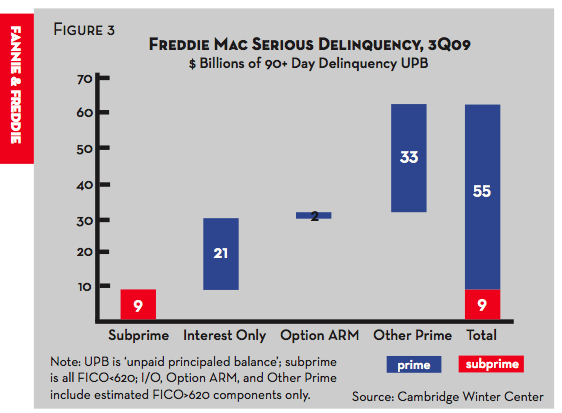
As Raj Date points out, the serious delinquencies came from “Alt-A” and “Interest Only”, which had average borrower FICO scores of 722 and 720, respectively, solidly within the “prime” category.
Between 2004 and 2006 the volume of subprime and the riskier (than conventional) Alt-A mortgages ballooned. In 2005 and 2006, conventional, conforming mortgages accounted for one-third of all mortgages originated.

From early 2004 to late 2007, it was the private-label insurers that played a large role in securitizing (pooling contractual debt into bonds) the higher-risk mortgages.

As Barry Ritholtz points out in his review of the Final Report of the National Commission on the Causes of the Financial and Economic Crisis in the United States:
They focus blame largely on the so-called “private label” mortgage market. These are bank and non-bank, brokers, lenders, and securitizers.
If F&F had accepted their lower market share and not tried to stay competitive with the private-label insurers during the bubble, their losses would have been substantially less. The F&F blame game is a desperate attempt, not borne out by facts, to shift the focus of the financial crisis away from the private-label insurers.
H/T: Mike Konczal, Karl Smith, Conservator’s Report.
.
Barack Obama is floundering in a sea of bad news, as White House chief economist jumps ship
http://blogs.telegraph.co.uk/news/nilegardiner/100090961/president-obama-is-floundering-in-a-sea-of-bad-news-as-white-house-chief-economist-jumps-ship/
Daily economic briefings disappear from Obama’s White House schedule
http://thehill.com/homenews/administration/164985-obamas-daily-economic-briefings-disappear
No, but assume what you like.
We’ve all seen how well that worked out for you in the past.
I will assume because they are pro free markets? Is that the only reason?
Yep.
so the Mises Institute is a fascist propaganda outlet? Is that what you are saying?
puzzling:
sounds more like jimmy carter as forest gump.
I’m saying anything that comes from von Mises is fascist propaganda, sock puppet.
You meant Briepart didn’t you 🙂
No.
I’m saying anything that comes from von Mises is fascist propaganda, sock puppet.
“Ooooo. An article from a von Mises organ. Yeah. That’s not fascist propaganda. Uh huh.”
So are you saying Carter was a fascist?
Yet clearly there isn’t. This only goes to prove that not all valuable services can be run on a for profit basis – nor should they be – and are indeed properly filled by government. Like the idea of privatized profit centered fire departments, the idea of privatized profit centered libraries is intrinsically faulty. Just like the idea of profit centered privatized health care insurance is fundamentally faulty.
Buddha,
Just to be clear, I get the impression that the people at The Mises Institute generally don’t go for outsourcing like that either. They seemed to think that there’s some evil force keeping someone from starting a for profit library business. The article was awhile ago though, so details are a little fuzzy.
Gyges,
From loopy minds come loopy ideas.
http://www.boston.com/news/globe/editorial_opinion/editorials/articles/2007/10/22/for_profit_libraries_a_sad_story/
Buddha,
I actually get Mise’s daily e-mails. I read them when they look especially… odd.
My two favorites are the one explaining how much better for profit libraries would be (although that one’s tied with the weird rant about how much better little leagues would be if they were ran for profit). Never mind the fact that in we’ve HAD people try and run for profit libraries in the recent past (it’s a major plot point in my favorite Orwell novel), and the one explaining that nobody makes home-made ice-cream because we buy the ice-cream maker, vanilla, cream, etc.
Supply-Side Economics in Fact and Fancy
by Robert E. Prasch
Common Dreams
May 7, 2011
http://www.commondreams.org/view/2011/05/07-7
Note: Robert E. Prasch is Professor of Economics at Middlebury College where he teaches courses on Monetary Theory and Policy, Macroeconomics, American Economic History, and the History of Economic Thought. His latest book is How Markets Work: Supply, Demand and the ‘Real World’ (Edward Elgar, 2008).
Supply-side economics is a hearty perennial, one that closely follows the election cycle. Every four years ambitious Republican politicians (and not a few ‘centrist’ Democrats) rediscover that the wealthy would like to pay less in taxes. But the rhetoric of politics does inhibit the wealthy, their kept intellectuals, and paid spokesmen from arguing their case directly. In democracies, even those resembling plutocracies, the rich must present their own interests as coinciding with the general good.
With this in mind, and yet still aspiring to a tax cut, the wealthy have lavishly supported ‘astroturf’ political organizations and ‘think tanks’ which, in turn, hire photogenic and eloquent spokespersons to present their case to the public. In its best form, the argument is that tax cuts for the rich will: (1) increase the national savings rate because the wealthy save a larger percentage of their incomes than others. This increased quantity of savings will (2) provide the funds required to spur business investment in plant and equipment. From this it follows that (3) supply-side tax cuts will have the effect of providing strong economic growth, which will “trickle down” to the “regular guy.” We are assured that not only are these propositions true, but that they were proven decisively during the Reagan Administration.
Let’s look up the figures. The key to this theory is in steps 1 & 2, describing a causal relationship between lower tax rates and increased private investment. Our starting point, or baseline, will be the average of what is called “net private domestic investment” over President Jimmy Carter’s four years (1977-1980), which we will compare to the average across the four years of President Ronald Reagan’s second term (1985-1988). The reason to select the former years is that they are widely recalled as having been dismal. Indeed, we have been repeatedly told that they were so bad that voters granted Reagan a mandate to pursue supply-side economic policies. Likewise, the latter years are selected as the effects of the enormous tax cuts enacted during Reagan’s first term should have had their strongest effect during his second term. Selecting data from Reagan’s second term allows us to set aside the economy’s abysmal performance during his first term with its devastating recession — the worst that occurred between the Great Depression and the Crash of 2008. In addition, by Reagan’s second term the wealthy should have had ample opportunity to adjust to their lower tax rates.
When we look up the figures on the official National Income and Product Accounts, we find that “net private domestic investment” did not increase. On the contrary, it declined from an average of 7.0% of total Gross Domestic Product during Carter’s four years to an average of 5.7% during Reagan’s second term. More shockingly, if we factor out inflation, we find that the real dollar amount of investment fell slightly despite the fact that the American economy of the late 1980s was over 17% larger than the late 1970s. To put it mildly, this is a powerful refutation of the supply-side story.
But, proponents might respond, surely overall savings rose as a consequence of the lower tax rates? Let us check. Comparing the averages over these same two four-year periods, consumption as a share of total National Income increased from 64.8% to 67.2%. Because the median American income for a full time year-round employee declined between 1980 and 1988 (from $34,483 to $34,253 in constant 1994 dollars according to the Bureau of the Census), this increase in the nation’s consumption was most likely undertaken by persons in the upper echelons of the income distribution.
In light of facts presented in the previous two paragraphs, we are ready to sum up. President Ronald Reagan’s supply-side economic policies left us with more consumption on the part of the wealthy, a lower savings rate, less net private sector investment, and a lower median income for a full-time year-round worker. These who lived through those years will not be surprised by these numbers, as conspicuous consumption on the part of the wealthy was a dominant and widely-noted theme of that era.
The ‘moral of the story’ is that proponents of more tax cuts for the rich will have to argue that its beneficial effects are very gradual, occurring only after an orgy of increased expenditure on the part of the policy’s immediate beneficiaries. Alternatively, they could argue that the National Income and Product Accounts put together by the Bureau of Economic Analysis at the Department of Commerce are profoundly flawed. Finally, they could drop the pretense that the Reagan years are an affirmation of their favored theory. The numbers presented above and the conclusions they point to simply cannot be sidestepped. If tax cuts for the wealthy are good for savings, investment, and the incomes of “regular guys” (that is to say the median earner), then some precedent other than the Reagan years will have to be invoked.
Ooooo. An article from a von Mises organ. Yeah. That’s not fascist propaganda. Uh huh.
Roco,
Here is an article with a superior explanation to my own, Rethinking Carter
I am just trying to refute the meme that Reagan was the grandfather of deregulation. That’s simply not true.
Seems to me David Stockman is saying that spending needs to be restrained. That spending should be limited to revenue.
He is also saying that freely printed money isn’t a good thing, as in stimulus and bail outs. Which is inflationary.
And he is saying foreign wars are a bad idea. All policies neither democrats nor republicans seem to understand.
Here’s is an excerpt from a NYT piece written by David Stockman who was director of the Office of Management and Budget under President Ronald Reagan:
Four Deformations of the Apocalypse
By DAVID STOCKMAN
Published: July 31, 2010
http://www.nytimes.com/2010/08/01/opinion/01stockman.html?ref=opinion
Excerpt:
The second unhappy change in the American economy has been the extraordinary growth of our public debt. In 1970 it was just 40 percent of gross domestic product, or about $425 billion. When it reaches $18 trillion, it will be 40 times greater than in 1970. This debt explosion has resulted not from big spending by the Democrats, but instead the Republican Party’s embrace, about three decades ago, of the insidious doctrine that deficits don’t matter if they result from tax cuts.
In 1981, traditional Republicans supported tax cuts, matched by spending cuts, to offset the way inflation was pushing many taxpayers into higher brackets and to spur investment. The Reagan administration’s hastily prepared fiscal blueprint, however, was no match for the primordial forces — the welfare state and the warfare state — that drive the federal spending machine.
Soon, the neocons were pushing the military budget skyward. And the Republicans on Capitol Hill who were supposed to cut spending exempted from the knife most of the domestic budget — entitlements, farm subsidies, education, water projects. But in the end it was a new cadre of ideological tax-cutters who killed the Republicans’ fiscal religion.
Through the 1984 election, the old guard earnestly tried to control the deficit, rolling back about 40 percent of the original Reagan tax cuts. But when, in the following years, the Federal Reserve chairman, Paul Volcker, finally crushed inflation, enabling a solid economic rebound, the new tax-cutters not only claimed victory for their supply-side strategy but hooked Republicans for good on the delusion that the economy will outgrow the deficit if plied with enough tax cuts.
By fiscal year 2009, the tax-cutters had reduced federal revenues to 15 percent of gross domestic product, lower than they had been since the 1940s. Then, after rarely vetoing a budget bill and engaging in two unfinanced foreign military adventures, George W. Bush surrendered on domestic spending cuts, too — signing into law $420 billion in non-defense appropriations, a 65 percent gain from the $260 billion he had inherited eight years earlier. Republicans thus joined the Democrats in a shameless embrace of a free-lunch fiscal policy.
The third ominous change in the American economy has been the vast, unproductive expansion of our financial sector. Here, Republicans have been oblivious to the grave danger of flooding financial markets with freely printed money and, at the same time, removing traditional restrictions on leverage and speculation. As a result, the combined assets of conventional banks and the so-called shadow banking system (including investment banks and finance companies) grew from a mere $500 billion in 1970 to $30 trillion by September 2008.
But the trillion-dollar conglomerates that inhabit this new financial world are not free enterprises. They are rather wards of the state, extracting billions from the economy with a lot of pointless speculation in stocks, bonds, commodities and derivatives. They could never have survived, much less thrived, if their deposits had not been government-guaranteed and if they hadn’t been able to obtain virtually free money from the Fed’s discount window to cover their bad bets.
Reagan’s supply side brought huge amounts of money into the treasury, as Carville and Begala like to say, he was responsible for the largest tax increase in history.
But congress has control of the purse and spent like, drunken congressmen.
Puzzling:
so what you are saying is that Carter’s actions led to the unprecedented growth we experienced in the 80’s? If that is true he truly did get the short end of that stick.
Can you back that up? I thought Reagan let interest rates float. He and Volcker, which was why we had the down turn at the beginning of his term. Or are you saying he just extended Carter’s policies?
Nixon’s wage and price controls did screw the economy up pretty badly. Are you saying Carter spent his presidency trying to correct those mistakes? And Reagan got credit for them?
I would like to see that from a credible source.