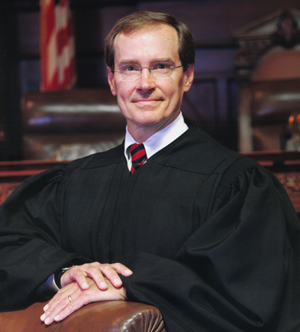
 Pennsylvania Commonwealth Court Judge Robert Simpson issued an important ruling on Wednesday that rejected a motion for a preliminary injunction of the Pennsylvania Voter ID law. Since these motions are based on a determination of the likelihood of prevailing on the merits, the decision has a significant impact not only for the case but cases around the country. Even if one disagrees with Simpson’s decision, the 70-page opinion below is well-reasoned and will be, in my view, difficult to reverse in the appeal to the state supreme court (which is divided evenly between Republican and Democratic jurists). With one Republican justice, Joan Orie Melvin, fighting criminal corruption charges, the Court is divided three to three along party lines. However, there is no reason to assume that these jurists will all vote in line with their political affiliations as opposed to their view of the law. A tie on the Supreme Court would result in a decision upholding the decision. I will be discussing the case this morning on CNN.
The law requires the showing of an ID for voting, which can include a driver’s license, military ID cards, U.S. passports, identification cards from accredited Pennsylvania colleges or universities, Pennsylvania senior care facility IDs, or other photo identification cards issued by the federal, Pennsylvania, county or municipal governments.
Simpson not only rejected the legal basis for the challenge but added factual findings that could pose a problem on appeal — minimizing the impact of the voters affected by the law.
Challengers to the law (which is similar to laws in nine other states) insist that it is designed to disenfranchise voters who are minority, poor, or elderly. Those are critical groups in the democratic base and the law is viewed as a Republican effort to suppress turnout. Even Pennsylvania admitted that voter fraud is exceedingly rare in the state and national studies have found similarly low numbers in other states. That reinforces the view that this was a politically motivated law by state GOP members concerned about the expected close presidential election in November.
Simpson acknowledged the possible political machinations and chastised comments by the Republican House leader, Mike Turzai, as “disturbing” and “boastful.” Turzai seemed eager to undermine any claim of a neutral rationale for the law in proclaiming at a dinner that the new law “is going to allow Gov. Romney to win the state of Pennsylvania.”
However, Simpson did not view such admittedly revealing (and rather moronic) public statements to be determinative in the legal analysis. He found that the Commonwealth’s asserted interest in protecting public confidence in elections is a relevant and legitimate state interest sufficiently weighty to justify the burden.” More importantly, he ruled that requiring a voter to show one government ID is a “reasonable, non-discriminatory, non-severe burden when viewed in the broader context of the widespread use of photo ID in daily life.”
Simpson’s decision is buttressed by the 2008 decision by the U.S. Supreme Court in Crawford v. Marion County Election Board, 553 U.S. 181 (2008) upholding an Indiana law requiring photo IDs. That decision was written by liberal icon Justice John Paul Stevens who found that such laws are “amply justified by the valid interest in protecting the integrity and reliability of the electoral process.” Stevens wrote in the 6-3 decision (which Simpson cites extensively):
“The relevant burdens here are those imposed on eligible voters who lack photo identification cards that comply with SEA 483.[2] Because Indiana’s cards are free, the inconvenience of going to the Bureau of Motor Vehicles, gathering required documents, and posing for a photograph does not qualify as a substantial burden on most voters’ right to vote, or represent a significant increase over the usual burdens of voting. The severity of the somewhat heavier burden that may be placed on a limited number of persons—e.g., elderly persons born out-of-state, who may have difficulty obtaining a birth certificate—is mitigated by the fact that eligible voters without photo identification may cast provisional ballots that will be counted if they execute the required affidavit at the circuit court clerk’s office. Even assuming that the burden may not be justified as to a few voters, that conclusion is by no means sufficient to establish petitioners’ right to the relief they seek.”
Simpson is likely to be challenged on not requiring more of a showing from the state on critical points. He gave “substantial deference to the judgment of the Legislature” on these questions. He specifically opted not to apply a strict scrutiny standard as requested by the challengers who argued that the standard applied due to the denial of a fundamental right. Simpson acknowledged in the opinion that “[i]f strict scrutiny is to be employed, I might reach a different determination.”
However, Simpson iron-plated his decision with extensive legal and factual findings. This is no ideological diatribe. You can disagree with him, but the opinion is well-constructed and well-presented.
The situation in other states can vary. Some of those states (like Texas, South Carolina and Florida) fall under added restrictions under the federal voting law and new voting laws must be approved by the Justice Department. The Obama Administration is opposed to the laws and Attorney General Eric Holder recently spoke to black ministers on fighting the efforts in these states. Moreover, while nine states — Alabama, Kansas, Mississippi, Pennsylvania, South Carolina, Tennessee, Texas, Virginia and Wisconsin — passed new ID laws, only Kansas, Pennsylvania and Tennessee appear set to apply the laws to the November elections.
Notably, Simpson created a factual record that found a much lower number of people affected by the law — a factual finding that is generally given deference on appeal as opposed to legal findings. Simpson rejected the estimate that 9 percent of the state’s 8.2 million registered voters lack a viable ID.
As I mentioned, I would bet on the decision being upheld or effectively upheld with a tie on the state supreme court. It is also doubtful the United States Supreme Court would intervene in the case before the November elections, particularly if it is upheld by the lower court. That will not be welcomed news in a key state for the President but the Obama campaign may be wise to focus on preparing voters rather than betting on a reversal.
Here is the opinion: Simpson Opinion
Blouise,
I most certainly did!
SwM,
Be safe, drive carefully and remember to come home!
Elaine,
This post was supposed to be to OS and you …( I’m getting old.)
Blouise
1, August 16, 2012 at 9:07 pm
OS,
That was grand! Did you notice the guy playing the cymbals at the very beginning?
Thank you, Elaine. We leave Saturday.
Swarthmore,
Have a great trip to the Emerald Isle!
Swarthmore mom,
I hope you have a wonderful vacation!
Pictures … lots and lots of pictures
I have a reservation there. It is in Cork where some relatives come from.
Swarthmore mom,
My daughter and son-in-law honeymooned in Ireland. They spent two weeks there–and had a grand time. One of their favorite places was a town called Kinsale.
http://kinsale.ie/
ID,
We’ve got analogies, metaphors, straw men, and rhetoricals, BUT
Condoms of Steel
will live in my memory forever!
People here have a lot of very good stuff to say, but NOBODY made me laugh like that. Remember that the next time the Black Wrinkly Face of Doom shows up.
OS, That is it and it is impressive. Thanks.
OS,
That was grand! Did you notice the guy playing the cymbals at the very beginning? 🙂
gbk,
You and I will just stay home and practice our bagpipes … we can give the drum to OS.
Not to worry … I have my own plus an extra set you can use.
I wish I knew the Gaelic phrase for, “take a deep breath, and possibly reconsider your position.”
Alas, I don’t. But I can confirm that Scots only speak english (please note the small “e”) when they need to.
Swarthmore mom,
Just guessing, but I’ll bet they are going to see the Edinburgh Military Tattoo. It is impressive, held every year at the Esplanade of Edinburgh Castle. It runs through August 25 this year.
http://www.edintattoo.co.uk/
Here is the opening from two years ago:
Elaine, That is what my sister is going to. I am going on a driving trip through the western and southern coast of Ireland and visiting with cousins that i have located.
Swarthmore Mom & Blouise,
In 1972, my husband and I had a grand time driving through England and Scotland. We attended the Military Tatoo at Edinburgh Castle. It was truly a memorable experience.
Blouise, if I went to bed now, I would be up by three or four. I have not had a good night of sleep since last August.
SwM,
Your family’s going Gaelic next week!
I, on the other hand, am vacating the premises so that the whole house can get its “Fall” cleaning … carpets, windows, walls etc. Leaving tomorrow and returning late Sunday. (sigh)
Blouise, My sister and brother and law are going to Scotland next week. His parents were born in Scotland. There is some musical event that they are going to.