-Submitted by David Drumm (Nal), Guest Blogger
 This campaign season we’ll hear a lot about “statistical ties.” The “statistical tie” misnomer is used to refer to the situation where one candidate leads another candidate but that lead is within the margin of error (MOE). However, what we’re really interested in is the probability that one candidate leads the other candidate.
Since polling all voters is a costly and time consuming process, a random sample of voters is selected and, based on some assumptions, one can make a probabilistic judgement regarding the outcome of an election. Polling all voters yields the “true” percentage while the random sample can only estimate the “true” value.
Every time a sample is taken, a different (perhaps) estimate of the “true” value is obtained. The estimate plus and minus the MOE is called the confidence interval. A 95% confidence interval says that 95% of the sample estimates will lie within that interval. Also, a 95% confidence interval says that we are 95% certain that the “true” value lies within that interval.
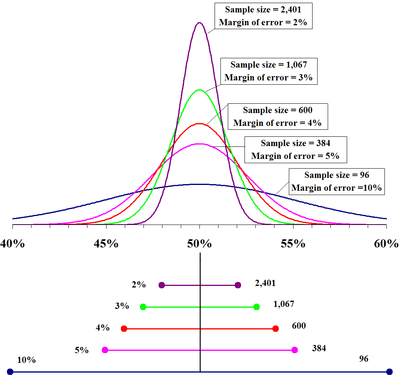 Consider two candidates, Smith and Jones. We want to know what percentage of the voters prefer Smith and what percentage prefer Jones. The “true” percentage is unknown so we randomly sample the population to obtain an estimate. We want to be 95% confident that our estimate lies within the “true” percentage plus-or-minus three points. The figure at the right determines the sample size for different MOEs. Sample sizes usually assume an infinite population and a correction factor is only required when dealing with very small populations.
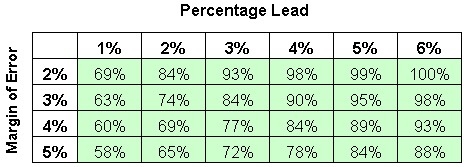
After our poll of 1067 likely voters, Smith leads Jones 49-46% with an MOE of 3%. Some would call this a “statistical tie” since the lead is within the MOE. However, the following table tells us that Smith’s lead is 84% probable.
H/T: Kevin Drum, Fritz Scheuren.
Every time a new poll is taken, a new confidence interval is generated. The 95% confidence refers to the fact that in repeated samplings, roughly 95 out of 100 times the interval will contain the “true” value. Some confidence intervals, about 5% of them, will actually not contain the “true” value. In other words, we have 95% confidence in our methods, not in a particular interval. I am fairly confident that this is the (a) correct interpretation.
Here in Sweden, everyone’s income income and fortune as registered with the IRS is an open data for all to access.
Kerstin when she got up in salary started to receive invitations to accept free copies of deluxe magazines with limited circulation. That’s called selective marketing.
Now what made BettyKath popular with the pollsters? Maybe she had applied as a fan to NASCAR once upon a time.
Joking of course.
I used to get Zogby polls by email but not any more, not since he sold out. So many of their polls were hard for me, they assumed that I was a confirmed consumer who would buy just about anything. Every poll wanted to know if I was a NASCAR fan.
A…that should be Z as in Zimmerman.
ElaineM,
Nowadays, when someone says: “Do a Florida”, it is difficult to know what to choose.
We have so much to choose.
GrorgeA versu TrayvonM
Voter resriction
Vote fraud as in when the Supremes decided.
Building Disney Worlds or Cape Canaveral.
Becoming a resident snowbird.
etc.
bettykath
1, October 6, 2012 at 10:27 am
(yawn) Just tell me who’s going to win.
*****
The guy who gets the most votes. Then again–maybe not!
A challenge to NAL and Frankly or just anybody.
Where on Earth do we have two summers and two winters?
Bruce,
A common misconception, you have.
Polls are not taken of station listeners. Nor are theu done by the stations, nor under their name when the questions are posed.
Good try at thinking. That did not sound like a rubber stamp, or was it?
OS,
Thanks for thinking of me. However, I actually enjoyed and understood(mostly) what David was talking about. I am glad to see Frankly feels the same way I do about Math!
Networks poll their listeners, people like to hear thier side of the argument, therefore they like to hear something they agree with. A liberal station will have a different result than a conservative station.
To come back to reality, as Betty Kath reminds us to do, let us consider Obama utter failure in the first debate.
Has he been given an offer that he can’t resist?
Do an LBJ for us or we do a JFK on you!
Certainly his gray hairs and longing for his youthful years do not explain it.
Certainly his longing to replace Dewey as the surprise loser, although a given in the polls.
Great mystery. What do he a-holes, sorry, pundits say?
Frankly,
Dear fellow sufferer, we feel the same pain, I believe.
Try it in very small portions. one concept until it suddenly lights up like the proverbial incandescent bulb—the ones to be forbidden soon. And then take the next step.
I could exemplify by ones I have used which deal with spatial relations, on which I also scored poorly.
(yawn) Just tell me who’s going to win.
Nal,
Thanks for enabling a bit more. Always have hated math.
I’ll take the figures as such, can’t otherwise.
But decreasing our MOE from 3 to 2 percentage more than doubles the sample size, and more doubles the operational costs. Thus we most often hear of a ca 1000 sample size.
A small increase in percentage lead gives a far greater certainty of lying within the MOE chosen.
Thus changing a race to an avalanche, to mix metaphors.
Now the percentage gabble will make more sense to me.
Does it occur that a “wild” sample occurs? And how many re-polls are necessary to restore confidence, if any?
Math is HARD! All I know is that when Willard is not leading in the polls Rush tells me they are rigged. I can understand that. When you talk all mathy-sciency my poor head hurts so the obvious fact is the polls are just rigged
The media has a vested interest in making the election appear close. People won’t watch a blow out. Candidates won’t spend their money on ads if they are certain to lose. They will fudge the numbers for profit.
Nal, thanks for this. However, did you take into consideration the liability issues that might arise for doing permanent damage to rafflaw?
Having been trained in statistics, I sometimes want to beat my head on the desk when pundits make sonorous proclamations about the meaning of polling results. I have given up trying to explain the Standard Error of Measurement to people.
Living on the margin of error …
There are lies, statistics, golf and taxes …… all within the margin of error…..
NAL:
so you are saying the president only has a 70% chance of being elected?
And Romney has about the same chance based on recent polls.
So I guess what you are really saying is WTFK.