 Submitted by Elaine Magliaro, Weekend Contributor
Doesn’t it seem “patently” absurd that Amazon would be granted a patent for the process of taking a photo against a white background? Earlier this week, Udi Tirosh broke that news at DIY Photography. Tirosh said that he really wasn’t sure how he could tag the story any way “other than a big #fail for the USPTO, or a huge Kudos for Amazon’s IP attorneys.” He added that in a patent titled “Studio Arrangement,” Amazon took IP ownership on what photographers “call shooting against a seamless white backdrop.”
Tirosh wrote that Amazon’s patent “describes the arrangement of elements in the studio to make a product shot—and “even details the F-stop, ISO value and focal length you need to use”:
a background comprising a white cyclorama; a front light source positioned in a longitudinal axis intersecting the background, the longitudinal axis further being substantially perpendicular to a surface of the white cyclorama; an image capture position located between the background and the front light source in the longitudinal axis, the image capture position comprising at least one image capture device equipped with an eighty-five millimeter lens, the at least one image capture device further configured with an ISO setting of about three hundred twenty and an f-stop value of about 5.6; …
Tirosh also noted that part of the patent “describes a table and some trivial lighting”:
… an elevated platform positioned between the image capture position and the background in the longitudinal axis, the front light source being directed toward a subject on the elevated platform; a first rear light source aimed at the background and positioned between the elevated platform and the background in the longitudinal axis, the first rear light source positioned below a top surface of the elevated platform and oriented at an upward angle relative to a floor level; a second rear light source aimed at the background and positioned between the elevated platform and the background in the longitudinal axis, the second rear light source positioned above the top surface of the elevated platform and oriented at a downward angle relative to the floor level; a third rear light source aimed at the background and positioned in a lateral axis intersecting the elevated platform and being substantially perpendicular to the longitudinal axis, the third rear light source further positioned adjacent to a side of the elevated platform; and a fourth rear light source aimed at the background and positioned in the lateral axis adjacent to an opposing side of the elevated platform relative to the third rear light source; wherein a top surface of the elevated platform reflects light emanating from the background such that the elevated platform appears white and a rear edge of the elevated platform is substantially imperceptible to the image capture device; and the first rear light source, the second rear light source, the third rear light source, and the fourth rear light source comprise a combined intensity greater than the front light source according to about a 10:3 ratio.
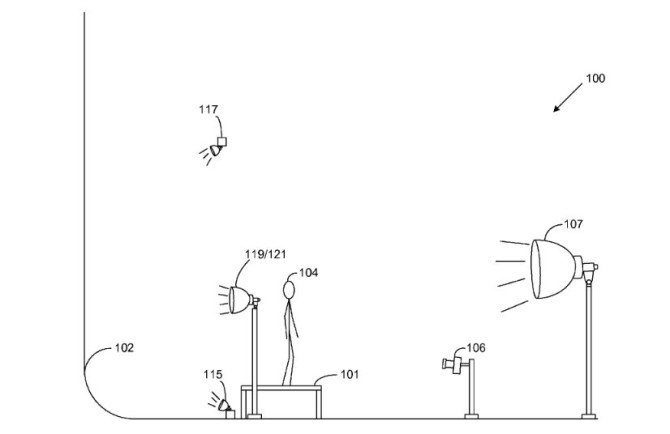
Tim Cushing of TechDirt wrote that Amazon differentiates “its proprietary white-background photo thing from others exactly like it by pointing out that prior art often refers to image retouching, green screens or other forms of image manipulation.” He jokingly remarked that Amazon’s technique “is apparently the purest of the pure, being only the photographer, the photographed object/person, the white background, a number of front lights/back lights and some sort of object separating the subject from the ground below it.”
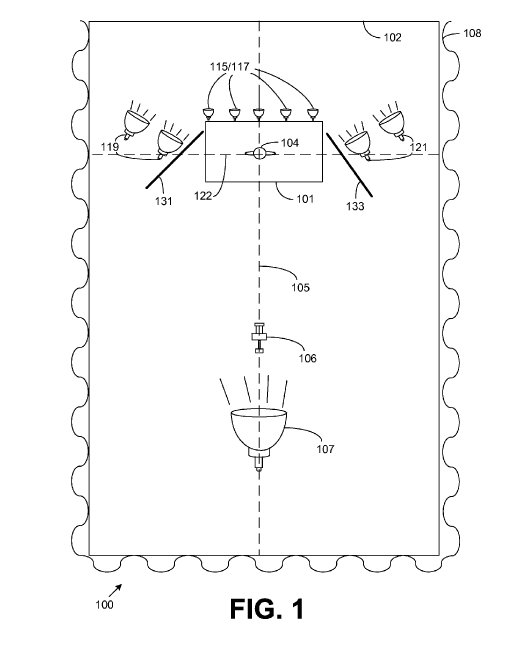
Tirosh said that he believes that “there is plenty of prior art on this”—and that there is “absolutely no way to enforce it.”
Cushing sarcastically explained how this innovative step-by-step photography method works in practice:
1. Turn back lights on.
2. Turn front lights on.
3. Position thing on platform.
4. Take picture.
Writing for Salon, Andrew Leonard said that studio photographers have been taking pictures of their subjects against white back drops for many years. He added that the “notion that such a thing could be patented strikes many people as inexplicable and bizarre. But that’s also exactly why this particular tidbit exploded so quickly out of the amateur photography blogosphere and into the mainstream tech press.”
Like Tirosh, Leonard said he, too, thinks that this Amazon patent seems “utterly unenforceable, absent an army of inspectors who barge into photography studios across the world patrolling for infringing setups.” He said it also seems “utterly ridiculous.” He questions how Amazon could “know that photographers haven’t already stumbled upon the exact same setup.” Then he asks, “And how, in any rational sense, is this the kind of thing that patent law was originally designed to protect?”
SOURCES
You Can Close The Studio, Amazon Patents Photographing On Seamless White (DIY Photography)
US Patent Office Grants ‘Photography Against A White Background’ Patent To Amazon (TechDirt)
Amazon inexplicably granted patent for common photography flash setup (The Verge)
Taking a photo against a white background? Amazon owns the patent on that (qz.com)
The views expressed in this posting are the author’s alone and not those of the blog, the host, or other weekend bloggers. As an open forum, weekend bloggers post independently without pre-approval or review. Content and any displays or art are solely their decision and responsibility.
No, it’s Amazon who’s not feeling the love.
It is worth a chuckle, the majority of folks here love government. It appears the US Patent Office is not feelin’ the love.
Well it is possible that the technique might be non obvious – to those who work in the patent office.
Peter, LOL! That is “literally” the best pun ever.
I saw this earlier today, and, like everyone else, agree that it’s fairly ridiculous. As a photographer who shoots both people and products on white all the time, the specifics here are laughable. In that it refers to approximate focal lengths and apertures, does that mean that if you shoot with a 24mm lens at f/11, you avoid their restrictions? Or if you use a different placement, number or angle of lights.
What I don’t see is why they decided that this was either patentable or even necessary.
Patently ridiculous I say.
Reblogged this on Taking Back America.
Reblogged this on CLINGERS… BLOGGING BAD ~ DICK.G: AMERICAN !.
I should have patented that technique when I first used it in the 1950s. Of course, photographers have been using it since wet-plate days.
I fail to see how this is even remotely enforceable.
This is ridiculous. Standard operating procedure for product shots. I do it all the time. I don’t understand the reasoning behind it, unless Amazon is going to get into the apparently lucrative practice of patent trolling. You have to be careful designing web sites, as if you create some code similar to some patented code, you can be sued by lawyers and companies looking for that very thing. But this is like patenting the process of using your dominant hand while using a wrench or something.
I’ve taken dozens of coin photos with a blazing white background and no photo editing. Maybe I should get my process of placing a blank sheet of white paper behind a coin patented.
Feynman,
That’s probably why they think we are one in the same. I was thinking that as well, just didn’t post it here.
Conditions in Amazon distribution centers have been abysmal. They now may be adding air conditioning. But they work under a lot of stressful conditions.
Maybe a union would help…
The patent seems to be very distinct in the process described. Proving a violation is going to be extraordinarily difficult based upon a photograph alone.
Yes Amazon has got a powerful legal department, I know this first hand. One would have to spend a lot of money going up against this mega rich corporation.Vendors need to dance to their tune and booksellers too, absolutely.
Oh how I Could turn a baritone voice into a crescendoing bass. Enough from the chickens fighting the chess players.
Trisha, They are a GREAT company. I know a company that sells via Amazon. They really hold you accountable if you want to remain being a vendor. But they are getting too powerful. My wife sells her books on Amazon and they call the shots.
Ridiculous! Amazon is getting way too powerful.
Amazon.
You got this out of the onion, right?
This seems to be so oblivious that any photographer could have applied, but for Apple, no one would have the ability to have the patent granted.
I just want to shrill when I hear something like this, but my baritone voice won’t allow me to.