 Submitted by Elaine Magliaro, Weekend Contributor
Doesn’t it seem “patently” absurd that Amazon would be granted a patent for the process of taking a photo against a white background? Earlier this week, Udi Tirosh broke that news at DIY Photography. Tirosh said that he really wasn’t sure how he could tag the story any way “other than a big #fail for the USPTO, or a huge Kudos for Amazon’s IP attorneys.” He added that in a patent titled “Studio Arrangement,” Amazon took IP ownership on what photographers “call shooting against a seamless white backdrop.”
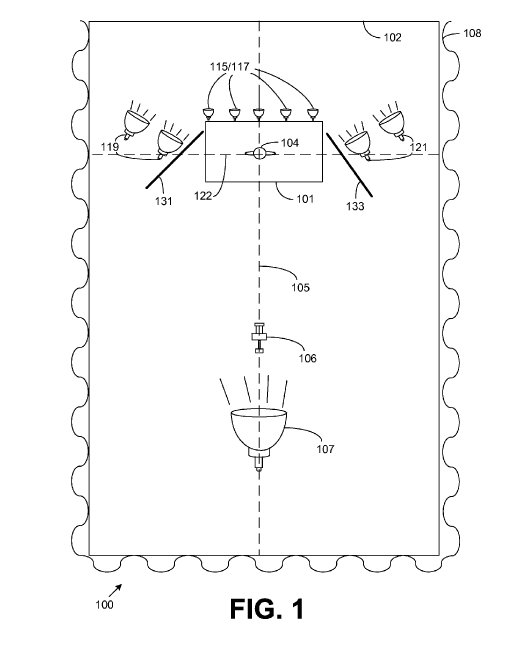
Tirosh wrote that Amazon’s patent “describes the arrangement of elements in the studio to make a product shot—and “even details the F-stop, ISO value and focal length you need to use”:
a background comprising a white cyclorama; a front light source positioned in a longitudinal axis intersecting the background, the longitudinal axis further being substantially perpendicular to a surface of the white cyclorama; an image capture position located between the background and the front light source in the longitudinal axis, the image capture position comprising at least one image capture device equipped with an eighty-five millimeter lens, the at least one image capture device further configured with an ISO setting of about three hundred twenty and an f-stop value of about 5.6; …
Tirosh also noted that part of the patent “describes a table and some trivial lighting”:
… an elevated platform positioned between the image capture position and the background in the longitudinal axis, the front light source being directed toward a subject on the elevated platform; a first rear light source aimed at the background and positioned between the elevated platform and the background in the longitudinal axis, the first rear light source positioned below a top surface of the elevated platform and oriented at an upward angle relative to a floor level; a second rear light source aimed at the background and positioned between the elevated platform and the background in the longitudinal axis, the second rear light source positioned above the top surface of the elevated platform and oriented at a downward angle relative to the floor level; a third rear light source aimed at the background and positioned in a lateral axis intersecting the elevated platform and being substantially perpendicular to the longitudinal axis, the third rear light source further positioned adjacent to a side of the elevated platform; and a fourth rear light source aimed at the background and positioned in the lateral axis adjacent to an opposing side of the elevated platform relative to the third rear light source; wherein a top surface of the elevated platform reflects light emanating from the background such that the elevated platform appears white and a rear edge of the elevated platform is substantially imperceptible to the image capture device; and the first rear light source, the second rear light source, the third rear light source, and the fourth rear light source comprise a combined intensity greater than the front light source according to about a 10:3 ratio.
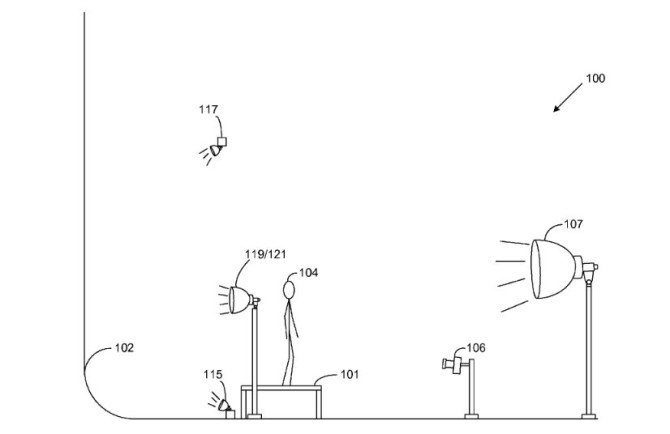
Tim Cushing of TechDirt wrote that Amazon differentiates “its proprietary white-background photo thing from others exactly like it by pointing out that prior art often refers to image retouching, green screens or other forms of image manipulation.” He jokingly remarked that Amazon’s technique “is apparently the purest of the pure, being only the photographer, the photographed object/person, the white background, a number of front lights/back lights and some sort of object separating the subject from the ground below it.”
Tirosh said that he believes that “there is plenty of prior art on this”—and that there is “absolutely no way to enforce it.”
Cushing sarcastically explained how this innovative step-by-step photography method works in practice:
1. Turn back lights on.
2. Turn front lights on.
3. Position thing on platform.
4. Take picture.
Writing for Salon, Andrew Leonard said that studio photographers have been taking pictures of their subjects against white back drops for many years. He added that the “notion that such a thing could be patented strikes many people as inexplicable and bizarre. But that’s also exactly why this particular tidbit exploded so quickly out of the amateur photography blogosphere and into the mainstream tech press.”
Like Tirosh, Leonard said he, too, thinks that this Amazon patent seems “utterly unenforceable, absent an army of inspectors who barge into photography studios across the world patrolling for infringing setups.” He said it also seems “utterly ridiculous.” He questions how Amazon could “know that photographers haven’t already stumbled upon the exact same setup.” Then he asks, “And how, in any rational sense, is this the kind of thing that patent law was originally designed to protect?”
SOURCES
You Can Close The Studio, Amazon Patents Photographing On Seamless White (DIY Photography)
US Patent Office Grants ‘Photography Against A White Background’ Patent To Amazon (TechDirt)
Amazon inexplicably granted patent for common photography flash setup (The Verge)
Taking a photo against a white background? Amazon owns the patent on that (qz.com)
The views expressed in this posting are the author’s alone and not those of the blog, the host, or other weekend bloggers. As an open forum, weekend bloggers post independently without pre-approval or review. Content and any displays or art are solely their decision and responsibility.
I don’t know anything about the patent process. Is a third party allowed to oppose the patent during the process? Is there a requirement for public notice that a party is seeking patent?
Look at it this way. Maybe the granting of this patent is so egregious that it will promote reform. (OK, I admit it. I’m still in bed drinking coffee and haven’t yet been polluted by the morning news.)
There have been a bunch of egregious patents and the system has not changed. Although there are some cases in the pipeline that might do some good.
“I put you all on notice that I have patent pending on what I can summarize as “A method for posting text on an Internet discussion form by pressing fingers on keyboard keys”.”
Yes. but I am claiming copywrite on all words used to inform people of patent infringement and related to filing a law suite against them, so even if you have the patent you can’t make a claim without paying me first.
‘Teach a man to fish and he eats for a lifetime, teach a man intellectual property and he eats everybody else’s lunch.’
bfm – you cannot claim a copyright if you cannot spell correctly.
Would this mean the end of similar photos on ebay.com? No pun intended, but this is patently absurd. Now the Washington Post, already ethically challenged by association with its educational services company, and a neoconservative redoubt, in support of American foreign policy, and interested in destroying Social Security as we know it on behalf of the oligarchs (all of which can be ascertained by research and an analysis of their articles and opinion pieces) has the benefit of Amazon’s “superior” way of doing business through Jeff Bezos as owner/publisher. Dean Baker, whose articles may be accessed through cepr.net, writes extensively on the distortions, dislocations, and injustices caused by our misuse of intellectual property on behalf of the elite.
I put you all on notice that I have patent pending on what I can summarize as “A method for posting text on an Internet discussion form by pressing fingers on keyboard keys”.
When I was composing the stories about the lost airmen of Buchenwald, I found a number of photos taken by military photographers, but some web pages had the photos watermarked and copyrighted. They wanted a fee to release the photos for online use, and some were selling prints as well.
I have no problem with somebody charging a small fee for going to the trouble of finding and cataloging old photos, but to claim copyright is a stretch of the first order. I did a work-around by continuing my search for photos, and on other web pages I found the same pictures open source with no copyright claimed. Those pictures were taken by military service members on both sides of the conflict, and should be public property. For someone who was not there, did not take the pictures, does not own the pictures, and yet has the nerve to copyright them is the height of hubris.
Discography, your comments has been deleted for violation of the civility rule.
This One Page Could End The Copyright War Over ‘Happy Birthday’
by Jacob Goldstein
June 17, 2013
http://www.npr.org/blogs/money/2013/06/17/192676099/this-one-page-could-end-the-copyright-war-over-happy-birthday
Excerpt:
The birthday song — Happy birthday to you, happy birthday to you, etc. — is still under copyright protection. If you want to sing the song on TV, or in a restaurant, or whatever, you have to pay a licensing fee to Warner/Chappell, the music company that owns the rights. The company makes about $2 million a year off the song, according to .
A lawsuit filed in federal court last week seeks to change that. The complaint () argues that the copyright to the song, if it ever existed at all, “expired no later than 1921.” Warner/Chappell hasn’t responded to the suit yet; I left them a message this morning asking for comment, but I haven’t heard back.
The story of the song is long and weirdly complex. The short version is: A pair of sisters published a song called “Good Morning to You” in 1893. Over the next few decades, the song morphed into “Happy Birthday to You.” In the 1920s and ’30s, a couple versions of the birthday song were published in copyrighted songbooks.
But Happy Birthday to You was in wide circulation for years before it was published and copyrighted, and it’s not clear who wrote that version of the song, according to Mark Rifkin, one of the lawyers who filed the suit. (The plaintiff is a filmmaker who’s making a documentary about the song.)
The complaint goes through the history of the song in excruciating detail. One key detail: The complaint says the lyrics were published by the Board of Sunday Schools of the Methodist Episcopal Church in a 1911 book, long before copyrighted versions of the song appeared.
allanbazar sez: “Next thing some clowns will copyright “Happy Birthday”!”
*******************************
I couldn’t tell if you were joking or not, but IIRC, that has been done. 🙁
Addendum, I forgot to include a few words in my prior posting,
Sorry about that.
The addendum:
Within the realm of honest science, what is a “false fact”?
Does the field of science jeopardize false facts which have been established through long-standing social reality construction traditions?
Does such a question infringe on the Constitutional rights of pseudo-science?
From the Salon article that I used as a source:
“Amazon is notorious for ratcheting up the patent wars online when it sought and won a patent in 1999 for one-click buying. At last count, the company boasts 1263 patents, (which is a lot more than the paltry 50 claimed by its retailing competitor Walmart, but not even in the league of technology giants like Samsung and IBM and Intel.)”
http://www.salon.com/2014/05/09/amazons_ridiculous_photography_patent_makes_mark_cuban_happy/
Given that the patent apparently specifies an ISO setting of about three hundred twenty, infringement can clearly be avoided by not using an ISO setting of about three hundred twenty. I suggest avoiding infringement through using an ISO setting of about three hundred twenty one or more, or using an ISO setting of about two hundred ninety nine or less.
Given that the words of the patent quoted here do not specify numerically the numerical value of “about”, I suggest using the physics laboratory workbook written by Frank Verbrugge, once upon a time a Carleton College physics professor, and, after departing from Carleton, a University of Minnesota physics professor.
Verbrugge posited that a scale can accurately be read to one half a scale division. Since the value of the ISO setting specified in the patent, as I know of it, is given to the accuracy of one ISO unit, the ISO value of the patent is clearly, in number form, “320 plus or minus 0.5 ISO units,” in accord with long established physical measurement principles.
Wow! Science is beautiful!
Valid scientific understanding is simply not a matter of mere opinion, and is of observable, measurable, verifiable, refutable-if-false, fact?
hand = hands
The patent office is over used and they clearly have too much time on their hand. Next budget, less money for them.
Time to ditch the patent system once and for all.
Amazon like all corporations– stealing what they can with government help. If true this parent is ridiculous and probably unenforceable in the world of law but if they decide to sue someone they wil ruin them regardless of the enforceability of this patent because to be determined unenforceable AMAZON will go all the way to SCOTUS. We know how SCOTUS loves coprations and thinks the law is well at least for corporations just a bunch of silly rules.
As soon as the patent office ignored the limitations on what could be patented, that is, it allowed patents on things and processes found in nature patents became anti competition devices that corporations wield as both shield and sword.
Next thing some clowns will copyright “Happy Birthday”!
A thought:
Amazon has been the victim of a lot of patent trolls, ones who have managed to get the USPO to award clearly invalid patents, which Amazon then had to fight to get invalidated.
Perhaps Amazon is getting ahead of the curve. Now no one can patent how they take product photos & come after them.
This is an amazing story of how a government agency could have the audacity to make a mistake. Of course, no corporation could possibly make a mistake or a bad decision. Amazon should be ashamed of themselves and the people responsible on approving this alleged patent should be looking for a new job.
Tim, For many of the people here, billionaires and their companies are evil and greedy. There are maybe a few exceptions. So, hatin’ on Amazon and Bezos is consistent. However, these same folks love govt. and believe it can solve all our problems. So, them being angry @ a govt. agency is the newsworthy story here. It’s tangential, just interesting to me.
I would have thought that you could get a patent on a device , but I would not have thought you could, or would have to, get one on some method of using a device. I expect we have not heard the last of this.