 Submitted by Elaine Magliaro, Guest Blogger

There’s been a lot going on in Wisconsin in the past week. I hope most Americans are aware of the reason why so many Wisconsinites have converged on the state capital to hold demonstrations.
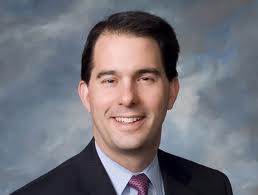
Wisconsin Governor Scott Walker, a Republican, claims that the state is in financial trouble. He’s asking teachers, plow drivers, janitors, nurses, garbage collectors, and other public sector workers to contribute more to their pensions and to pay a larger amount of their health premiums. It appears many of those workers are willing to negotiate with the governor and to consider having more money taken out of their paychecks for their pensions and health insurance. What those employees are not willing to do is relinquish their right to collective bargaining.
I can understand why Governor Walker is asking public employees to have more deductions taken from their paychecks during these fiscally difficult times. What I question is his budget-repair bill that would strip public employees of their right to collective bargaining. If the governor believes that taking away that right will help with the state budget shortfall, why isn’t he demanding that police, firefighters, and state troopers give up their right to collective bargaining too? Could it be political payback? Does that sound like a possibility to you?
Here is an excerpt from an article that Todd Richmond wrote for Bloomberg:
Walker has introduced a bill that would strip public employees across the board — from teachers to snowplow drivers — of their right to collectively bargain for sick leave, vacation, even the hours they work. But absolutely nothing would change for local police, fire departments and the State Patrol.
The bill smacks of political favoritism for public safety unions that supported Walker’s election bid last year and sets up new haves and have-nots in Wisconsin government, said Paul Secunda, a Marquette University professor who specializes in labor law.
“That’s called ‘thank you, I got your back,'” Secunda said. “There’s no surprise there. This is the worst type of favoritism there could be.”
Well, Wisconsin firefighters are showing their solidarity with their fellow public employees. There’s a post at Mother Jones about an interview that Uptake’s Oliver Dykstra had with Mahlon Mitchell, president of the Professional Firefighters of Wisconsin. (Mother Jones also posted a video of the interview.)
Here are some of the highlights of that interview—which I’ve taken from Mother Jones:
- “The reason that we are here is because it’s important that labor sticks together. There was a message from the governor’s office to conquer and divide…collective bargaining is not just for us, police and fire, it’s good for all involved. It’s a middle-class upbringing.”
- “When firefighters see an emergency, one thing we do is respond. And we see an emergency in the house of labor, so that’s why we’re here.”
- “Every day, if you notice, we lead the AFSCME employees, the SEIU employees, all the public sector employees into the building, because we are here to fight with them.”
- “Collective bargaining is not about union rights; it’s about rights of workers…We ask Gov. Walker to come back and negotiate with the people, negotiatie with the state workers’ unions, and get things worked out, as opposed to just putting out this bill and we don’t hear from him again.”
- “Us as firefighters, we have been exempted from this bill…There’s a 5.8 percent pay into the pension, there’s a 12.4 percent pay into the health care premium benefits…For the betterment of the government, for the betterment of the state, we don’t mind helping to pay for that. We don’t want to price ourselves out of a job. Ever. What we want to do is have a fair and equitable treatment among our members.”
I have great respect for the Wisconsin firefighters who are supporting their fellow public employees—even though they have nothing to gain politically or financially by doing so.
“We must, indeed, all hang together, or most assuredly we shall all hang separately.” ~Benjamin Franklin
Sources
The Beast’s Ian Murphy—pretending to be David Koch-prank calls Gov. Scott Walker of Wisconsin. I think this is for real. It sure sounds like Scott Walker’s voice.
[youtube=http://www.youtube.com/watch?v=WBnSv3a6Nh4&w=480&h=390]
Go to this link for part 2 of the telephone conversation:
http://www.buffalobeast.com/?p=5045
Blouise,
” threat level orange or red?”
I’ve posted this in the past but it does deserve reposting:
http://comedians.jokes.com/lewis-black/videos/lewis-black—homeland-security
Sam,
“For example business is conducted in the statehouse, why should protesters be allowed to create an atmosphere where people cannot or will not come to do legitimate business?”
Yes, but aren’t they supposed to be doing the people’s business? And, are the protestors not Wisconsin people?
Sam in Sheboygan
1, February 23, 2011 at 10:15 am
Elaine M:
Because they can bring the government to its knees. Which would inconvenience the rest of us. Which is not right. bit of an overstatement there … threat level orange or red?
People have the right to protest but they do not have the right to infringe the rights of other people during their protest. For example business is conducted in the statehouse, why should protesters be allowed to create an atmosphere where people cannot or will not come to do legitimate business? everybody was locked out of the Statehouse in Ohio … not by the protesters but by the Republicans … well, almost everybody (heh, heh)
It is a violation of the rights of citizens to be shut out of the capital. Just as it is a violation of the rights of motorists to have a street(s) shut down during rush hour by protesters to prevent them from going home or to after work activities. what about the St. Patty’s Day parade, the Doo Duh Parade, the Ohio State Marching Band, the Fair? The list of inconveniences to the citizens of Columbus just goes on and on but hey, let’s criticize those lousy Union people!
Sam,
“People have the right to protest but they do not have the right to infringe the rights of other people during their protest. For example business is conducted in the statehouse, why should protesters be allowed to create an atmosphere where people cannot or will not come to do legitimate business?”
The governor of Wisconsin could have resolved the problem easily and all the demonstrators/protesters would have gone home. All Walker had to do was agree to let the unions keep their right to bargain collectively. The unions have already made the monetary concessions that Walker said were necessary to keep the state from having a budget shortfall. Walker is intransigent on the issue of collective bargaining. He got what he SAID he wanted from the unions–but he still refuses to compromise. This kind of behavior absolutely smacks of union busting, in my opinion.
Sam,
What Mike S. said. No matter how “worth a shit” you think you are? You are infinitely replaceable to most employers. A tool to be used and discarded at whim.
[youtube=http://www.youtube.com/watch?v=-u07oXPKefQ&w=480&h=390]
Mike Spindell:
“Most employers are interested in their bottom line and as in the case of Circuit City, they fired their best talent to raise profits and the next year were out of business.”
I guess they didnt care enough about their bottom line. Maybe now other companies will learn a lesson.
Although for whatever reason, I never liked Circuit City.
From The Boston Globe (2/23/2011)
Scapegoats in Wisconsin
Why is the middle class demonized when Wall Street is the problem?
By Mark Erlich
http://www.boston.com/bostonglobe/editorial_opinion/oped/articles/2011/02/23/scapegoats_in_wisconsin/
(Note: Mark Erlich is executive secretary-treasurer of the New England Regional Council of Carpenters.)
Excerpt:
WE ARE in the third winter of the recession; 26 million Americans are out of work, cannot find full-time work, or have given up looking for work, and $11 trillion in household wealth has vanished.
As winter turns to spring, there is an evolving perspective on the crisis, shifting from an attempt to identify the causes to blaming the victims.
Congress is aggressively looking to eliminate regulatory excesses that are presumably hindering economic recovery only weeks after the Financial Crisis Inquiry Commission, appointed by Congress in 2009, issued a report concluding that the crash was caused by 30 years of deregulation, the stripping of key safeguards, and an overly optimistic reliance on self-regulation by large financial institutions. If the Republican approach were part of a homicide investigation, it would be as if the detectives had removed the smoking guns from the perpetrators’ hands and arrested the corpses.
Wisconsin is only the most dramatic site of a broader strategy of absolving Wall Street and scapegoating public employees and their unions. While there are legitimate and critical public policy issues about education reform, spiraling health costs, and pension liabilities at a time of state and municipal budget deficits, why is the fault laid at the feet of teachers, police, and firefighters? Today’s pension obligations are the product of massive investment losses, not excessively generous public pensions that, in fact, average about $19,000 a year. For that matter, a 2010 Economic Policy Institute study showed that, controlled for educational achievement, public sector workers actually earn less than their private sector counterparts.
With corporate profits at record levels, strong bank balance sheets, along with the return of large compensation packages in the financial sector, the commission’s reminder that the continuing devastation of the crisis was entirely avoidable is worth remembering. It was not the invisible hand of the free market but rather “the result of human action and inaction,’’ a reckless environment in which the five major investment banks had leverage ratios (assets protected by capital) as high as 40 to 1.
For a brief moment after the economy fell off the cliff, the excesses of financial manipulations put broader social and economic questions back on the table. Why, for example, does the United States rank 31st out of the world’s 33 most advanced economies in terms of income inequality, more unequal than Third World countries such as Guyana, Nicaragua, and Venezuela? Why, according to the Census Bureau, has inequality increased by 22 percent, and why have the wealthiest 5 percent expanded their share of total income by 32 percent since 1980? And why, during the same period, has average family income climbed less than 1 percent a year, especially when there are far more two-income earners in most families?
Elaine M:
Because they can bring the government to its knees. Which would inconvenience the rest of us. Which is not right.
People have the right to protest but they do not have the right to infringe the rights of other people during their protest. For example business is conducted in the statehouse, why should protesters be allowed to create an atmosphere where people cannot or will not come to do legitimate business?
It is a violation of the rights of citizens to be shut out of the capital. Just as it is a violation of the rights of motorists to have a street(s) shut down during rush hour by protesters to prevent them from going home or to after work activities.
Blouise,
Your road trip inspired me and reminded me once again of what a blessing it is to have people like you hanging out here. Not only did it remind me of days past, but filled me with hope for the future.
““If you hear of a private sector company trying to prevent workers from collectively bargaining let me know and I will join you on the barricades.” (Sam) … Walmart?”
Whole Foods?
“I think government employees should be treated fairly but they should not have the ability to shut down a sector(s) because they think they need more money or don’t have enough holidays, etc.”
Sam,
Civil Servants get paid far less then people in private industry. When I left my work for NYC, the Commissioner (think CEO) of my agency, that had 20,000 employees and a 10 Billion dollar budget, got paid $143,000 per year. If he got paid that, what do you think the rest of us got. In the multi-national that my wife worked for an average salesman made $150,00 per year. As an analogy (in military terms) when I left I was the equivalent of a Lt. Colonel.
I never made more than $75,000 per year (that was in my last 3 years) and before retirement I had over 300 people working for me. Since I was an executive my bargaining options were limited, yet compared to the other workers I was doing well. Since my pay was based on what the Unions of lower titles got through collective bargaining, the pot wasn’t exactly overflowing for jobs that were as hard, or in many cases harder than the private sector. Without collective bargaining things would have been much
worse because politicians used abuse of civil service as a way to curry favorwith their constituents. Civil Service was made ascapegoat despite the fact thatour administrative costs of operation were tiny when compared to the private sector.
This was with strong unions in place, if it were no unions and no collective bargaining Civil Service would have been destroyed and employment and promotions would beup tothe politicians taking care of their supporters. Next door to NYC in Nassau County, which had been controlled for six decades by Republicans a Civil Servant was openly required to contribute to the party both for jobs and advancement.
Now as to your own situation I take it that you are very good at your job. Ihope though that you are fairly young, because across this country people in their late 40’s and skilled at what they do are replaced continually by younger people willing to work for half the salary. What seems secure to you now, might not be so secure next month. Most employers are interested in their bottom line and as in the case of Circuit City, they fired their best talent to raise profits and the next year were out of business.
In the end though, if you have read through this entire thread and read the facts posted mainly by others (expressing themselves more clearly and thoroughly than I) and still feel as you do, I’m certainly not going to convince you. I just hope for your sake that you never have to face up to the reality that has hit so many people, which is that as good as they are, most employers see them only as replaceable tools and not as people.
Blouise,
“I could have gone to Cleveland where Obama was speaking but then I would have had to be … well, you know … polite.”
LOL – manners are overrated in times like these 😉
—————————————————————
Sam,
Without unions, you wouldn’t have been able to negotiate such generous terms with your employer. And, not everyone has employers as generous as you.
You know the saying that, “It takes a village to raise a child?” Well, sometimes it takes a village to ensure that all members of the village are treated fairly.
Sam,
You wrote of collective bargaining: “I am merely saying that I am not sure if government employees should have the same right to do so.”
Why do you think that public employees should not have the right to bargain collectively as people in the private sector do?
Sam,
Uh huh
Blousie:
I take February off, it is slow at the shop. So next week I will be gone.
But this has been very interesting.
Thank you.
“If you hear of a private sector company trying to prevent workers from collectively bargaining let me know and I will join you on the barricades.” (Sam) … Walmart?
Get to work, Sam, you’re cheating your employer spending all this time playing on your computer.
Elaine M:
I am not saying unions don’t have a place in society, they do. People should be free to engage in collective bargaining in the private sector, it is their right to do so. And can be a good way to “encourage” management to treat workers with decency and respect. Any private company which tries to prevent people from collective bargaining is not one I would want to work for. But at the same time I don’t think people should have to join a union to get a job or pay union dues to support political causes they disagree with.
I am merely saying that I am not sure if government employees should have the same right to do so. I have seen much emotion but really no one has put forth a compelling reason other than “that is how it should be or has to be.”
If you hear of a private sector company trying to prevent workers from collectively bargaining let me know and I will join you on the barricades.
Sam,
It’s 9:30 in the morning … why aren’t you working?
“it just seems to me there is something wrong with government employees having the ability to collectively bargain. And I have not seen a proper justification written here for collective bargaining. … What do they need to bargain for? They receive cost of living raises (at least during good times) and have a certain number of days off and a certain number of sick days and health care and retirement.”(Sam) The juxtaposition of those two statements is truly funny … he questions the need for collective bargaining and then mentions benefits obtained through the collective bargaining process.
“I understand collective bargaining, but maybe people who actually work hard and are worth a shit dont need collective bargaining. I hope that isnt to “obtuse” for you.” (Sam) .. and who do you work for again?