-Submitted by David Drumm (Nal), Guest Blogger
 The Supreme Court will soon hear arguments on the affirmative action case of Fisher v. University of Texas at Austin. Opponents of affirmative action claim that the process is inherently unfair: a non-white student gains admittance over a more qualified white student. That certainly seems unfair.
A key question in verifying the unfairness of affirmative action is an objective measure of each student’s qualifications.
A recent study helps to shed some light on the objectivity of determining qualifications. While the study involved the question of gender disparity in academic science, its results apply to other areas of qualification determination.
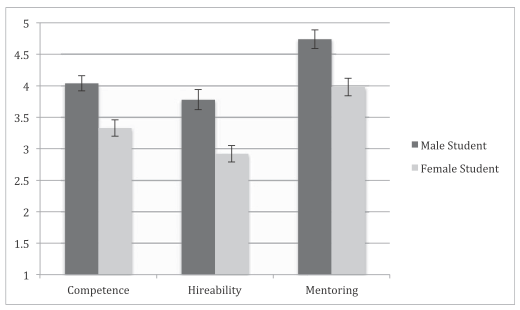 The randomized double-blind study took two identical resumes except that one was labeled as from a candidate named John and the other from a candidate named Jennifer. Faculty members studied the resumes and reported on the applicant’s qualifications. The results of the study are shown in the graph at the right. An amazing finding was:
It is noteworthy that female faculty members were just as likely as their male colleagues to favor the male student.
The study shows that cultural stereotyping can effect the perceived qualifications. A female, looking to make a career in a scientific field, has had to deal with stereotyping throughout her school years.
It is not unreasonable to conclude that cultural biases exist throughout the classrooms of America and that these biases can lead to lower performance scores. An objective measure of a student’s qualifications for university admittance should include any relevant biases that might impact high school grades and SAT scores.
H/T: Caroline Mala Corbin.
The answer to the athletes who are not academically qualified is simple, but will never happen. Major League baseball has a farm system. If a baseball player is not academically qualified or inclined he can sign a professional contract and work his way up from A to AA to AAA, then the Majors. If he is academically inclined there are many schools w/ great baseball programs, almost all in nice climates. This is why you never see scandals invloving recruiting or academic cheating w/ university baseball programs. The athlete has a choice The NBA and NFL will never expend the revenue for a farm system. They have the NCAA. Kids are chattel in universities, earning huge sums for their university. The basketball and football athletes coming out of high school have no real choice, they almost have to go to school, whether they should or not.
Another excerpt from the NYT article:
I think Amherst has created a model for attracting talented low- and middle-income students that other colleges can copy. It borrows, in part, from the University of California, which is by far the most economically diverse top university system in the country. But before we get to the details, I want to address a question that often comes up in this discussion:
Does more economic diversity necessarily mean lower admissions standards?
No, it does not.
The truth is that many of the most capable low- and middle-income students attend community colleges or less selective four-year colleges close to their home. Doing so makes them less likely to graduate from college at all, research has shown. Incredibly, only 44 percent of low-income high school seniors with high standardized test scores enroll in a four-year college, according to a Century Foundation report — compared with about 50 percent of high-income seniors who have average test scores.
“The extent of wasted human capital,” wrote the report’s authors, Anthony P. Carnevale and Jeff Strohl, “is phenomenal.”
This comparison understates the problem, too, because SAT scores are hardly a pure measure of merit. Well-off students often receive SAT coaching and take the test more than once, Mr. Marx notes, and top colleges reward them for doing both. Colleges also reward students for overseas travel and elaborate community service projects. “Colleges don’t recognize, in the same way, if you work at the neighborhood 7-Eleven to support your family,” he adds.
http://www.nytimes.com/2011/05/25/business/economy/25leonhardt.html?adxnnl=1&pagewanted=1&adxnnlx=1349629949-3jfNCAYOR1BqPXUjr19HlQ
What Frankly, rcampbell and Elaine said. If you are an athlete at most Div. 1 schools, as long as your SAt/ACT scores and core grades are at the minimum, you are accepted if the coach wants your athletic services. There are exceptions, but even at the Dukes and the Stanfords there are athletes that would normally not have a chance of being admitted except for their athletic abilities.
Great articel David!
Top Colleges, Largely for the Elite
By DAVID LEONHARDT
Published: May 24, 2011
http://www.nytimes.com/2011/05/25/business/economy/25leonhardt.html?adxnnl=1&pagewanted=1&adxnnlx=1349629949-3jfNCAYOR1BqPXUjr19HlQ
Excerpt:
The last four presidents of the United States each attended a highly selective college. All nine Supreme Court justices did, too, as did the chief executives of General Electric (Dartmouth), Goldman Sachs (Harvard), Wal-Mart (Georgia Tech), Exxon Mobil (Texas) and Google (Michigan).
Like it or not, these colleges have outsize influence on American society. So their admissions policies don’t matter just to high school seniors; they’re a matter of national interest.
More than seven years ago, a 44-year-old political scientist named Anthony Marx became the president of Amherst College, in western Massachusetts, and set out to change its admissions policies. Mr. Marx argued that elite colleges were neither as good nor as meritocratic as they could be, because they mostly overlooked lower-income students.
For all of the other ways that top colleges had become diverse, their student bodies remained shockingly affluent. At the University of Michigan, more entering freshmen in 2003 came from families earning at least $200,000 a year than came from the entire bottom half of the income distribution. At some private colleges, the numbers were even more extreme.
In his 2003 inaugural address, Mr. Marx — quoting from a speech President John F. Kennedy had given at Amherst — asked, “What good is a private college unless it is serving a great national purpose?”
On Sunday, Mr. Marx presided over his final Amherst graduation. This summer, he will become head of the New York Public Library. And he can point to some impressive successes at Amherst.
More than 22 percent of students now receive federal Pell Grants (a rough approximation of how many are in the bottom half of the nation’s income distribution). In 2005, only 13 percent did. Over the same period, other elite colleges have also been doing more to recruit low- and middle-income students, and they have made some progress.
It is tempting, then, to point to all these changes and proclaim that elite higher education is at long last a meritocracy. But Mr. Marx doesn’t buy it. If anything, he worries, the progress has the potential to distract people from how troubling the situation remains.
When we spoke recently, he mentioned a Georgetown University study of the class of 2010 at the country’s 193 most selective colleges. As entering freshmen, only 15 percent of students came from the bottom half of the income distribution. Sixty-seven percent came from the highest-earning fourth of the distribution. These statistics mean that on many campuses affluent students outnumber middle-class students.
“We claim to be part of the American dream and of a system based on merit and opportunity and talent,” Mr. Marx says. “Yet if at the top places, two-thirds of the students come from the top quartile and only 5 percent come from the bottom quartile, then we are actually part of the problem of the growing economic divide rather than part of the solution.”
rcampbell,
And how about students accepted for their prowess in sports?
When “Legacy” admissions are outlawed then Affirmative Action can be done away with. Not until then.
OS – the bigger picture is that all the applicants will fall in on a bell curve. It is simple work to pick out the top and bottom 10%. You are still left with the middle 80%. But to date nobody has identified a set of criteria that guarantee success at college. We know that SAT and ACT are biased but nobody has figured out why women and blacks out perform the test & white males under perform what the tests suggest. It might have to do with commitment but who knows, and why would women and black students be more committed that their white male counterparts?
College admissions are a crap shoot and my guess is the number of kids actually harmed by affirmative action in miniscule, particularly when compared to the benefit it has provided to kids whos ancestors were systematically excluded. But then, as a guy who didn’t finish a degree, I believe too much weight is given to the school you graduated from. HR departments are lazy and unable to identify real winners also so they fall back of simple gimmicks.
OS,
General Admission at the University…. Of Texas is color, age, race blind…. They take the top 10% of any high school student.. Once you get into grad school or law school at Texas….. It’s race, Sex qualification gets extra points…. And it’s not who you know……
The president of the University could not even get the dean of the law school to allow his nephew admission….. I think the pay back was the marching bands practice field was placed next to the law school…..
Frankly/nick,
They had (have) a form of Affirmative Action for college students based on financial ability. It’s called public student loans and grants and it is a system that has been steadily eroded over the years by pols who want to reserve higher education for the wealthy and by private lenders who want interest income.
Nick – as soon as someone seriously proposes that solution we should look at the proposal to see if it would fit the need. I mentioned that I thought.
I also bet it wouldn’t be long before people were whining about it also.
It seems to me that an admission process that is both color and status blind would be the best ultimate solution. Single criteria such as SAT or ACT scores should only be a single factor, not the controlling factor. How about applicant who has a medium ACT score, but has been involved in civic activities, has been employed, and has other tangible achievements? All identifying information should be removed from the application, including name, age, gender and ethnicity. Also remove any information regarding place of origin, if possible.
How about a kid who has a slightly above average ACT score, but is a member of Mensa and has won several art competitions, speaks three languages, plays several musical instruments and has worked with Hospice? I know this kid. Very well.
affirmative action used to include asian students, but statics showed they didn’t need it. maybe they just studied harder?
Frankly, If poverty is such an important factor, and I believe it is, then why not base affirmative action on income levels, not race?
Here’s the problem being ignored above. There are no great predictors for success at college. SAT and ACT claim to be, but the truth is studies have shown that women & minorities do better that their scores indicate and white males do worse. High school grades are also not a reliable predictor.
Poverty, on the other hand, is a very reliable predictor of a delayed start. This nation worked for 400 years to insure that people of color were given little or no opportunity to climb out of poverty. Affirmative Action was meant to try and correct this past failure and it has worked to the extent that a lot of people of color are now struggling in the middle class that would not be there if not for AA. But to expect 40 years of some corrective to overcome 400 years of abuse, as well as the still ingrained racism that we all wish would vanish but quite obviously has not, is unrealistic.
Some colleges still have “legacy admissions” that insure the children and grandchildren of the all white graduating classes of previous generations get extra credit despite their other qualifications and there is no whining about how that is unfair.
As we move forward it might make family income and status rather than color into account but until there is an accurate predictor of college success it will still be a crap shoot as to who gets in and who doesn’t.
Given this courts love of politics over the law I full expect another 5-4 decision ignoring reality and history for a ruling that favors the ruling class.
What about legacy preferences–affirmative action for the rich?
10 Myths About Legacy Preferences in College Admissions
By Richard D. Kahlenberg
9/22/2010
http://chronicle.com/article/10-Myths-About-Legacy/124561/
Excerpt:
Legacy preferences, which provide a leg up in college admissions to applicants who are the offspring of alumni, are employed at almost three-quarters of selective research universities and virtually all elite liberal-arts colleges. Yet legacy preferences have received relatively little public attention, especially when compared with race-based affirmative-action programs, which have given rise to hundreds of books and law-review articles, numerous court decisions, and several state initiatives to ban the practice.
The secrecy surrounding legacy preferences has perpetuated a number of myths, including the following:
1. Legacy preferences are just a “tie breaker” in close calls.
While some colleges and universities try to play down the impact of legacy preferences, calling them “tie breakers,” research from Princeton’s Thomas Espenshade suggests that their weight is significant, on the order of adding 160 SAT points to a candidate’s record (on a scale of 400-1600). Likewise, William Bowen, of the Andrew W. Mellon Foundation, and colleagues found that, within a given SAT-score range, being a legacy increased one’s chances of admission to a selective institution by 19.7 percentage points. That is to say, a given student whose academic record gave her a 40-percent chance of admissions would have nearly a 60-percent chance if she were a legacy.
The children of alumni generally make up 10 to 25 percent of the student body at selective institutions. The proportion varies little from year to year, suggesting “an informal quota system,” says the former Wall Street Journal reporter Daniel Golden. By contrast, at the California Institute of Technology, which does not use legacy preferences, only 1.5 percent of students are children of alumni.
4. After a generation of affirmative action, legacy preferences are finally beginning to help families of color. Pulling the rug out now would hurt minority students.
In fact, legacy preferences continue to disproportionately hurt students of color. John Brittain, a former chief counsel at the Lawyers Committee for Civil Rights, and the attorney Eric Bloom note that underrepresented minorities make up 12.5 percent of the applicant pool at selective colleges and universities but only 6.7 percent of the legacy-applicant pool. At Texas A&M, 321 of the legacy admits in 2002 were white, while only three were black and 25 Hispanic. At Harvard, only 7.6 percent of legacy admits in 2002 were underrepresented minorities, compared with 17.8 percent of all students. At the University of Virginia, 91 percent of early-decision legacy admits in 2002 were white, 1.6 percent black, and 0.5 percent Hispanic.
Moreover, this disparate impact is likely to extend far into the future. In 2008, African-Americans and Latinos made up more than 30 percent of the traditional college-aged population but little more than 10 percent of the enrollees at the U.S. News’s top 50 national universities.
9. Legacy preferences don’t keep nonlegacy applicants out of college entirely. They just reduce the chances of going to a particular selective college, so the stakes are low.
True, legacy preferences don’t bar students from attending college at all. But the benefits of attending a selective institution are substantial. For one thing, wealthy selective colleges tend to spend a great deal more on students’ education. Research finds that the least-selective colleges spend about $12,000 per student annually, compared with $92,000 per student at the most-selective ones. In addition, wealthy selective institutions provide much greater subsidies for families. At the wealthiest 10 percent of institutions, students pay, on average, just 20 cents in fees for every dollar the college spends on them, while at the poorest 10 percent of institutions, students pay 78 cents for every dollar spent on them. Furthermore, selective colleges are better than less-selective institutions at graduating equally qualified students. And future earnings are, on average, 45 percent higher for students who graduated from more-selective institutions than for those from less-selective ones, and the difference in earnings ends up being widest among low-income students. Finally, according to research by the political scientist Thomas Dye, 54 percent of America’s corporate leaders and 42 percent of governmental leaders are graduates of just 12 institutions. For all those reasons, legacy preferences matter.
“It is noteworthy that female faculty members were just as likely as their male colleagues to favor the male student.”
This does not surprise me at all. This is reflected everywhere all the time in every way. In my particular corner of the world of court, I came to fear the actions of a female judge against mothers in custody battles MUCH MORE than a normal garden variety critical male counterpart. Female judges tended to reflexively assume that if the mother was beneath her (the judge) in educational and professional attainments, she was worthless and if she was above her in educational and professional attainments (rare), she was a vindictive b*tch — all without supporting data. One mother in Florida heard this from a woman judge:
“You are obviously intelligent enough to understand the situation here. Even Judge [name of prior judge on the case, a man] kept you on a very short leash. Don’t expect me to give you a longer leash NOW!”
If science is still relevant at universities, then modern genetics should be too.
Experience and behavior change our genetic make up, meaning that the underprivileged majority of the 99% experience a different reality than the 1%, and therefore experience a genetic impact.
That is arguably doing damage to the genetic makeup of the nation, and adds another good reason to practice affirmative action until our genetic damage subsides:
(One Man’s Junk Gene Is Another Man’s Treasure Gene? ). The holy grail of the 1%, handed down from on high by Ayn Rand: Patron Saint of the Plutocracy, is nothing more than a cruel, self-serving illusion.
One of the consequences of affirmative action is that it casts a shadow over minority students, employees, etc. who didn’t need it to succeed. There’s nothing that can be done to eliminate that unfair shadow except to eliminate affirmative action. I truly don’t know the answer, but I’m not going to pretend there’s not a legitimate question.
I think affirmative action has outrun its time in places like Texas that have rules to cull the top 10% for automatic admission into university. I can’t believe Texas is ahead of the curve on anything, but it is smart, fair and bias neutral. The problem with discrimination in college is bigger then any race and gender these days. It is economic and increasingly cost prohibitive and it does not discriminate in who it discriminate against.
wow can’t we just go on someone’s brains or the smarts they have??? why does male…female… color …. any of that come into play… crazy… but that is the world we live in today… how sad…. just saying