-Submitted by David Drumm (Nal), Guest Blogger

 The U.S. Supreme Court held oral arguments (pdf) in Shelby County v. Holder, a case involving Section 5 of the Voting Rights Act. Shelby County, Alabama, is challenging its requirement under Section 5 to get preclearance, from either the United States Attorney General or a three-judge panel of the District Court of the District of Columbia, before making any changes to their voting rules. Oral arguments before the Supreme Court seem to be one-sided with the Justices hammering the attorneys who seem totally unprepared with counter-arguments.
In a statement that drew gasps in the courtroom, J. Scalia called Section 5 a “perpetuation of racial entitlement.” Later, J. Sotomayor asked the attorney for Shelby County: “Do you think the right to vote is a racial entitlement in Section 5?” Although J. Scalia has been the reigning bully of the Supreme Court, some new Justices are more than capable of standing up to him. It is likely, however, that J. Scalia was referring to the use of Section 5 to create African-American (or Hispanic) voting districts to counteract the practice of vote dilution. J. Sotomayor also called Shelby County’s voting law record “the epitome of what caused the passage of this law to start with.”
It is Section 2 of the Voting Rights Act that prohibits the gerrymandering of election districts to dilute minorities’ voting power. Under Section 2, either the United States Department of Justice or private citizens can sue election officials. However, this would be a time-consuming process and the racial gerrymandering would continue unless injunctive relief was granted. Section 5 is a procedural 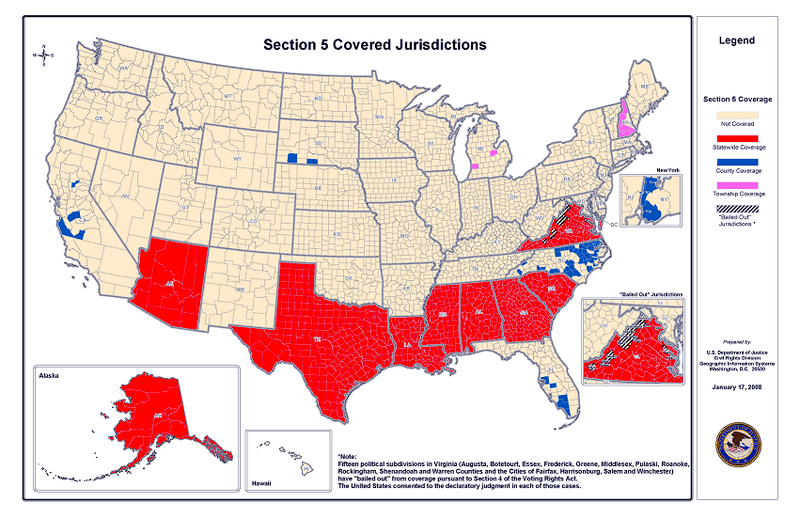 mechanism to stop the discrimination before it occurs, but for only those areas shown on the map. As J. Sotomayor noted: “Section 5 was created was because States were moving faster than litigation permitted to catch the new forms of discriminatory practices that were being developed.”
In League of United Latin American Citizens v. Perry, Chief Justice Roberts wrote that “this divvying us up by race” a “sordid business.” Unfortunately, Chief Justice Roberts wasn’t writing about the racial gerrymandering that leads to vote dilution, he was writing about the racial gerrymandering that maintains minority voting power. Chief Justice Roberts also wrote: “The way to stop discrimination on the basis of race is to stop discriminating on the basis of race.” Racial gerrymandering that leads to vote dilution is discrimination. As Joey Fishkin writes: “The way to stop Congress from discriminating on the basis of race is to stop all this discrimination on the basis of race.”
UCLA con-law professor Adam Winkler notes the irony of originalists J. Scalia and J. Thomas voting against the Voting Rights Act. Prof. Winkler finds broad agreement among legal historians that the Fifteenth Amendment’s express grant of authority to Congress to pass “appropriate legislation” was intended to ensure African-American’s right to vote.
The right to vote is more that allowing voter registration. It is more than casting ballots. It is more than having those ballots counted. It is about equal participation in the political process. Vote dilution has the same effect as not counting minority ballots.
The Court is poised to facilitate the “sordid business” of racial gerrymandering designed to exclude African-American and Hispanic participation in the political process.
H/T: Charles P. Pierce, Adam Serwer, Rick Hasen, Scott Lemieux, Roger Clegg, Adam Serwer.
“believes him to be the “racist” some folks here throw around like a baseball.”
So Nick,
Do you believe calling Scalia a racist is unfair and if so why? Also since I was the first commenter to directly call him a racist, am I among the “some folks” you refer to? Also by mentioning Ruth Bader Ginzburg’s friendship with Scalia was that supposed to be a rebuke to me because she is Jewish? Just some questions about a rather vague comment whose implications you don’t seem willing to own up to.
Then again do you have any Italian friends that call Black people “mulignan’s”?
Now my calling Scalia a racist actually has some currency since he called the Law a ““perpetuation of racial entitlement.”. Of course that also may be your point of view since you repeat over and again here that we all should be color blind and everything will just work out fine. That’s a good message to give those people who suffer from this: http://jonathanturley.org/2011/11/26/the-incarceration-of-black-men-in-america/ . Incidentally, I don’t think your particular problem is racism. Your problem is that you are so entwined in your own political beliefs, that you view everything through that narrow prism and thus miss the forest for the trees.
Dredd, Come on!! Ginsburg is a smart, perceptive, philosophical woman. The fact that the two are GOOD friends says a lot to me about BOTH. Many here could learn a lesson from them. I have little, if any doubt, that Ginsburg would be good friends w/ Scalia if she saw him as the “racist” folks here accuse him of being. Words like “racist” sexist” “homophobe” fly around here like hummingbirds in a flowery meadow.
Justice Antonin Scalia raises racism’s ugly head
July 8, 2012
By: Thomas Mangan
http://www.examiner.com/article/justice-antonin-scalia-raises-racism-s-ugly-head
nick spinelli 1, March 2, 2013 at 12:24 pm
I wonder if Nino’s good friend, Ruth Bader Ginsburg, believes him to be the “racist” some folks here throw around like a baseball.
=============================================
I think it depends on whether or not she is listening to what he is saying.
I wonder if Nino’s good friend, Ruth Bader Ginsburg, believes him to be the “racist” some folks here throw around like a baseball.
raf,
Political terrorism is the perfect descriptive phrase!
Blouise,
You are correct. This attack on the voting rights act protections along with the nationwide attack on the right to vote and the attempts to steal electoral college votes is political terrorism. The rabble cannot be allowed to vote because the wealthy and the corporations know better.
Scalia has been a whore for the Elite for his entire career and a racist to boot. No doubt he longs for their approval and acceptance and if he has to be a lapdog to get it he barks like a Chihuahua.
SwM,
Sotomayor is one woman I would like to meet for lunch.
Your daughter is making the most of opportunities that come her way and I suspect this is going to lead to a very fulfilling career that will contribute a great deal to the advancement of our civilization.
http://www.npr.org/blogs/itsallpolitics/2013/03/01/173276943/in-voting-rights-arguments-chief-justice-may-have-misconstrued-census-data?sc=tw
http://tpmdc.talkingpointsmemo.com/2013/02/sotomayor-liberal-justices-defend-voting-rights-act.php “No one was more emphatic than Soromayor”….. Blouise, my daughter recently met Sotomayor in Austin. She found her to very impressive, and I think she is turning out to be a very excellent judicial appointment.
“And a man can’t ride your back unless it’s bent.” (MLK)
This is a back bender move all dressed up for the “we must remain relevant” ball. It was bound to happen given the power from the voting booth that swept Obama into the Oval Office.
It’s a desperate move by desperate people who are counting on their supporters on the bench to “make this happen”.
This move is just as dangerous to the future of our democracy as any terrorist attack.
Chief Justice Roberts’ Long War Against the Voting Rights Act
Roberts has been a critic of the Voting Rights Act for 30 years. Now he will help decide whether the law’s most important section lives or dies.
—By Adam Serwer
Feb. 27, 2013
http://www.motherjones.com/politics/2013/02/john-roberts-long-war-against-voting-rights-act
Excerpt:
When he was in his late 20s, John Roberts was a foot soldier in the Reagan administration’s crusade against the Voting Rights Act. Now, as chief justice of the Supreme Court, he will help determine whether a key part of the law survives a constitutional challenge.
Memos that Roberts wrote as a lawyer in President Reagan’s Justice Department during the 1980s show that he was deeply involved in efforts to curtail the effectiveness of the Voting Rights Act, the hard-won landmark 1965 law that is intended to ensure all Americans can vote. Roberts’ anti-VRA efforts during the 1980s ultimately failed…
A Racial Entitlement? Supreme Court Threatens Voting Rights Act, One of Civil Rights Era’s Key Gains
http://www.democracynow.org/2013/2/28/supreme_court_review_of_voting_rights
Excerpt:
AMY GOODMAN: I want to turn to a clip, going back in history, from a documentary that recently featured King. It’s called A Filmed Record…Montgomery to Memphis. This is President Lyndon Johnson speaking just as he is signing the Voting Rights Act in 1965. Over his shoulder is Dr. Martin Luther King, who speaks next. First, President Johnson.
PRESIDENT LYNDON JOHNSON: Today is a triumph for freedom, as huge as any victory that’s ever been won on any battlefield. This law covers many pages, but the heart of the act is plain. Wherever, by clear and objective standards, states and counties are using regulations or laws or tests to deny the right to vote, then they will be struck down. If it is clear that state officials still intend to discriminate, then federal examiners will be sent in to register all eligible voters. This good Congress, the 89th Congress, acted swiftly in passing this act. And I intend to act with equal dispatch in enforcing this act.
REV. DR. MARTIN LUTHER KING JR.: I think the greatest victory of this period was not in terms of an external factor or an external development, but it was something internal. The real victory was what this period did to the psyche of the black man. And the greatness of this period was that we armed ourselves with dignity and self-respect. The greatness of this period was that we straightened our backs up. And a man can’t ride your back unless it’s bent.
AMY GOODMAN: That was Dr. Martin Luther King and, before him, President Johnson, from King: A Filmed Record…Montgomery to Memphis, the day President Johnson signed the Voting Rights Act. Ari Berman, where does it go from here, as we hear the significance of this moment when this was signed in 1965?
ARI BERMAN: Well, it’s been such a transformative law. It’s often been described as the most consequential law passed in the 20th century and really the high watermark of the civil rights movement. And Section 5 is the heart and soul of the Voting Rights Act. So, if the Supreme Court was to get rid of Section 5 or to significantly narrow it, and we will know this in June when a decision comes down, there really is no substitute for it, and it would be a very devastating setback for voting rights, not just in the places where Section 5 is covered, but there’s a thinking that if Section 5 goes, conservatives are going to start challenging those other provisions of the Voting Rights Act, like Section 2, which applies nationwide. The court has already limited Section 2 in many respects. So, this would kind of be like the Citizens United decision for voting rights. It would open the floodgates to more voter suppression laws, more legal challenges, and it would make it difficult to enforce the voting rights laws that are on the books in addition to Section 5. And so, there really is no substitute, and it would be one of the most radical and consequential decisions made by the court in a very long time.
Martin Bashir | February 28, 2013
Justice Roberts’ long crusade against the Voting Rights Act of 1965
Rep. James Clyburn, D-S.C., discusses whether Justice John Roberts and his conservative majority will correctly “referee” recent arguments about the validity of a key portion of the Voting Rights Act of 1965 – or whether he will continue a decades-long attempt to neuter the law.
http://video.msnbc.msn.com/martin-bashir/50995560/#50995560
Follow
Great job Nal!
The idea that Scalia is controlling the discussion is disgusting. Of course the Voting Rights Act is still necessary. Just look what States are trying to do to all voters to game the election on behalf of Republicans. How do these guys sleep at night? Maybe Congress should pass a bill that requires all states to get permission before voting rights are limited or restricted. Wouldn’t that solve the the Scalia and Roberts crowd claim that we should stop racially discriminating in order to stop racial discrimination if every state and had to get approval under the voting rights act for any change in voting?? Even the laws they are trying to pass to dilute the electoral college votes?
Now that the voting rights act is doomed who thinks it will be very long before corporations start wondering why they cannot vote, after all they are people too. After all this whole thing about limiting voting rights to humans seems to make it a species entitlement doesn’t it? Corporations pay taxes dont they? They generally dont but isnt this taxation without representation?
Its a “sordid business” indeed. The Supreme Corporate Court wrong on the facts, wrong on what used to be the law and the Consitution and well just wrong.
Nal,
Roberts is probably the most prepared justice in regards to the voting rights cases. I think he was Ronnie’s boy years ago that already had already presented some cases and hammered the solicitor general fairly well…. Oh the days of Blackmun, Brennan and Marshall…. They should be deciding this case….