-Submitted by David Drumm (Nal), Guest Blogger

 The U.S. Supreme Court held oral arguments (pdf) in Shelby County v. Holder, a case involving Section 5 of the Voting Rights Act. Shelby County, Alabama, is challenging its requirement under Section 5 to get preclearance, from either the United States Attorney General or a three-judge panel of the District Court of the District of Columbia, before making any changes to their voting rules. Oral arguments before the Supreme Court seem to be one-sided with the Justices hammering the attorneys who seem totally unprepared with counter-arguments.
In a statement that drew gasps in the courtroom, J. Scalia called Section 5 a “perpetuation of racial entitlement.” Later, J. Sotomayor asked the attorney for Shelby County: “Do you think the right to vote is a racial entitlement in Section 5?” Although J. Scalia has been the reigning bully of the Supreme Court, some new Justices are more than capable of standing up to him. It is likely, however, that J. Scalia was referring to the use of Section 5 to create African-American (or Hispanic) voting districts to counteract the practice of vote dilution. J. Sotomayor also called Shelby County’s voting law record “the epitome of what caused the passage of this law to start with.”
It is Section 2 of the Voting Rights Act that prohibits the gerrymandering of election districts to dilute minorities’ voting power. Under Section 2, either the United States Department of Justice or private citizens can sue election officials. However, this would be a time-consuming process and the racial gerrymandering would continue unless injunctive relief was granted. Section 5 is a procedural 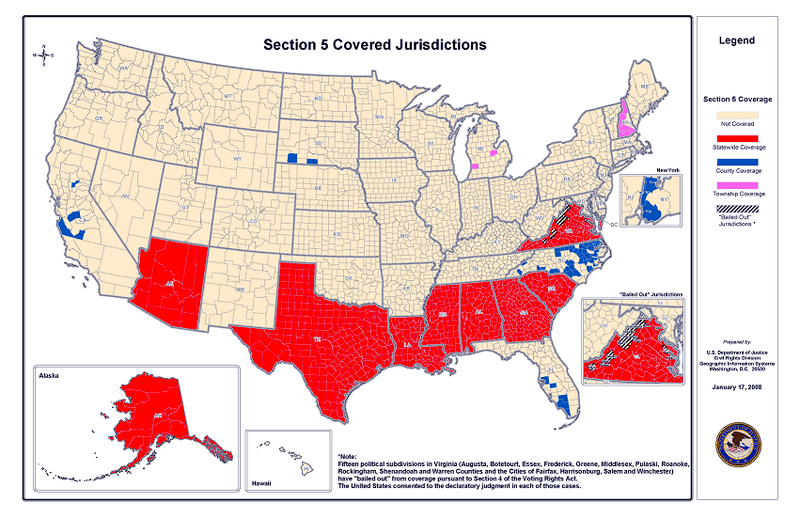 mechanism to stop the discrimination before it occurs, but for only those areas shown on the map. As J. Sotomayor noted: “Section 5 was created was because States were moving faster than litigation permitted to catch the new forms of discriminatory practices that were being developed.”
In League of United Latin American Citizens v. Perry, Chief Justice Roberts wrote that “this divvying us up by race” a “sordid business.” Unfortunately, Chief Justice Roberts wasn’t writing about the racial gerrymandering that leads to vote dilution, he was writing about the racial gerrymandering that maintains minority voting power. Chief Justice Roberts also wrote: “The way to stop discrimination on the basis of race is to stop discriminating on the basis of race.” Racial gerrymandering that leads to vote dilution is discrimination. As Joey Fishkin writes: “The way to stop Congress from discriminating on the basis of race is to stop all this discrimination on the basis of race.”
UCLA con-law professor Adam Winkler notes the irony of originalists J. Scalia and J. Thomas voting against the Voting Rights Act. Prof. Winkler finds broad agreement among legal historians that the Fifteenth Amendment’s express grant of authority to Congress to pass “appropriate legislation” was intended to ensure African-American’s right to vote.
The right to vote is more that allowing voter registration. It is more than casting ballots. It is more than having those ballots counted. It is about equal participation in the political process. Vote dilution has the same effect as not counting minority ballots.
The Court is poised to facilitate the “sordid business” of racial gerrymandering designed to exclude African-American and Hispanic participation in the political process.
H/T: Charles P. Pierce, Adam Serwer, Rick Hasen, Scott Lemieux, Roger Clegg, Adam Serwer.
Elaine, the link/quote at 8:30 is an excellent one.
Massachusetts official challenges Chief Justice Roberts’ claim about voting
Galvin rebukes nation’s top judge
Boston Globe
By Akilah Johnson
February 28, 2013
http://www.boston.com/news/local/massachusetts/2013/03/01/massachusetts-official-challenges-chief-justice-roberts-claim-about-voting/u8rYN2MVzc3GOdq4cWyYEK/story.html
Excerpts:
Supreme Court Chief Justice John G. Roberts Jr. certainly sounded authoritative when he made a striking, though unflattering, declaration about Massachusetts as the high court heard arguments over the Voting Rights Act of 1965, which is designed to assure equal access across races to polling booths.
“Do you know which state has the worst ratio of white voter turnout to African-American voter turnout?” Roberts asked Donald Verrilli Jr., solicitor general for the Department of Justice, during Wednesday’s arguments.
“I do not know that,” Verrilli answered.
“Massachusetts,” Roberts responded, adding that even Mississippi has a narrower gap.
Roberts later asked if Verrilli knew which state has the greatest disparity in registration. Again, Roberts said it was Massachusetts.
The problem is, Roberts is woefully wrong on those points, according to Massachusetts Secretary of State William F. Galvin, who on Thursday branded Roberts’s assertion a slur and made a declaration of his own. “I’m calling him out,” Galvin said.
Galvin was not alone in his view. Academics and Massachusetts politicians said that Roberts appeared to be misguided. A Supreme Court spokeswoman declined to offer supporting evidence of Roberts’s view, referring a reporter to the court transcript.
On Thursday, Galvin tried to set the record straight. “We have one of the highest voter registrations in the country,” he said, “so this whole effort to make a cheap-shot point at Massachusetts is deceptive.”
*****
Galvin and political scientists speculated that Roberts drew his conclusions using US Census Bureau data known as “The Current Population Survey,” which collects information on voting and registration every other year. Political scientists say this is one of the few national databases, if not the only one, providing state-by-state voting information.
But a review of those census data appears to contradict Roberts, showing such states as Washington, Arizona, and Minnesota with similar if not bigger gaps between black and white voters.
“The concept of black communities in Massachusetts not voting is an old slur, and it’s not true,” Galvin said. “I guess the point [Roberts] is trying to make is Mississippi is doing so much better they don’t need the Voting Rights Act. He can still relay that conclusion, but he shouldn’t be using phony statistics. It’s deceptive, and it’s truly disturbing.”
Antonin Scalia’s uber-activism
Feb 28th 2013
http://www.economist.com/blogs/democracyinamerica/2013/02/voting-rights-act
Excerpt:
WEDNESDAY’S oral argument at the Supreme Court on the constitutionality of Section 5 of the Voting Rights Act of 1965 brought an extraordinary piece of analysis from Justice Antonin Scalia—a comment that drew gasps from the audience. The law’s utility as a shield against voting practices that discriminate based on race, Mr Scalia suggested, had evaporated. He argued that requiring nine Southern states and sections of seven others, all with a history of discrimination, to “pre-clear” changes to voting procedures with the Justice Department is now needless interference with “state sovereignty”.
Analysing the most recent reauthorisation of the act in 2006, Mr Scalia explained away its lopsided support in the Senate (98-0) and House of Representatives (390-33):
And this last enactment, not a single vote in the Senate against it. And the House is pretty much the same….I think it is attributable, very likely attributable, to a phenomenon that is called perpetuation of racial entitlement. It’s been written about. Whenever a society adopts racial entitlements, it is very difficult to get out of them through the normal political processes.
After his comment caused a minor stir in the courtroom, Mr Scalia added:
I don’t think there is anything to be gained by any Senator to vote against continuation of this act. And I am fairly confident it will be reenacted in perpetuity unless—unless a court can say it does not comport with the Constitution… [T]his is not the kind of a question you can leave to Congress….Even the name of it is wonderful: The Voting Rights Act. Who is going to vote against that in the future?
This is not Mr Scalia’s first impolitic outburst. But for a justice who stakes his jurisprudence on deferring to the democratically elected branches of government, it is a stunning line of reasoning. Consider, by comparison, Mr Scalia’s endorsement of Justice Benjamin Cordozo’s 1933 statement decrying judicial second-guessing of legislative acts:
We do not pause to consider whether a statute differently conceived and framed would yield results more consonant with fairness and reason. We take the statute as we find it.
And recall Mr Scalia’s claim in the 1990 euthanasia case Cruzan v Missouri that it is not for judges to decide when a patient’s life is “worthless”, but “it is up to the citizens of Missouri to decide, through their elected representatives, whether that wish [to end a life] will be honored.”
So why not let the people’s elected representatives handle the matter of racial discrimination and voting? Why, in this case, does Mr Scalia believe he should substitute his views for those of legislators? Members of Congress, after all, considered 12,000 pages worth of testimony in 2006, which showed “pervasive discrimination” in the covered districts. As Justice Elena Kagan said yesterday to Burt Rein, the attorney for the petitioner, “that’s a big, new power that you are giving us…the power now to decide whether racial discrimination has been solved. I did not think that that fell within our bailiwick.”
For a justice who sniffs out closet activism even in his fellow conservative justices—in 2007 he criticised Chief Justice John Roberts for exercising “faux judicial restraint”—Mr Scalia apparently finds the Voting Rights Act to be a uniquely egregious specimen of legislative incompetence. While Mr Scalia has voted to overturn congressional laws from time to time, such as in City of Boerne v Flores (which got a brief mention during Wednesday’s argument), never has he couched his judicial activism in such cynical terms. We cannot trust the Congress to legislate earnestly on questions of race, Mr Scalia implied, because senators and representatives feel bound to uphold “racial entitlements” that their forebears have enacted. Political correctness rules.
Justices Scalia And Thomas’s Attendance At Koch Event Sparks Judicial Ethics Debate
By Sam Stein
First Posted: 10/20/10 Updated: 05/25/11
http://www.huffingtonpost.com/2010/10/20/scalia-thomas-koch-industries_n_769843.html
Scalia? I think he’s a smug, pompous a** who believes he’s smarter than everyone else. He doesn’t need to listen to the opinions and rationale of others because he’s always right. He likes the company of mega wealthy businessmen like the Koch brothers. I don’t think he’s the most ethical justice on the Supreme Court.
lottakatz, that’s the article I was referring to. Thanks for finding it.
Raf, “The rabble cannot be allowed to vote because the wealthy and the corporations know better.”
******
Scalia essentially said that about Congress being the author of a law as important as the voting rights act. He’s not only a racist he’s not a fan of democracy IMO:
_______
From transcript:
“I don’t think there is anything to be gained by any Senator to vote against continuation of this act. And I am fairly confident it will be reenacted in perpetuity unless — unless a court can say it does not comport with the Constitution. You have to show, when you are treating different States differently, that there’s a good reason for it.
That’s the — that’s the concern that those of us who — who have some questions about this statute have. It’s — it’s a concern that this is not the kind of a question you can leave to Congress. There are certain districts in the House that are black districts by law just about now. And even the Virginia Senators, they have no interest in voting against this. The State government is not their government, and they are going to lose — they are going to lose votes if they do not reenact the Voting Rights Act.
Even the name of it is wonderful: The Voting Rights Act. Who is going to vote against that in the future?”
______
Right, the really important questions shouldn’t be left up to Congress because they may actually cater to their constituents or vote for the good of the country, ’cause, you know, democracy. BUT, this is a new position for him because in a statement regarding sex discrimination (It’s not prohibited by the 14 Amendment according to our esteemed Justice) all you need is a legislature and ballot box to change the way a state or country does business:
______
“Q. In 1868, when the 39th Congress was debating and ultimately proposing the 14th Amendment, I don’t think anybody would have thought that equal protection applied to sex discrimination, or certainly not to sexual orientation. So does that mean that we’ve gone off in error by applying the 14th Amendment to both?
A. Yes, yes. Sorry, to tell you that. … But, you know, if indeed the current society has come to different views, that’s fine. You do not need the Constitution to reflect the wishes of the current society. Certainly the Constitution does not require discrimination on the basis of sex. The only issue is whether it prohibits it. It doesn’t. Nobody ever thought that that’s what it meant. Nobody ever voted for that. If the current society wants to outlaw discrimination by sex, hey we have things called legislatures, and they enact things called laws. You don’t need a constitution to keep things up-to-date. All you need is a legislature and a ballot box. You don’t like the death penalty anymore, that’s fine. You want a right to abortion? There’s nothing in the Constitution about that. But that doesn’t mean you cannot prohibit it. Persuade your fellow citizens it’s a good idea and pass a law. That’s what democracy is all about. It’s not about nine superannuated judges who have been there too long, imposing these demands on society.
_______
Scalia’s arguments are whatever shores up his world view, that they contradict themselves is unimportant. It’s all about how he feels.
http://thinkprogress.org/justice/2013/02/27/1646891/scalia-voting-rights-act-is-perpetuation-of-racial-entitlement/?mobile=nc
http://www.huffingtonpost.com/2011/01/03/scalia-women-discrimination-constitution_n_803813.html
The discussion of this Electoral College has us perplexed. Where is it located and what do the graduates do and what kind of degrees do they receive? We in our group have read up on the “Originalist” thinking of this Scalia guy. What would the Framers have thought about two Italians, one negro, three or is it four women, on this present Court? It is odd that one of the Italians is a trumpet for the Originalists. The “entitlement” word he uses is also odd. One commenter on this blog speaks to he and the other Justices being enttitled to free health care just because they sit on the Court. Not insurance, but health care for life, for Justice and family, in retirement, til death. That is an entitlement. All paid for on the taxpayer’s dime. Inquiry minds want to know.
Justice Holmes, I found this and posted it recently, LOL, it’s just a matter of time:
1, February 23, 2013 at 1:28 pm
Montana legislator introduces bill to give corporations right to vote
http://www.rawstory.com/rs/2013/02/23/montana-legislator-introduces-bill-to-give-corporations-right-to-vote/
Hilarious “map” Darren!
Folks:
I have created for you a map based upon double-secret-probationary information on how our federal elected officials view the United States:
http://www.sagebrush.us/images/politicians-view-of-usa.jpg
SwM,
Like Justice Holmes said on another thread: “We have celebrities but no leaders.”
Scalia courts celebrity.
Justice Holmes 1, March 2, 2013 at 9:28 am
“Now that the voting rights act is doomed who thinks it will be very long before corporations start wondering why they cannot vote, after all they are people too.”
Actually, a bill was presented in a state legislature to do just that. The bill probably won’t make it out of committee, but the move has started. The article came out in the last week or so. I can’t find it now, but it I do, I’ll post it.
“Rachel Maddow had some choice words for Supreme Court Justice Antonin Scalia during an appearance on Thursday’s “Daily Show.”
Maddow told Jon Stewart that she had been flabbergasted to be watching Scalia and his fellow conservative justices lambasting the Voting Rights Act at the same time as a statue honoring Rosa Parks was being unveiled at the Capitol Building nearby. She particularly took umbrage at Scalia’s line that the law was a “perpetuation of racial entitlement,” comparing him to an Internet “troll”:
“He’s a troll. He’s saying this for effect. He knows it’s offensive and he knows he’s going to get a gasp from the courtroom, which he got, and he loves it. He’s like the guy on your blog comment thread who is using the n-word. ‘Oh, it made you mad? How about if I say this? Does it make you mad? Did it make you mad? Did it make you mad?’ He’s that guy! He’s that kind of guy! When we’re all shocked that he said something so blatantly racially offensive while talking about the cornerstone of the federal Civil Rights Act, he’s thinking, ‘Oh yeah!'” Huffington Post
So Mr. Spindell calls J. Scalia a racist and then asserts that Mr. Spinelli must prove the Justice is not one? Wow.
“So Mr. Spindell calls J. Scalia a racist and then asserts that Mr. Spinelli must prove the Justice is not one? Wow.”
Mahtso,
As usual you mis-characterize rather than read. I am asserting that Scalia is a racist and offering his statement as proof. I am not stating Nick “must” do anything at all, but I do reject that Ginsburg being “friends” with Scalia proves anything.
“My hemmorhoids have been acting up lately.”
Nick,
I would suspect your problems if any, have something to do with your ass smoking, or maybe being one.
I’ve been receiving a lot of free psychological evaluations lately. Are there any proctologists on staff here? My hemmorhoids have been acting up lately.
Mike S,
Though I loath Scalia in many ways, I think he is not really as much of a racist…. Thomas on the other hand…. Very much so….
I do however agree with nick on calling a spade a spade…. For some it’s ok to use flowery language while others get chastised for the same vernacular….
“It’s not the votes, it’s the manipulation that counts.”
— Random Politician
“I have little, if any doubt, that Ginsburg would be good friends w/ Scalia if she saw him as the “racist” folks here accuse him of being.”
Nick,
As usual the evidence you present to back up your views is silly and childish.