By Mark Esposito, Weekend Blogger
 Can religious beliefs actually retard our intuitions for justice and fairness? Research seems to suggest it might well. The Christian religion has imbued Western thought with the fundamental belief that God presides over a just world – one where sin is punished and rightly-held beliefs and actions are rewarded. We see this attitude in every aspect of human interaction. Today, in some sparkling sports stadium an earnest athlete is bound to thank his deity of choice for the good fortunes that befell his team or his game changing performance. By extension, the loser ( a value loaded word if ever there was one) will decry his lack of luck. From the Book of Job to Pinocchio and Cinderella, this belief in what some psychologists call “immanent justice” or “The Just Word Hypothesis” seeks to explain our plight and our success. It also hardens our attitudes about the poor, victims of crimes and those folks either buoyed or sunk by pure chance.
The Book of Job gets us into the mindset. A saintly man if ever there was one as the Bible itself acknowledges, God allows Satan to test Job with all manner of suffering to determine his worthiness. Stripped of his wealth, prestige and power, Job then loses his children and ultimately his health and vigor. Still, Job endures and never ever curses his fate – or his God. He does consult his friends for some inkling as to the cause of his travails. Their answer, which comes like a thunderclap is: “Behold,” one of them declares, “God will not cast away an innocent man, neither will he uphold evildoers” (Job 8:20). Classic “Blame the Victim” mentality from this coterie of advisers.
Puzzled but resolute, Job however concludes that despite his worldly righteousness, he can never know divine justice and according to the story prostrates himself silent before his Master’s “Just World.’ For that, he is rewarded with the resumption of his wealth and status. He even replaces his children with seven new ones. The clear message to the world however is the same: God handles the world’s justice and we are powerless to exact our own except on only the most superficial level.
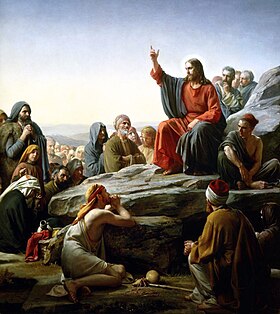
Jesus himself gets in on the act in the New Testament. Addressing the multitude in the Sermon on the Mount, he has two distinct things to say about justice and our expectations of it: Blessed are…..those who hunger and thirst for righteousness: for they will be filled. (Matt. 5:6) and Blessed are those who are persecuted for righteousness’ sake: for theirs is the kingdom of heaven. (Matt. 5:10). In modern speak, “Don’t worry God will handle it in his own way and, if you let him do so, you’ll get the whole enchilada. The pearly gates, the mansions, those singing and harp-playing cherubim … you, my faithful believer, get it all.”
Job and Jesus illustrate the two transcending features of Just World Hypothesis: The world is just and if it isn’t in your opinion, it’s still not your problem. Grin and bear it and you’ll get rewarded. As for your neighbor’s suffering the words of that saying from India keeping ringing through my head, “ The tears of your neighbor are just water.”
The same notion has transcended the ages in everything from fairy tales to modern songs. Pinocchio is punished for his lies by the ever-growing nose. Cinderella is rewarded for her suffering. Not through her own works mind you, but through a deity stand-in –her fairy godmother – who whisks her off into a magical world of wealth and power that her tormenting family can never hope to achieve. In our own times, the belief in a Just World has musical accompaniment. Here’s country music star Craig Morgan telling us the value of suffering and what that our reaction to it should be: “It ain’t nothing,” he sings.
“So what?” you are probably asking. Nothing new here. Well, as author and observer to religion, Sam Harris is wont to remind us “Beliefs have consequences.” And research tells us that beliefs in a Just World promote negative attitudes towards victims and the poor and reinforce undesirable attitudes in those unafflicted including emotional callousness, indifference and victim blaming. In one shocking Florida case cited by researchers Claire Andre and Manuel Velasquez, a 22-year-old rape victim saw her confessed attacker exonerated by jury because according to the foreman “We all feel she asked for it [by] the way she was dressed.” Her provocation to the knife-wielding Georgia drifter who raped her twice? Wearing a white lace miniskirt, a green tank top, and no underwear.
Writing on the Santa Clara University website Ethics Page (here), Andre and Velasquez attempt to explain the phenomenon:
The verdict of the jurors in the Fort Lauderdale rape trial may have been influenced by a widespread tendency to believe that victims of misfortune deserve what happens to them. The need to see victims as the recipients of their just deserts can be explained by what psychologists call the Just World Hypothesis. According to the hypothesis, people have a strong desire or need to believe that the world is an orderly, predictable, and just place, where people get what they deserve.

“Get what they deserve” is a ubiquitous rationalization in all manner of situations but most prominently in cases like the one unfolding in Ferguson, Missouri. “They” is the operative word as those using this corollary to Just World Hypothesis always tend to distance themselves from the plight of the victim. Here’s one observer’s reaction to the gunning down of unarmed teenager Michael Brown by an overly-militarized police mindset. Former Prosecutor and Fox News’ Kimberly Guilfoyle offered this little piece of legal advice for those who want to avoid police shootings: “Don’t go out and commit crimes.” Less that insightful on the topic of carnage in the streets but revealing on the mindset of Just World Hypothesis.
We shouldn’t judge Kimberly too harshly. She has lots of company. In the seminal study published in 1966, psychologist Max Lerner observed student reactions to apparently painful electric shocks inflicted on fellow students. The students watching the agony were given the choice to “reassign” the victims to a “reward condition” – stopping the pain and pay a monetary award for the victims’ troubles. Virtually all of the students “jury” voted to stop the pain and dole out the cash. But things changed dramatically when the student “jury” was told they could do nothing about the plight of the victims except watch. In the latter instance, the attitude toward the victim changed. When asked, the student “jury” rejected the suffering of the victim and suggested that the victim somehow deserved the punishment. Aversion reaction? Maybe. But more likely the “Just World Hypothesis” kicking in.
Zick Rubin of Harvard University and Letitia Anne Peplau of UCLA (here) have taken Werner’s work a step further to analyze the attitudes of the student “jurors.” Their findings, published in Journal of Social Issues in 1975, found subscribers to Just World Hypothesis tend to be religious, authoritarian, conservative and admire social institutions and authority figures. Further, the adherents to Just World Hypothesis harbor negative attitudes toward the underprivileged including the poor. They also tend to “feel less of a need to engage in activities to change society or to alleviate plight of social victims.”
These attitudes also shape the mindset of society’s privileged classes as terrific blogger Michael Spindell has written many times on this blog (here and here). The rich truly do think differently than the rest of us and we culturally reinforce the perception. Science proves it. In an earlier study in 1965, Lerner had deduced that student subjects routinely equated success with virtue. In that study Lerner demonstrated this “perceptual link between reward and virtue. Subjects who learned that a fellow student had been awarded a cash prize as a result of a random drawing were likely to conclude that he had in fact worked especially hard. “
A recent article in Salon illuminates (here). Why do the headlines always remind us that rich people are different – and better. “What The Middle Class Doesn’t Understand About Rich People,” “9 Things Rich People Do Differently Every Day,”“15 Surprising Ways Rich People Think Differently” scream the banners. They are “better” aren’t they? They have to be in a Just World.
Study after study says “no”. Researcher Paul Piff finds those with more modest incomes are more generous, charitable, helpful and give a larger percentage of their disposable income to charitable causes than the wealthy. Other studies find that drivers of luxury cars are more likely to cut you off in traffic than drivers of less expensive models. The wealthy are more likely to endorse lying and cheating than their less well-heeled contemporaries reasoning that they are entitled to do so due to superior intellect or work-ethic. Just World Theory?
Zick Rubin and Letitia Anne Peplau say probably “yes” and the successful are prettier, too (here):
The converse of the tendency to blame the victim also seems to be common: Success is often taken as a sign of virtue. Newspaper features on state lottery winners frequently mention the winner’s hard work, good deeds, and admirable qualities, as if these characteristics helped to account for his or her purchase of the lucky ticket. Recent studies have documented people’s tendencies 68 ZICK RUBIN AND LETITIA ANNE PEP1AU BELIEF IN A JUST WORLD 69 to view physically attractive people as more sensitive, kind, and better-natured than less attractive people (Berscheid & Walster, 1974), suggesting that even the “reward” of beauty is often seen as deserved.
Even more perversely we tend to agree with our haughty, rich friends reasoning it must all happen for a reason and in a Just World its got to be merit and not mere happenstance. We are orderly beings despite what you see in other people’s houses on the next episode of Hoarders and we want to believe that merit makes the world go ’round.
What does all this mean? Seemingly, religious culture and our intuitions for justice are at odds despite the seeming congruity. Conservative attitudes shape perceptions of justice and it takes some doing to overcome the “Blame The Victim” mentality. None of this bodes well for those hoping for a peaceful and just outcome for the Michael Brown case. When coupled with institutional racism, Just World Hypothesis takes on the pernicious role of divider along social-economic, racial, and ideological fissures.
Will we ever accept that we are responsible for social justice and that “someone else will do it” just won’t work? As one of my favorite philosophers, Stevie Wonder, says; “Lord, Heaven help us all.”
Sources: See throughout
~Mark Esposito, Weekend Blogger
By the way and for better or worse, the views expressed in this posting are the author’s alone and not necessarily those of the blog, the host, or other weekend bloggers. As an open forum, weekend bloggers post independently without pre-approval or review. Content and any displays of art are solely the author’s decision and responsibility. No infringement of intellectual property rights is intended and will be remedied upon notice from the owner. Fair use is however asserted for such inclusions of quotes, excerpts, photos, art, and the like.
From: “Defending The Jefferson Lies: David Barton Responds to his Conservative Critics“:
“Throckmorton strongly objects to the commonly accepted view that Jefferson intended the 1804 Bible to be used by native Americans. He writes that:
“Jefferson may have had a fleeting interest in using his 1804 work with Indians, but we doubt it. The evidence is overwhelming that he did not share it with anyone and had no abiding interest in sharing it with Indians or missionaries.”
This claim is particularly odd given the title that Jefferson himself penned and placed on that 1804 work:
“The Philosophy of Jesus of Nazareth. Extracted from the Account of His Life and Doctrines Given by Matthew, Mark, Luke and John. Being an Abridgement of the New Testament for the Use of the Indians, Unembarrassed [Uncomplicated] with Matters of Fact or Faith beyond the Level of their Comprehensions”
Jefferson’s title certainly indicates that he had an interest in sharing this work with native peoples, yet notice Throckmorton’s response to this seemingly obvious fact:
“[T]he reference to Indians on the title page of the 1804 version is puzzling and seems to support claims that Jefferson’s work was designed for some kind of outreach to native people. Although is it possible that Jefferson entertained this purpose for a brief time, we doubt this . . .”
Throckmorton finds it inconceivable that Jefferson would actually mean what he said about his own work; and since Jefferson’s words do not agree with the conclusion Throckmorton has already reached about Jefferson’s beliefs, he simply dismisses contradictory evidence – such as the title of the work itself.
Notice an additional reason he gives for disbelieving Jefferson:
“Another reason to think that Jefferson did not really intend his work to be shared directly with native people is that he initially hoped to do the job using Greek, Latin, and French in addition to English but time constraints kept him to a more modest effort in 1804. As indicated by his own words and his purchases of Bibles in the four languages, Jefferson has planned this multilingual effort by as early as 1805. Surely, he did not intend the Indians to master Greek, Latin, French and English in order to comprehend the moral teachings of Jesus.”
Throckmorton has confused Jefferson’s two distinctly separate works (the first from 1804, and the second from 1820), apparently concluding that they are really just two different phases of the same work. This is a truly astounding claim considering that:
1. Jefferson personally assigned a distinctly different title to each of the two works;
2. Jefferson indicated a separate purpose for each work: the first for the use of native peoples, the second for his own use;
3. Jefferson’s first work was in English only; the second was in four languages: English, French, Latin, and Greek; and
4. Bible verses Jefferson placed in each work were distinctly different from verses in
the other.”
http://www.wallbuilders.com/downloads/newsletter/DefendingTheJeffersonLiesDavidBartonRespondstohisConservativeCritics.pdf
Mespo, Good post and timely, too. I see those who turn their lives over to god or jesus as abdicating responsibility for their behavior and every thing else. They make themselves powerless, a self-defeating thing to do.
——————
Olly
“David Barton claims that the famous “Jefferson Bible” was not a result of Thomas Jefferson removing things he disagreed with but rather an effort by Jefferson to share Jesus with the Native Americans.”
Barton is just plain wrong. The Jefferson Bible was written fairly late in Jefferson’s life and reflected his true beliefs. He embarked on an effort to remove the diamonds from the dung as he put it. He rejected all the supernatural things attributed to Jesus. He considered Jesus one of very best philosophers.
Getting Jefferson Right: Fact Checking Claims about Our Third President – by Warren Throckmorton and Michael Coulter takes each of Barton’s claims and proves by documentation of Jefferson and those with whom he interacted that Jefferson had no interest whatever in evangelizing the Indians. In fact, when Jefferson shared his Bible with a few close family and friends, he made it clear that it was not to be published. What he wanted to do was produce the words of Jesus (not those who embellished for their own purposes) in four or five columns, a different language in each column: English, French, Greek, and Latin. (I think there’s another language) He bought Bibles in each of these languages for the purpose.
Annie
There is dual “justice” everywhere.
============================
When they boiled it down it was duel justice at the core.
We have two of a lot of things.
When that gets messed up the thuglicans proliferate:
Barking
A quick search online hasn’t revealed anything about dog eating in Morroco, or anywhere near there for that matter. Considering that dogs are considered unclean for touching, eating them sounds pretty …off a high!
I have no issue with anyone posting on religion, criticizing, hating religion…etc. Knock yourself out! My issue is with stereotypical and generally untrue
criticism.
Bring up a specific religion, a specific sect within, a specific passage, a specific theology… just do not talk to me about RELIGION for there is no such thing as RELIGION, there are religions, each different from the other. And if you do not know that, you have no business writing about religion.
chestercat1
“I’m tired of those who know little of religion trying to cram said religion down my throat.”
Well, chester, I am tired of those too, and am also tired of those atheist telling I have no business being religious. I have never told you how to manage your atheism, don’t tell me how to handle my faith.
Chester:” I believe that morals, ethics and just how to be a human being should be formed by more than a threat of eternal damnation.”
Well, we agree on that! How do you handle those who need threat of damnation in order to be moral?
Don’t you realize it, that without religion and the good it does and has done for humanity, we would not be here for you to render it obsolete?
Finally,many here hate Islam, but what is your gripe with it? And please offer something, anything to sustain it. And please, do not quote Islamophobic sites.
Humble Christians certainly create a moral dilemma, don’t they?
“In a letter to a pagan priest, Julian wrote: “For it is disgraceful that, when no Jew ever has to beg, and the impious Galilaeans support not only their own poor but ours as well, all men see that our people lack aid from us.””
http://thefederalist.com/2014/10/07/is-it-fair-to-criticize-missionary-doctors/?utm_source=The+Federalist+List&utm_campaign=a17eb02a21-RSS_DAILY_EMAIL_CAMPAIGN&utm_medium=email&utm_term=0_cfcb868ceb-a17eb02a21-79248369
Po: “Coming off a high”? Am I serious? Yes. You reference the dogs being sold in Morocco for human food consumption. Don’t you believe it? Have you never been East of Corfu where the Ten Commandments Don’t Apply?
As to those who do not like a post or article here which concerns religion. Well. Skip over it. Read the posts which don’t concern religion. Like all those posts about ISIS. Well, ok, wrong there. The posts about Siciliy today. oops. Ok, wrong there. Uh, the posts about Kentucky politics. oops. Ok. wrong there, it is about religion. It just so happens that religion is in our hearts and minds. Unless we are atheists. I got one for you: what is a Blue Dog Democrat who does not believe in God? Can you name one?
Thank you, Mespo!
J. Brian, I had to read your comment twice, which is often the case, and almost always worthwhile. It was indeed this time. You went to a superb small school in Carleton College. I coached a kid who went on to play baseball there. Good baseball player but a better person.
To have a post about religion be this civil, so far, is commendable and noteworthy.
po@minutebol
“I am one of those who are a bit tired of people who know little of religion, trying to frame their argument against religion using the holy books.
Paul has a point here.”
I’m tired of those who know little of religion trying to cram said religion down my throat.
Example? The Supreme Court recently refused to take the same-sex marriage cases, and the web has been all but overloaded with the 3 or 4 mentions of homosexuality in the Bible. Meanwhile, the same book has hundreds of admonitions for heterosexual couples, ones that are flaunted daily. If we stay on the topic of the OLD Testament, something my people are more than a little familiar with, you will also see admonitions against wearing more than one type of fabric, eating shellfish, tips on how to treat your slaves, your wives (yes, plural), and your children, none of which are followed except when carried to the extreme (Adrian Peterson comes to mind concerning children. Funny, he “knows” how to discipline them, but not to refrain from having them out of wedlock)..
You know what? I DO take religion out of humanity. I believe that morals, ethics and just how to be a human being should be formed by more than a threat of eternal damnation. I also believe they ARE formed by more – it’s survival, and we learn it at an early age. I know ethical people who never read the Bible, or who read it and dismissed it, and horrid religious people.
You’d “appreciate it” if mespo would separate one religion from the others…
Really? Does Christianity get a pass? What about Jews? Buddhists? Are they not moral, ethical, human, worthy?
Sorry, but I’ve seen much more of mespo’s view of religion in this country, and while I dislike Islam more, doesn’t mean that the majority get a pass just because they self-describe as Christian. So do many writing here, and it’s frightening.
po, Very thoughtful comment. This is a good thread, for the most part.
Po,
Very good posts!
Tyger:
Thanks for your input and especially for those lovely photographs on your site. Wow!
Barking Dog
“In some places they are doing a good job and humans are acclimated to dog. In other places like Morocco you will find a market with dogs hanging by their feet still alive and ready for sale for human food consumption.”
BD, please let the folks know you are coming off a high, lest they think you are serious.
And let the record show that I agree with Nick fully! re:”Zealotry is always the problem, not religion or atheism, it’s zealotry.”
I am one of those who are a bit tired of people who know little of religion, trying to frame their argument against religion using the holy books.
Paul has a point here.
I am also one of those who say that Sam Harris is a fundamentalist, or to quote Noam Chomsky, a religious fanatic. Were he president, or powerful enough to make something happen on the strength of other than ideas? There would be a sustained and relentless attack against the religious.
Once again, and I keep reiterating this, take religion outside of humanity and you have every right to blame it for all its actions. As I see it, religion is the structured application of faith and the rituals of faith, and therefore, it is simply and fully, ,no more and no less than those who practice it. And there is great variety among those who practice religion.
Humanity has a need to blame one’s fate on one’s actions. Some may claim that it is exactly what brought religion in the first place, the intellectual search for the source of rewards and punishment, which brought along the understanding of causality. Causality is therefore an intellectual argument before it is a religious one. The atheist assigns it to randomness, the religious asks why the exception to the rule that everything has a cause? Thus appears God, either a human creation or as divine inspiration.
Additionally, I’d appreciate we separate one religion from the others. Which one are we referring to? And no, no, they are certainly not the same, whether internally or externally.
I’d also appreciate a separation between faith and religion, and from the holy books and the rituals. Any religious knows the difference, but such knowledge seems to be lost on many who criticize religion.
It is not unlike, me, from Senegal with one case of Ebola, successfully treated,hearing the media refer to ebola as an African problem. Sure, it is from Africa, but among Africans and African countries, it affects a minority of a minority.
It is also one of those peeves of mine when the whole argument is based on a criticism of the Christian perspective when Christianity is merely one quarter of the global religious realm!
The same argument that mespo makes regarding the religious mind, is one that characterizes only one part of the religious realm. For every one who justifies the fate of another on that other’s actions, there is one who worries little about it, and instead seeks to alleviate the pain the other feels. That alone counters the argument.
Christianity is one of the greatest forces for good, currently. A countless number of people worldwide have gotten help, sustained help in sometimes incredibly dire situations where no one else dared show up, by dedicated Christians whose faith dictated they risk life and limb to help alleviate the suffering of others. To dismiss that wholesale is to be blind at best.
http://youtu.be/FeBBCISf3lY
Doctors Without Borders is not a religious group.
Gigi, Virtually all of the people fighting Ebola in West Africa are Christian missionaries. It is ZEALOTRY that is the problem.
Oooooo, code words, “Social Justice”.
http://youtu.be/6YiZTyO2Fz8
Gigi, Don’t waste your time or energy. A committed atheist w/ derision for religion. I have no love of organized religion but mespo has an atheist chip on his shoulder. C’est la vie. We do need balance from the folks who try and shove religion down people’s throats. I suppose mespo fill that need?