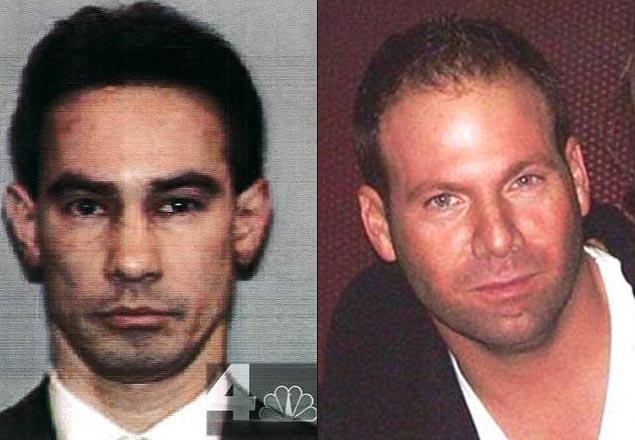
 Reports now indicate that all nine wounded bystanders in the recent shooting near the Empire State building were shot not by the gunman, Jeffrey Johnson, 58, (left) but by police officers.
Witnessed have complained that officers appeared to fire “randomly” in the confrontation, but the NYPD insists that the officers acted appropriately in facing the gunman. Johnson began the shooting by walking up to his former boss at Hazan Imports, Steve Ercolino, 41, (right above) and shooting him three times.
Victim Robert Asika said that the officers appeared to be spraying shots and that he saw at least two other people hit by officers.
NYPD Commissioner Kelly said that Johnson drew his .45 caliber handgun as the officers approached. The officers proceeded to fire 16 rounds, but Kelly insisted that “These officers … had absolutely no choice.” Johnson never fired at the officers.
There has been a long controversy over the switch of police officers to automatic or semi-automatic weapons with the capability if firing dozens of bullets in a clip. Critics have charged that the rate of fire has increased due to the switch with rising numbers of bystander injuries.
The question is whether someone like Asika could sue. Courts generally treat such shootings as covered by immunity rules and thus insulated from civil liability. The wounded could claim negligence in the use of lethal force by the department, but the police tend to get a great deal of deference in facing a deadly threat, particularly with someone who has already killed an individual.
The most notable case was that of Ruby Ridge, Idaho. In 1992, police sought to arrest Randy Weaver. The confrontation resulted in the death of Weaver’s son Sammy, his wife Vicki, their family dog Striker, and Deputy US Marshal William Francis Degan. The surviving family members sued and secured a settlement of $100,000 for Randy Weaver and $1 million for each of the daughters. Twelve agents were later disciplined and both the investigation and prosecution of the Weavers were criticized by officials like FBI director Louis Freeh. FBI sniper Lon Horiuchi was indicted for manslaughter in 1997 by the Boundary County, Idaho prosecutor but it was later transferred to federal courts and dismissed on the basis of sovereign immunity.
Here is a video from the scene and the confrontation.
Source: Gaurdian
bigfatmike is correct. Both Otteray Scribe and Tom Stedham are somewhat confused. A DAO is still a semi-automatic. Only a DA/SA has the trigger/firing mechanism left in the cocked position after the first round is fired.
As to Otteray Scribe’s assumption that the trigger is placed in a half-cocked position after a round is fired; I have never seen a firearm of that design. -The half-cocked position is a safety-position. (meaning the gun won’t fire if the trigger is pulled). Many left-handed shooters used to carry their pistol in a half-cocked position because it was safe, and it was easier to pull the hammer back than it was to release the safety.
http://youtu.be/HPQVNj-YHWs
BigFatMike,
If what you say is correct, then the weapon seems situation adapted, with reservation for the pull on the first shot. By that I mean, a pistol dropped in scuffle will not go off, and one grabbed by a perp, will, due to his general lack of experience, not be fired so easily. (Latter is an assumption.) It is unclear if the pull diminishes with second and subsequent shot.
The succeeding shots done in SA mode is proper when actual repeat firings are needed.
Defective police training seems to still be a question.
How wise is it to engage a single gunman with multiple police weapons? Don’t know but seems unwise. What was the info the police had received aa to number of gunmen? Were they expecting more than one.
Were they equipped with automaqtic weapons as implied earlier?
OS,
that is an amazing video!
Tom, I defer to you on the Glock. I do not own one, and moreover, never plan to buy one. For one thing, the damn thing is uncomfortable in my hand when I heft one at the gun shop. I much prefer a couple of other semi-auto brands. My favorite semi-auto pistol is a Browning, with my Walther a close second.
Otteray Scribe:
I’m almost 50; I’m a M1911 fan for life. The old ways are often still the best! I really wish the NYPD could change the trigger pull and offer more realistic training, including “judgement calls”, but…
they are far too busy spending huge amounts of money spying on American citizens to do that, I suppose.
@Tom Stedham “Please use Google to research the Glock pistol under discussion, and pistols in general.”
Actually Wikipedia under Semi-automatic pistol has a pretty good article that would help you learn to distinguish Double Action Only, Double Action, and Single Action semi auto pistols.
“Some modern semi-automatic pistols are double action only (DAO); that is, once a round is chambered, each trigger pull will cock the hammer, striker, or firing pin, and will additionally release the same to fire a cartridge in one continuous motion. “
http://www.chuckhawks.com/trigger_options.htm
Trigger Options of the Semi-Automatic Service Pistol
By David Tong
The dawn of the reliable semi-automatic pistol began in 1896, with the announcement of the famous Mauser “Broomhandle,” so named because of the walnut grip thusly shaped. Firing the 7.63mm (.30 cal) Mauser bottlenecked round at nearly 1400 fps, it heralded the beginning of smokeless powder use in handguns and was also the first autoloading pistol used in military application.
So popular an item it was that individual officers of the British Army carried it in harm’s way. These included one Winston Churchill, who used it in a cavalry action during the Boer War. His famous account of having to shoot, and hit, enemy soldiers in battle may be the first written record of an autoloading pistol fired in anger.
The early pistols all used the so-called “single-action” (SA) design. Whether the pistol had an exposed hammer, like the revolvers they proposed to replace, or were striker fired, a la the famous Luger, the salient feature of the single-action semi-automatic pistol is that the weapon is automatically re-cocked after firing. A single action pistol cannot be fired when the hammer is down. The principle advantage of most single action pistols is that, when cocked, the firing mechanism can be released and fired with a very short press (usually less than 1/4″) of the trigger.
Other advantages of this system include first shot accuracy, because there is minimal mechanical disturbance to maintaining precise aim with the short press; consistency of the handling/manual of arms with other firearms, such as rifles and shotguns which use a similar trigger; and repeat shots are accomplished in exactly the same fashion until the magazine is empty.
If one is properly trained with firearms, one learns to keep one’s finger off the trigger until the decision to fire has been made and the sights are aligned on target. This does not matter if you are in a hunting situation, at the target range, or shooting in self-defense. Usually, when the shooter starts his pistol in a “ready-low” position after drawing from the holster, the pistol is brought from a point about midway between beltline and torso, the safety catch (if equipped) is released, and the trigger finger only touches the trigger when the sights reach alignment. This deployment methodology does not change with action type and is designed to minimize negligent discharges.
Examples of the single-action auto include the renowned Colt Model 1911 “Government Model,” the Browning P-35 Hi-Power, the German P-08 Luger, and the Russian Tokarev TT33. Literally millions of these handguns have been manufactured, and until comparatively recently were the most prevalent designs used by military forces around the world.
Nowadays, the 1911 pistol is widely used in both civilian target and combat competition, as well as by elite military and police units. The primary reason is the trigger system, which makes hitting one’s target a comparatively simple and repeatable matter. It is far easier to hold a three pound pistol steady when squeezing a four pound trigger, than it is to shoot the same weight sidearm with a 12 pound first round pull, and so it is my personal preference.
In the event of a failure to fire with a single action pistol, the slide must be manually cycled to clear the dud round and bring another cartridge from the magazine into the chamber. This procedure also re-cocks the hammer, leaving the pistol ready to fire. This is known as “tap, rack, bang” among some shooters and instructors. (The tap is when the shooter slaps the bottom of the magazine to insure that it is completely seated, the rack is when he manually operates the slide, and the bang–hopefully–occurs when he pulls the trigger the second time.)
There have been, and continue to be, many developments designed to remove the specter of a cocked pistol while still making the weapon capable of being instantly fired. The reason for this development was safety. “Safety” might be a misnomer for a training issue, yet police agencies, militaries, civilians, and liability attorneys all seemingly desire a pistol that is ready to fire, but without the compressed springs or that frightening cocked hammer. In a defense situation, some experts have opined that it is an advantage to have a heavier first shot trigger squeeze to reduce the likelihood of a negligent discharge. Another stated advantage is that the double action (DA) auto allows for a defective primer to be struck a second time by a second trigger pull.
The German Walther factory released the so-called double-action, or trigger-cocking auto in 1929, in the Model PP, or “Polizei Pistole.” With this pistol, the first round is triggered exactly as one would shoot a double action revolver, merely aim and squeeze, without the necessity of releasing a safety. The trigger cams the hammer back before it is released to drop onto the firing pin. After the first shot, the pistol is self-cocking and reverts to normal single action operation. The safety lever, located on the left side of the slide, allows for the safe lowering of the cocked hammer onto a locked firing pin and prevents operation of the trigger when applied.
However, as stated earlier, that first round trigger pull is generally much longer and quite a bit heavier than the subsequent SA trigger pull of the same pistol. Hit probability for the first round suffers unless much more time is taken for training to overcome a system designed more to prevent negligent discharge than encourage accuracy.
After the U.S. Army adopted a high capacity, double action pistol in 1985 there was a rush by American police agencies to follow suit. Examples of first-generation double-action designs include the German Walther Models PP and P-38, W.W.II service pistols; the Beretta M92, which is the current U.S. military handgun; and the traditional double-action Smith & Wessons, e.g., the Models 39, 59, 645, and 4006.
Some pistols use a hybrid of the two trigger systems, allowing for either mode of first shot employment. The Czech CZ-75 is that country’s official service pistol, and uses either a DA first shot, or the SA cocked and locked carry of the Colt 1911. The Heckler & Koch USP, Variant One, has a similar system. Both allow for loading and unloading while on safe for administrative handling and second strike capability.
I would classify the Glock “Safe Action,” in terms of the shooter interface, as a single-action, even though its concealed striker is cocked by the short trigger stroke of 5.5 pounds and is, by definition, a trigger-cocking design. (The BATF classifies the Glock design as “double action only.”) It does not offer second-strike capability, however, and so the manual of arms in case of a cartridge malfunction is exactly the same as a single-action pistol (tap, rack, bang). In reality, the Glock design is neither SA nor DA, but something new.
@Tom Stedham “classify the Glock “Safe Action,” in terms of the shooter interface, as a single-action, even though its concealed striker is cocked by the short trigger stroke of 5.5 pounds and is, by definition, a trigger-cocking design. (The BATF classifies the Glock design as “double action only.”)
Thanks, this is interesting stuff.
I personally would describe the weapon as Double Action Only, but apparently there are shooters who believe the, shall we say, ergonomics of the weapon are best described as Single Action.
I suppose the most reasonable description might depend on whether one is giving a technical description of the operating mechanism or orienting shooters prior to practice on the range.
Lona,
Shoot to wound or disable is the stuff of movie fiction. All law enforcement as well as military are taught to aim for center mass, which is the torso. If deadly force is needed, then one shoots to stop….permanently. Unless you have spent time on a firing range, you have no idea how hard it is to even hit an 18-inch wide target every time, let alone putting rounds into the bulls-eye. In this case, the problem is compounded by the police being handicapped by having all their pistols set with a twelve pound trigger pull.
The only time aiming for some other body part or even a weapon is an acceptable tactic, is if the officer is a sniper. Even then, a sniper must have a good rest position and excellent sight picture. This video shows how it can work in an ideal situation where a police sniper does an exemplary job.
Otteray Scribe:
I’m getting swamped with email. My comment was re: your original statement:
“For those who do not know, double action means the pistol is no longer truly a semi-automatic, but works more like the old west revolver where the trigger not only has to fire the shot, but to force the hammer back as well. This modification makes the firearm more dangerous to bystanders, not less.”
First, Glocks don’t even have hammers; they have “strikers.” Second: the trigger does NOT move the hammer. The trigger (spring) only makes the hammer FALL, NOT COCK. So, to re-clarify (again) my original point:
There is no trigger “forcing the hammer back”… The SLIDE does that. We can argue about other semi-auto pistols, where the first DA shot does that, but that’s not the case here, so it’s irrelevant.
The trigger spring, of whatever pull it is set at, only determines at what point the hammer (or striker) will go forward, not backward (except on the first shot on other pistols, which I already pointed out is not relevant to this discussion)…
The SLIDE cocks the HAMMER (or on Glocks, the STRIKER).
Good video as to the fact of showing a great shot. I still insist that police are too easy on the trigger and should handle many situation much different than they do.
Frankly had it right early on and Kudos to OS for the primer for non-gun owners like myself. Why is it when the police do not hit their target, the losses are considered collateral damage? They are human and they have just been shot by the police and not the so called shooter.
Civil Rights 101. Sovereign immunity can be claimed by the State. In some states a municipality can claim sovereign immunity because it is defined by State law as part of the state, same with a county government. This does not apply to the officers sued individually and in their official capacity. So Professor please be advised of the parameters of that defense. The Superior officers can also be named in a civil rights suit. 42 U.S.C. Section 1983. See also Section 1985 for conspiracy. Section 1988 for atty fees. The books on the shelves in many libraries are covered in dust and many lawyers can not find this stuff on the internet. My point here though is that the article fails to grasp the limits of immunity defenses in a federal civil rights suit. Here the cops did not intend to shoot all the bystanders. But when one fires a gun it is not the same as negligently leaving a banana peel on the sidewalk.
My bark is with Mayor Bloomberg. He goes on tv and yaks about gun control. It was his guns that were out of control. He can start by implementing some classes in aiming straight.
I agree with you and hope there might be ways to lessen the danger of bystander injury in such situations. But, making some sort of rule that police should not shoot if there’s any bystanders around or unless there’s near certainty of hitting their target or only shoot once and wait a bit to see if you incapacitated him before firing again, just doesn’t seem feasible to me. That’s a rule for getting yourself shot in a situation like these officers faced.
@Tom Stedham “There is absolutely no “safety” issue with the pistol. NOTHING about that weapon is unsafe or dangerous, ”
Actually the Glock’s have quite a controversial history. The first weapons issued in NYC had a trigger pull that was considered light.
Some believed that the light trigger pull contributed to badly aimed or unanticipated shots being fired which jeopardized officer and citizen safety.
The weapons were then modified to have a heavier trigger pull. The heavier trigger pull may well have reduced unanticipated or inadvertent firing in the heat of battle.
But as others have noted on this blog, the heavier trigger pull may have negative effects on accuracy.
“There is absolutely no “safety” issue with the pistol. NOTHING about that weapon is unsafe or dangerous,”
If what you mean to say is that the weapon is not defective then I would agree with you.
But I would argue that there is always a safety issue with a fire arm. Those who forget that do so at their own and others peril.
Mike,
“I too have concerns regarding police use of their weapons.
But I am not sure that ordinary human beings are capable of much better performance under real life conditions. ”
Right. Which is why I said “higher” standard. I don’t want ordinary human beings to be the ones responding, I want people who can handle this kind of situation. Functioning well in situations like this is a skill, and like other skills it takes practice and training. OS said it best:
“There is a vast difference between qualifying on the range at paper targets and combat shooting training. For one thing, combat shooting is complex, intensive, takes more time and is more expensive than just running through the minimum amount of ammunition. Combat shooting trains the officer (among other things) to have more situational awareness and look downrange from the target. Target fixation can get whoever is behind the target shot.”
Johnson 1, cops 10.
@Gyges “you need to be held to a higher standard.”
I too have concerns regarding police use of their weapons.
But I am not sure that ordinary human beings are capable of much better performance under real life conditions.
I am going to assert with out evidence that the performance of these officers is not much different form the performance of other officers and the military in similar circumstance.
I think we need to remember this is not target shooting at Camp Perry.
When lives are on the line, nerves, situational awareness and other psychological factors come into play and all too frequently reduce accuracy.
@Jack Reacher and Otteray Scribe
You have given us some good information but perhaps obscured the key point.
Double Action refers specifically to the two functions performed by the trigger in pulling the hammer back and then releasing the hammer to fire the weapon.
Single Action refers to the mode of operation in which the trigger performs the single function of releasing the hammer to fire the weapon.
Of course the hammer is always pushed back by the slide. The key point is whether the hammer must first be locked back to fire the weapon as in Single Action mode, or whether the weapon can be fired with the hammer down in the rest position which is what happens in Double Action mode.
Double Action Only refers to a semi auto pistol that fires in Double Action mode on every shot.
In contrast Double Action auto pistols typically fire double action on the first shot and then in single action mode on the second and succeeding shots.
You and Otteray Scribe have it exactly right.
This is why I bang my head against the wall every time someone complains that a shooting officer, “..didn’t have to kill him–he should have shot him in the leg”. Police officers cannot shoot. They don’t train sufficiently to shoot, the stress and uncertainty of the situation makes it difficult to shoot, and none of us would fair any better. To suggest that they should do anything but attempt to use deadly force by aiming for center mass is insanity. These officers surely were shooting to kill, and this was the result. I say, bring on Robocop!
Otteray is correct about the problem with the 12 pound trigger pull. It is ridiculous. Seattle PD went to a heavy trigger pull several years ago and I had commented to many this idea was more of an administrator’s whishfull thinking that somehow it will prevent accidental shootings but the solution is worse than the problem.
I would have to look at the investigation notes, diagrams, and such before I make a judgement as to how justified this is, but going after one man and shooting 9 bystanders, that is very bad at face value.
I believe the big factor would be was the suspect actively shooting at others at the time the police engaged him with lethal. That would be more mitigating. The spray and pray approach does not work in crowded areas however.
Regarding double action. From what I have been able to glean from various web sites, is the NYPD Glocks have been rigged to leave the hammer on half-cock instead of full cock. Much harder trigger pull that way. With 12 pounds, I would not be able to hit the broad side of a barn, and I am a pretty good shot. I agree with the observation above that the hit rate on the perp was actually pretty good, all things considered. Unfortunately, there was way too much collateral damage.
Waldo:
I don’t think anyone is saying the shooting wasn’t justified as being in self-defense. The issue is the method and magnatude of response and the amount of firepower employed. 7 of 16 hits sounds like good shooting to me and I know that one round will not typically stop a human but the police’s goal is to protect the public. Nine wounded? Some wonder if this was the best way to accomplish that goal or if something else could have been tried. A question is not usually an attack.
“The cops fired16 shots. Seven shots hit the guy in the chest.”
Woo! almost 50%. If you’re going to be in a position where you’re forced to fire while surrounded by innocents, you need to be held to a higher standard.