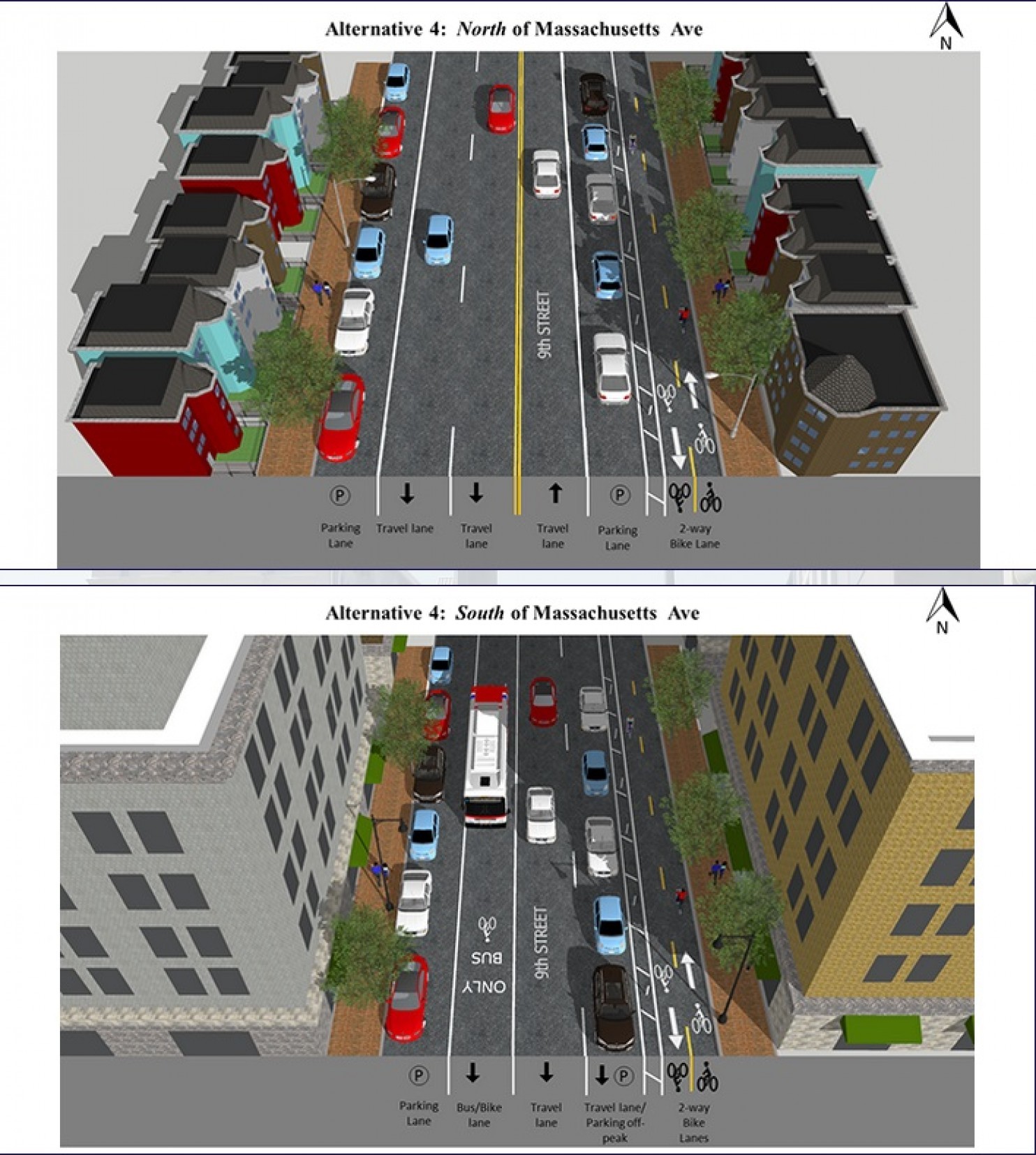
 The United House of Prayer on M Street NW in Washington, D.C. has a curious view of the free exercise clause of the First Amendment. The Church has claimed that the city is denying the freedom of religion by seeking to add a bike lane on one side of its street. While there is a rich literature on the scope of the protections afforded to religious practices, it is perfectly delusional to claim that the addition of a bike lane violates “constitutionally protected rights of religious freedom and equal protection of the laws.”
The Church has 800 members and its lawyer wrote the District Department of Transportation that the proposed bike lane are “unsupportable, unrealistic and particularly problematic for traffic and parking.” The lawyer suggested the addition of a standard bike lane would add to traffic congestion and thus violate the Constitution. It suggests sending the bike lane down another street (where presumably another church would not claim a constitutional violation).
The church lawyer insisted that by potentially increasing congestion the DDOT was impinging on religious freedoms: “As you know, bicycles have freely and safely traversed the District of Columbia throughout the 90-year history of the United House of Prayer, without any protected bicycle lanes and without infringing in the least on the United House of Prayer’s religious rights.”
Notably, the District previously caved to another church’s objections to a bike lane and agreed to make the bike lane unprotected in front of the church despite the view of groups and other churches can now make similarly frivolous claims under the Constitution.
The District is now considering the latest religious freedom claim. The use of the religious rights argument would suggest that a church might be able to block a municipal traffic plan where a non-religious institution might not.

“It is contrary to the principles of reason and justice that any should be compelled to contribute to the maintenance of a church with which their consciences will not permit them to join, and from which they can derive no benefit; for remedy whereof, and that equal liberty as well religious as civil, may be universally extended to all the good people of this commonwealth.”
~Founding Father George Mason, Virginia Declaration of Rights, 1776
Is the church paying taxes to support the city’s initiatives?
Then they should have no expectation to be made whole by the expense of the taxpayer.
Max-1 – the members of the congregation pay taxes.
Equal application of the law?
Wouldn’t that undermine affirmative action as well?
And, given the Kelo decision, the State has a very low hurdle to prove this is “in the public interest”.
Pace Kelo, eminent domain becomes a tautology: It is in the public interest because they say it is in the public interest.
Equal application of force would be more accurate.
KCFleming – in the public interest might be a higher hurdle given the few number of people it is expected to help.
KCFleming writes, “Equal application of the law? . . . Wouldn’t that undermine affirmative action as well? . . . And, given the Kelo decision, the State has a very low hurdle to prove this is ‘in the public interest’. . . .
Pace Kelo, eminent domain becomes a tautology: It is in the public interest because they say it is in the public interest. . . . Equal application of force would be more accurate.”
Equal application of the law put another way is this: Does the church or any of its parishioners have any credible evidence of some tacit conspiracy to harm them by this public mandate? S*it or get off the bucket.
I don’t know what the Kelo decision states, but if it has anything to do with affirmative action, it’s much more complex than you make it out to be. If it were my pen writing the opinion, I might disagree with the Bakke case and its progeny to the extent that a state-funded university may take race into account under the Equal Protection Clause. On the other hand, who am I to decide how many generations a group such as African Americans requires to heal the emotional and physical scars of not only their ancestors but of the racism they still see on a daily basis? Are you such a person who can manage to partition those scars and the intentional mediocrity their generations have been forced to bear to persevere in school without dysfunction? I’m not.
Their point is,that the bike lane will permanently remove the historical parking availability for the parishioners to attend church. In essence making it difficult if not impossible to get TO the location of the church. Removing a parking lane and replacing it with a bike lane, which also increases congestion on the traffic lanes by smooshing more cars into less lanes. Look at the attached cartoon above with the article to see this.
City planners have been known to try and remove undesirable business from some areas by using this manipulation in the name of planning or rezoning. Removing accessibility or making it difficult for patrons to actually get to the business. Whether this, in the case of this Church, is on purpose by the planning commission and the City or just a by product of pie in the sky idealism about bike lanes is difficult to say.
However, the end result of the bike lane would be to remove the ability of the people to attend their church. An alternative would be for the city to provide some parking for the church, build a parking building. Of course, then THAT would inconvenience others or be a product of eminent domain, or stealing someone else’s property for the convenience of the church attendees.
Social engineering NEVER works out the way they envision it. 😐
DBQ,
If it’s shown to be an equal application of the law, whether the purported harm is to a church, business, or residence, then I don’t see a problem. Do you?
Who’s ninian?
ninianpeckitt said …
Another example of how a badly written Constitution can be manipulated to address an issue it was not intended to address. [italics emphasis is mine]
THUNK!! That’s the sound of my head hitting my desk top in a double face palm plant. However, I am sure nothing like this ever occurs in the UK, manipulation that is, in the land of milk & honey and all that.
The Constitution is fine, too bad you have no clue. Church feels removing parking spaces is prejudicial, so they object. The court will decide if this is true or simply “collateral” results. That is what our Constitution allows…you can bring a case but there’s no guarantee of victory.
@Paul
Generally drunkbloggers seem only to stop typing when they are no longer awake.
KCF, Great inside baseball joke. LOL.
KCFleming writes, “Bike lanes are the holy sacrifice of the modern environmental-socialist religion.”
Well, stated, KC. Next they’ll encourage children to recite the Pledge of Allegiance with right hand over heart, to sign up for Cub Scouts and Brownies, and to become lapel-pin-wearing robo-consumers who vote for the lesser of two evils in one of the two major parties to maintain the oligarchy. It’s a dark epoch for the otherwise comfortably-numb bourgeoisie.
@Nick
Ah, Madison, the liberal enclave in which it’s always 1971, their love for non-whites is not returned, and drunk-blogging is common.
KCFleming – about this drunk blogging thing. How the devil does one do it? Speech translator?
KCF, You are absolutely correct about liberals and bikes. Madison is like Chinese cities. But, here’s an interesting dynamic. The liberals in Madison worship bicyclists but hate skateboarders and make their lives miserable. In San Diego, a balanced city, both bicyclists and skateboarders have equal rights. Skateboards are a means of transportation, not just play, for many young people. You don’t have to lock up a skateboard, just pick it up and take it inside w/ you.
“To those who say we should consider the impact on business and CHURCHES. WELL THATS NOT WHAT IS Happening.”
justice holmes,
Absolutely correct, the impact is not being consider and it should be. Every business and Church considers themselves special, if they didn’t they would no longer exist. If a business is negatively impacted by such changes they will seek accommodations just like this Church or risk losing customers and shut their doors. The business may never recover as their clientele will just move along to some other venue; the Church is more than just a building with pews, it is its congregation. The parishioners may be inconvenienced but they WILL NOT lose faith simply because parking is lost.
Be as hostile to religion as you want, the faithful WILL accommodate you. 😉
“Home owners and businesses lose parking spots all the time…”
You say that like its a good thing.
So, apparently no one should remain uncrushed by Leviathan.
Interesting viewpoint.
Allow me to disagree, instead that resistance to the overwhelming State should be supported, that limits to the State’s control should be applauded.
To those who say we should consider the impact on business and CHURCHES. WELL THATS NOT WHAT IS Happening. Businesses and residents Don’t get that privilege. Home owners and businesses lose parking spots all the time to bike lanes and other changes cities make. Churches see themselves as special and to their parishioners I’m sure they are. They should not be considered “special” when it comes to city regulations or generally applicable laws.
David,
It’s a “click” headline.
That’s my point as well Paul. If this proposed bike lane change is not intended to be hostile to businesses or Churches then the reasonable solution would be to determine when the parking is most necessary and mark it “bike lane only” outside those times. This is not difficult IF the intent is simply to create bicycle friendly routes.
The headline got me upset at this church, but then as I read more, I realized that the issue was not an objection to a bike lane, but rather they objected to losing parking spaces in front of the church. Invoking the Constitution is overreach, but I do understand it in a culture that has successfully invoked the Constitution to protect the practice of sodomy and abolish the institution of traditional marriage.
I am with the church here. If the bike riders have ridden safely in that area before, then so be it. If the church is losing parking spaces, then it is a taking from church usage. I can see their thinking. Now they could work out a compromise. Protected lanes M-Sa. Unprotected Sunday before and after services
“Justice” says: “If the church needs parking it can buy some land and build a lot just like any other business!”
So, if a church was established 50 years ago, based on the presence of available parking on the street, in your view, the city can unilaterally remove that access at any point without consideration and that’s just too damned bad. “Buy more land” you say, even if there isn’t any land to buy, and even if they can’t afford it.
That’s the Chicago way, of course, but Chicago is losing people because of similar disregard for its citizens to the point that it is broke and down to a population last reached in the 1920s.
The religious will vote with their feet, moving to the more hospitable climes of the South, which are gaining population over against blue cities.
You may love the fact the religions will drag their parishioners out of state, but you will be stuck paying the taxes, which will not decline. Again, see Chicago.
It doesn’t matter what the entity is that is being affected by the bike lane changes. It is reasonable to consider the impact the change would have on existing businesses AND in this case Churches. What data exists that necessitates such a negative impact on this one entity that NO reasonable accommodation could be considered?
A street is a neighbor to the adjacent properties. One cannot dictate what neighbors do so long as what they do is legal.
On the other hand, if the department has, in the past, allowed public parking on its street, because that did not interfere with the purpose of the street, it is something like adverse possession. When it takes away that parking, it may be taking away some sort of previously held right. I’m not a lawyer and haven’t researched this. Just knee-jerk jabbering.