
 In a blow to secularists and civil libertarians, the Supreme Court voted 5-4 in Greece v. Galloway to allow Christian prayers at a local council. The Court again left little clarity on the standard for future cases in what proved a highly fractured decision. Justice Anthony Kennedy tipped the balance in favor of the Town of Greece with Chief Justice John Roberts, Justice Samuel Alito, Justice Antonin Scalia, and Justice Clarence Thomas. However, his opinion was left in pieces by a series of concurring opinions. Scalia and Thomas specifically bolted over Part II-B of Kennedy’s opinion (except as to Part II–B, concluding that the town’s prayer practice does not violate the Establishment Clause.) Alito wrote a concurring opinion, joined by Justice Scalia. Justice Thomas also wrote a concurring opinion joined by Justice Scalia in part. Even the dissenting justices divided with a Breyer opinion for himself and a dissent by Kagan that was joined by Justices Breyer, Ginsburg, and Sotomayor. In other words, an unholy mess.
Category: Constitutional Law

 The California state assembly has passed a new law that will be prohibit the selling or displaying items with an image of the Confederate flag. We have previously discussed the disciplining of students and others over the display of this flag as protected speech. In the same way, this bill raises serious constitutional questions and could trigger a court fight.
Continue reading “California Assembly Moves To Ban Sale Or Display Of Confederate Flag”

 The United States Court of Appeals for the Second Circuit has handed down a major decision on responsibility for 9-11 liability. In a decision by Judge Dennis Jacobs, a panel ruled that American Airlines, United Airlines and the World Trade Center leaseholder are not liable for environmental cleanup costs for the attacks in New York City. It is not the conclusion but the rationale that raises concerns about the immunity decision. The panel ruled that none of these parties were responsible for the attacks because it constitutes an act of war. That rationale negates the obvious responsibility of not just the government in ignored numerous indicators of the attacks but the refusal of the airlines to take rudimentary security changes advocated for years such as secure cockpit doors and flight protocols. The decision is In Re September 11 Litigation, 2014 U.S. App. LEXIS 8293.
By Mike Appleton, Weekend Contributor
“It certainly may be said that the Bible is worthy of study for its literary and historic qualities.”
–Abington School District v. Schempp, 374 U.S. 203, 225 (1963) (Justice Clark)
“The nation is in danger because of its ignorance of what God has taught. . . . If we don’t know it, our future is going to be very scary.”
-Steve Green, Templeton Biblical Values Award acceptance speech, April 15, 2013.
The three children of Edward and Sidney Schempp attended public school in Abington, Pennsylvania in the 1950s. A Pennsylvania statute in effect at the time mandated that, “At least ten verses of the Holy Bible shall be read, without comment, at the opening of each public school on each school day. Any child shall be excused from such Bible reading, or attending Bible reading, upon the written request of his parent or guardian.” The readings were followed by recitation of the Lord’s Prayer and the Pledge of Allegiance.
Mr. and Mrs. Schempp, as practicing Unitarians, objected that various doctrines contained in the readings violated their religious beliefs and sought to enjoin the exercises as a violation of the Establishment Clause. The Supreme Court agreed, finding that the Pennsylvania law violated the principle of “strict neutrality” required under the First Amendment. Abington School District v. Schempp, 374 U.S. 203 (1963).
But while the Court found the statute unconstitutional due to its openly sectarian character, it emphasized that its ruling did not preclude entirely the use of the bible as a valuable educational source. “Nothing we have said here indicates that the study of the Bible or of religion, when presented objectively as part of a secular program of education, may not be effected consistently with the First Amendment.” 374 U.S. at 225. The test of constitutionality, said the Court, is whether a statute has “a secular legislative purpose and a primary effect that neither advances nor inhibits religion.” 374 U.S. at 222.
In the years since the Schempp decision, a variety of academic programs incorporating the bible have been successfully implemented in public schools in a number of states. But there is about to be one more, and the early indications are that this one won’t pass constitutional muster. Continue reading “The Hobby Lobby Bible Curriculum and the Constitution”

Respectfully submitted by Lawrence E. Rafferty (rafflaw) Weekend Contributor
When I think of places that would be ideally suited for taking advantage of solar power, Arizona is high on the list. There are approximately 20,000 Arizona buildings utilizing solar collection technology to replace or supplement normal power sources. However, that number may soon decrease if a new “solar tax” is implemented.
“A new interpretation of state law in Arizona could force customers to pay property taxes on leased solar panels. In a state with an estimated 20,000 solar customers and 85 percent of new solar installations being leased systems, the implications of an extra charge are tremendous. The new tax could result in an additional $152 per year for a residential solar array and even more for larger installations, the Arizona Republic reported. What’s more, the tax would apply to both new and existing customers.” Think Progress
At first glance, I guess it should not surprise anyone that a new tax may be initiated. However, when that tax is a tax on solar panels on commercial and residential buildings and includes solar panel arrays that are leased, it raised some eyes in Arizona. Why would the State of Arizona decide on a tax on the collection of power of the sun? The answer may surprise you. Continue reading “The Arizona Solar Tax and Who Benefits From It”
By Darren Smith, weekend contributor
 Japanese voters are split over changing the country’s pacifist constitution, in order to allow Japan to ease limits on the military, according to a recent poll. About 50 percent of voters want Japan to be able to exercise its right to self-defense in case of an international conflict, while almost 90 percent of lower house lawmakers back the change.
The survey was made by the Asahi newspaper and a University of Tokyo research team. It showed that half of the voters want the revising of the constitution, up from 41 percent in 2009.
Japan’s prime-minister Shinzo Abe made clear he wants to change the constitution in order to give more power to the military. The constitution has never been changed since it was drafted by the United States Occupation forces in 1947, after the World War Two.
Continue reading “Increasing Support In Japan For Changing Pacifism Article In Constitution”
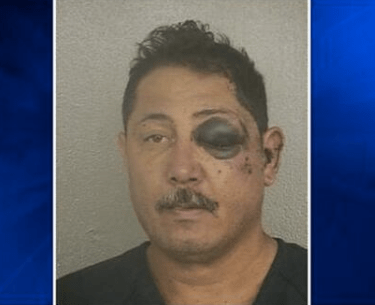 Two Broward Sheriff’s Office Deputies are under investigation after a videotape was discovered showing a deputy punching David Gonzalez in the face and then the deputies slamming him into the pavement. As shown by his mugshot, Gonzales was injured, including broken bones in his face. The officers have been identified as deputies Justin Lambert and Mike Manresa. They reportedly claimed that Gonzalez was drunk and resisting arrest but that is not what the videotape below indicates. The officers said that Gonzalez was abrasive and yelling at them and added “We then escorted Gonzalez to the ground.” That “escort” was preceded by a punch to the face before sending him face first into concrete.
 There is a highly disturbing story and photos out of Tennessee where a police officer is shown choking a college student, Jarod Dotson, 22, who does not appear to be resisting. The police had been called to a party at the University of Tennessee and police reported that bottles were thrown at officers. However, in this picture, there appears no risk or resistance for the officer, Deputy Sheriff Frank Phillips.
Continue reading “Tennessee Officer Shown Choking An Unresisting Student Into Unconsciousness”
 We have been discussing the Court’s ruling in the Michigan affirmative action case, Schuette v. BAMN. This included a recent column in CNN with two of my George Washington law students. This Sunday, civil rights attorney Shanta Driver went on Fox News Sunday to denounce the decision as “racist” and presumably anyone supporting the result. The comments caused quite a stir and highlights the continuing difficulty in discussing such issues — and the fear of some that they will be labeled racists if they support a color-blind admissions process.
By Darren Smith, Weekend Contributor
 There is an interesting ruling from U.S. Magistrate Judge James Francis in New York. The case stems from a search warrant sought by the government for the contents of an individual’s e-Mail account that was hosted by Microsoft but stored on a server located in Dublin, Ireland.
Magistrate Francis stated that internet service providers such as Microsoft or Google cannot refuse to turn over customer information and emails stored in other countries when issued a valid search warrant from U.S. law enforcement agencies.
In a statement, Microsoft said it challenged the warrant because the U.S. government should not be able to search the content of email held overseas.
“A U.S. prosecutor cannot obtain a U.S. warrant to search someone’s home located in another country, just as another country’s prosecutor cannot obtain a court order in her home country to conduct a search in the United States,” the company said. “We think the same rules should apply in the online world, but the government disagrees.”
Continue reading “US Magistrate Judge Rules Search Warrant May Include Email Account Hosted Overseas”

Respectfully submitted by Lawrence E. Rafferty-(rafflaw)- Weekend Contributor
If you were like me, you may never have heard the term “Communications Management Units” before. They are basically a section of a prison where certain prisoners are housed with limited or no access to communications or family visitations. The reason very little was known about the CMU’s is that when they first were initiated at prisons in Indiana and Illinois, their existence was kept from the public.
“The units opened almost in secret in 2006 and 2008. Critics say they flouted federal law by not publishing the proposed rule and opening up a period for public comment.” Readers Supported News If a lawsuit filed by the Center for Constitutional Rights had not been filed in 2010, we may never have known much about these abusive tactics in our domestic prison system. Maybe the harshest aspect of being sent to the CMU was the realization that you may never know why you were sent there or how you could get out of it. Continue reading “Communications Management Units and Prisoners Rights”

 We have recently discussed attacks on lawyers for simply doing their jobs in representing accused individuals. It is truly vile and McCarthyist trend that seeks to punish professional working within our criminal justice system. It is particularly offensive therefore when a large, presumably respectable organization unleashed such an attack. However, that is precisely what the Republican Governors Association has done in the attack ad below against State Senator Vincent Sheheen (left) who is being opposed because he represented people accused of crimes. To its credit, the South Carolina Bar Association has stepped forward to denounce the ad as containing “uncivil, misleading political rhetoric.” It is a shameful and shocking ad that attacks the very notion of due process guaranteed by our Constitution. The ad is designed to help Gov. Nikki Haley in her reelection campaign.

 Below is yesterday’s column on CNN.com on the ruling in the Michigan affirmative action case, which we discussed earlier this week. I was asked to write a response to the decision and jumped at the opportunity to feature a couple of the GW “justices” from my Constitution and the Supreme Court seminar. The class meets in the Spring Term and reviews one case a week from the docket of the Supreme Court for that term. We read and discuss a selection of briefs filed in each case and the lower court opinion. The “justices” then rule on the merits, explaining their own take on the underlying legal issues and the role of the Court in the controversy. We then take a separate vote to predict what that “other” Supreme Court will do. Over the years, I have found that the students are remarkably accurate in their predictions, far more accurate than most commentators. Indeed, I have often found the opinions of the GW Court to be superior to its more famous counterpart on Capitol Hill. At the end of the term, each student writes a majority opinion and either a dissenting opinion or concurring opinion. They can choose any case from the current term. Of course, public commentary following the release of a decision might raise some questions of judicial ethics, we can at least claim to have been more circumspect than some of the members of that “other” Court. So here is the column from CNN and thank you Justices Yvette Butler and Vincent Cirilli.
Continue reading “The Michigan Affirmative Action Case: Two [GW] Justices Face Off On CNN”
We previously discussed the case of Doyle Randall Paroline, who pleaded guilty in Texas in 2009 to possessing child pornography. He downloaded hundreds of images and two were found to be child pornography dedicating the abuse of Amy. After pleading guilty, Paroline was hit by $3.4 million in restitution damages for Amy even though he had no role in her victimization nine years earlier or any role in the production or distribution of the two photos. The United States Court of Appeals for the Fifth Circuit found that the federal restitution law does not require “proximate causation” — a critical limitation in torts and criminal law that ensures that liability is confined to those parties immediately responsible for injuries. I have criticized the expansion of restitution in this area for years and I spoke with NPR’s On The Media on the case. The Court has now ruled and reversed the Fifth Circuit in a 5-4 decision. As discussed with regard to yesterday’s decision in the Michigan affirmative action case, my Supreme Court class votes on the merits and predicted outcome of the major cases of the term before the Supreme Court. On this occasion, the vote was 8 to affirm and 6 to reverse. The latter “reversal” is closest to the outcome in the case. On prediction, the vote was 11 to 2 in favor of affirming so we were way off on the prediction on this one.
Continue reading “Supreme Court Vacates Jane Doe Child Pornography Restitution Case”
I was just on CNN discussing the decision in Schuette v. BAMN, reversing the United States Court of Appeals for the Sixth Circuit and declaring that the citizens of Michigan have the constitutional authority to prohibit racial and other preferences in university admissions. We addressed this case this term in my Supreme Court class and the students voted not only in the same way as the majority today but predicted this result. What was surprising was the vote — 6-2. Only Justice Sotomayor and Ginsberg voted to upheld the Sixth Circuit.