 There is an interesting case out of Des Moines, Iowa where Jennifer Conner is suing Iowa Methodist Medical Center over the alleged refusal of the hospital to make relatively small accommodations for her disability: shy bladder syndrome. Conner fears urination in public restrooms and could not complete the required drug test for a position with the hospital.
Mohammed Nisham appears to have as little concern for his children as he does for his luxury cars. Nisham has been charged with having his nine-year-old drive his sports car. It was not hard for Inspector M.V. Verghese to prove: Nisham filmed his son driving the car with his brother (neither with seatbelts on of course) and then posted it on YouTube.
Continue reading “Indian Father Charged After Posting Video Of Nine-Year-Old Son Driving Sports Car”
 This really summed up my reaction to Sarah Palin’s comment about her anger as one of the struggling Americans to see the President go to the White House Correspondent’s Dinner.
 We have previously discussed reports of billions disappearing in Afghanistan and the long record of corruption surrounding the family and friends of President Hamid Karzai. Now a new report details how for more than a decade, the CIA has been dropping off monthly suitcases, backpacks and even shopping bags filled with cash to Karzai at his office. Despite these reports of grotesque corruption, the money continues to flow into Karzai’s pockets even as he attacks the U.S. and Americans as “demons”, and moves to shift alliances to Iran and China.
Continue reading “Karzai’s Bag Men: CIA Dropped Off Monthly Bags Of Cash To Karzai”
 I could not help but note a criticism of the White House Correspondent’s Dinner by former Alaska governor and vice presidential nominee Sarah Palin last week. Palin denounced the dinner as “pathetic” and a case of “DC assclowns” were throwing “themselves a #nerdprom” while “the rest of America is out there working our assess off.” This was a remarkable statement from a person who resigned from her governorship early to create a reality show and make millions being Sarah Palin. I am not sure that many Americans would see Palin as one of those “working out asses off.”
 Many of us have criticized our politicians for years for abandoning the national interest in favor of petty or corrupt interests. I have worked in this town for decades and I have never seen the situation quite this bad where lobbyists seem to have unprecedented and open control of Congress. No greater example can be found than the move this week to spend hundreds of millions of dollars on tanks that the Army does not want and experts overwhelming say the country does not need.
I just saw this remarkable farewell by the New Zealand Infantry Regiment to a dead colleague. This is the Haka, which is by many in New Zealand (not only the Māori). I found this a touching farewell to a dead fellow soldier
Continue reading “New Zealand Infantry Regiment Says Farewell To Dead Soldier”

 Below is today’s column on the calls for expanding security and surveillance powers in the aftermath of the Boston bombing. (An Internet version ran last week but was updated for print) [I untangled one line that was changed in editing]. My greatest concern is that the Boston response will become the accepted or standard procedure in shutting down cities and ordering warrantless searches. No politicians wants to be seen questioning the necessity or efficacy of such measures out of fear of appearing “soft” on terror.
 by Gene Howington, Guest Blogger
The Law of Identity is one of Aristotle’s fundamental Laws of Thought. It is expressed often in the terms of A=A or in other philosophical works as some variation of Marcus Aurelius’ admonishment to “ask of each and every thing what is it in itself”. This is less commentary than informal unscientific survey, but some of your answers will likely inform a future commentary. These questions kept hovering about as I considered the topic of the social compact. There seems to be a lot of confusion about the nature of the social compact model of government and that had been my intended topic for this weekend. However, as I thought about it and reviewed some older threads here where the subject had come up in preparation for addressing the subject, another area of confusion stood out as prevalent as well. That confusion centers around the proper role of government in society, specifically the proper role of government as defined by the U.S. Constitution.
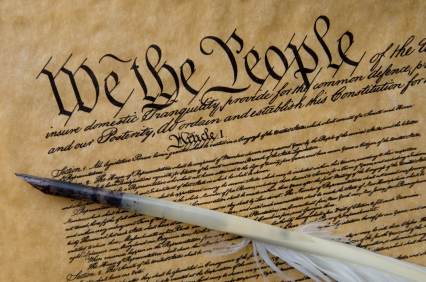
If we look at the Constitution itself, the Preamble contains a basic description of the function of our Federal government.
We the People of the United States, in Order to form a more perfect Union, establish Justice, insure domestic Tranquility, provide for the common defence, promote the general Welfare, and secure the Blessings of Liberty to ourselves and our Posterity, do ordain and establish this Constitution for the United States of America.”
It is important to note that the Preamble is not law in the traditional sense. It neither grants powers nor restricts action. It simply provides context for the purpose of the form of government as established in the following articles and amendments. It is a statement of our aspirational goals of government.
Continue reading “The Function of Government: What Is It In Iteself?”

Respectfully submitted by Lawrence E. Rafferty (rafflaw)-Guest Blogger
Lately we have been barraged with news stories that the recovery of the United States economy has been historically, a slow one. We have also seen stories that state that the vast majority of the gains in the economy since the recession started in December of 2007 have been enjoyed by the very wealthy. “According to a new analysis (pdf) of Census Bureau data published Tuesday by the Pew Research Center, since the economy officially emerged from the recession in mid-2009, the wealthiest 7 percent of households saw soaring gains of an estimated $5.6 trillion, while the remaining 93 percent—111 million households—saw their overall wealth fall by an estimated $0.6 trillion.” CommonDreams
As the Common Dreams quote suggests, the poor and middle-income portions of our economy have been left out in the cold when it comes to an economic recovery. Many of those who have benefitted during the recovery have their money and assets tied into shares of American corporations who are enjoying record profits, while the vast majority of Americans are unable to invest in the stock market or do not have 401K plans that could invest retirement funds in those same American corporations.
“Cha adds that the findings demonstrate, “how it is the rich, not the poor, that benefit from government handouts. It was direct government support with taxpayer funds that saved the big banks and, in turn, enriched their shareholders. It’s not social safety net programs that are bankrupting our country: it’s the rich.” -Mijin Cha, Demos Government policies following the recession drove an even larger gap in wealth disparity as the richest 7 percent’s slice of the nation’s wealth grew from 56 to 63 percent by 2011.
“The Fed has kept things pretty good for the wealthy,” said New York University economist Edward Wolff, of the policies that supported these gains in stock and bond markets. CommonDreams Continue reading “Just How American Should Corporations Be?”
Submitted by Charlton Stanley (Otteray Scribe), guest blogger
 This story started out in one place and ended somewhere else. I had been thinking about privacy issues for some time. A friend of mine, a forensic psychologist, like so many professionals, has gone to a (mostly) paperless office. Instead of taking a thick bulky file to court when called on to testify, he takes one dedicated laptop. As all our attorneys and anyone else who has had to testify as an expert knows, if you take your files to court, opposing attorneys are allowed to examine anything brought to the witness stand, such as the contents of a briefcase. My friend was concerned that he did not want anyone to rummage through his private files and other client files if he brought his regular laptop. So he bought an inexpensive laptop. When he goes to court, he simply downloads the files for that one case, as well as any emails associated with the case. That way he has everything at his fingertips, and counsel opposite can look at everything in that little laptop without compromising privacy or violating HIPAA rules.
A few days ago, he and I were discussing smart phones. Because of a recent article in the news, the question came up of who owns your cell phone if you use it for business purposes. Almost everyone I know uses their personal cell phone in relation to their employment. Texting, emails and file storage of all kinds. Suppose the employer is sued, and either the plaintiff or the defense attorney demands all cell phones used in the business be rounded up for evidence in discovery? What does one do in a case where your employer tells you to turn in your personal cell phone, and you may not delete anything, lest you be accused of spoliation of evidence.? Your employer and all the parties are now privy to your personal emails, photos and possibly even all your passwords. Furthermore, you may or may not get your $300+ smart phone back, and if you do, it may take weeks or months. You may find your memory card gone or erased if you ever do get it back.
That led me to thinking about the broader issue of privacy and new technology, especially regarding drones. Drones have been a hot item in the news recently. There has been as much misinformation as information, and I wanted to set some of the record straight. This story is probably going to scare some people. I must admit, I am a bit nervous about this new technology and the future of privacy myself the more I learn about research projects in the works.
Continue reading “The Future of Privacy, or is the Genie Out of the Bottle for All Time?”
Submitted by Elaine Magliaro, Guest Blogger
As this is the last weekend of National Poetry Month, I wanted to share the following video from The Favorite Poem Project. The video was produced and directed by Juanita Anderson.
-Submitted by David Drumm (Nal), Guest Blogger
You’ll never see a cat who wants a puppy.
-Submitted by David Drumm (Nal), Guest Blogger
 To go along with blasphemy and hate-speech criminalization, there’s a new line of attack on atheists that has recently gained some popularity. Critics of atheism are trying to associate atheistic arguments against Islam with Islamophobia. In a recent article in Salon, Nathan Lean has written what is basically one long ad-hominem fallacy focusing on Richard Dawkins. Lean’s attempt to link Dawkins with the Islamophobia of the far-right is totally lacking in substance.
Submitted by: Mike Spindell, guest blogger
 I must begin this guest blog with a bit of a confession. When I first started posting on Jonathan’s blog many years ago I found that he had recognized me in one of his end of the year posts. He wrote words to the effect that what he found appealing in my comments was my tendency to reveal much about myself in the course of them. He had seen into the essence of not only my writing style, but also of the way I interpret the world around me. For me it always starts from my personal emotions about an issue and then I work to try to see how my personal experiences can apply to the world around me. It is the key to my empathy, which allows extrapolating my personal experience into a more global view of the world I live in. I imagine that is how it is for most people, but we all live in the isolation of our own consciousness. It is in truth not the best writing style and certainly not the most creative one, but at least limited by my own ability to be self critical, it is the most honest writing that I am capable of producing.
With that caveat in mind, let’s talk about my own health care experiences. I was genetically endowed with the predisposition towards heart disease. Both my parents and many of their siblings died in their early fifties from variations of heart disease. My Mother had perhaps four heart attacks (MI’s) and three strokes. My father had two heart attacks. As a family we were far from wealthy, struggling to maintain ourselves at the lower end of the middle-class, but my father had prescience that kept us from disaster. He always paid for good medical coverage and back then and most importantly medical coverage was affordable. Given my seeing so many medical issues as a boy my families medical insurance made a big impression on me. As a civil servant in New York City in lieu of an adequate salary I was covered by good health insurance and always elected to have the best, most costly plan. Up until the age of 36 this “Cadillac” (to use the current verbiage) plan wasn’t necessary because I seemed to be in good health, although the high blood pressure that kept me out of the Viet Nam draft was a concern to Doctors, but then I rarely needed to see Doctors. Six months after I married though at age 37, I suffered my first massive heart attack. With the help of my wife who nursed me through the recovery I seemed to return to normal. The hospital costs were huge and would have bankrupted me but for my health insurance. As my life progressed I had two more MI’s and then finally Congestive Heart Failure so bad that it led to me being put on an artificial heart device LVAD to keep me alive and finally a heart transplant to give me a new life. http://jonathanturley.org/2012/01/22/from-the-bottom-of-my-new-heart/
Thanks to my Medicare and my secondary health insurance I am alive today and nearing 70 years. My health insurance has probably paid out many millions to keep me alive and I sm grateful for that and in truth very lucky that I chose to be an underpaid Civil Servant.
My personal experience with the health care system came to mind when the Boston Marathon bombing occurred leaving so many victims with dire health care problems, many with loss of limbs. I can remember that day thinking what the costs of these patients treatment would be and how many of them would pay for it, even with the Massachusetts Health Insurance system. You see even though my Heart Transplant was covered, it is estimated that costs to the transplant patient are $30,000 for the first year after the transplant. I can’t cry poverty, but let’s say that those ancillary costs wiped out most of my savings. The loss of a limb and the rehabilitation from it can take many years and is costly. Prosthetics wear out and must be replaced. Depending on ones occupation their income can be adversely affected and their family lives severely disrupted as a consequence. While it is true that thus far some $23 million dollars has been raised purportedly for the victims how far will that money go towards allowing them to return to their normal lives? Given this what are the implications of the response to this particular act of horror in terms of the entire health care debate that is far from settled in this country? Continue reading “Health Care, Boston and the Luck of the Draw”