Submitted by: Mike Spindell, Guest Blogger
 As a visceral person who loves film, I am easily moved when I watch productions that connect the struggles of human beings with the vicissitudes of life. This week I watched such a creation and its’ genius was that it led me to thoughts larger than the particular subject of the program. Hubris is an ancient Greek word that can be thought of as indicating: “a loss of contact with reality and an overestimation of one’s own competence or capabilities, especially when the person exhibiting it is in a position of power”. http://en.wikipedia.org/wiki/Hubris . To the ancient Greeks, hubris played an important part in their philosophy and in their philosophic expression in Greek dramas. In those times sexuality was also deeply intertwined in its examples. However: “In its modern use, hubris denotes overconfident pride and arrogance; it is often associated with a lack of humility, though not always with the lack of knowledge.” I intend to extrapolate from one desperate time in American history a sense of what fault it exposes in a macro-cosmic human sense.
Along with the “Great Depression” in the United States, an ecological disaster occurred and added to the general economic misery of the country. This was the advent of the “Dust Bowl” in the agricultural “heartland” of our country. The documentary I watched was “Ken Burns: The Dust Bowl” which I’ll link at the end of this guest blog. From 1930 through 1940 immense dust storms, with ever increasing frequency, began to plague this area along with a parching drought, devastating this formerly fertile region. As the farming economy shrank, children died and farm folk were driven into despair, it became apparent that this ecological disaster was brought about by the people who had worked the land into becoming among the most productive farmlands in the world. I watched this documentary, tearing up frequently at the human misery I saw and clenching my jaw in anger at the sheer cupidity that caused it. I was rediscovering a part of our history that I had known little about except for where it happened. By retelling this tale though I want to make a larger point. The Greeks had it right about humanity in general, in that as we have become masters of this planet, so many of us have so often been laid low by the hubris of thinking ourselves completely in control of our world and immune to the effects of nature.
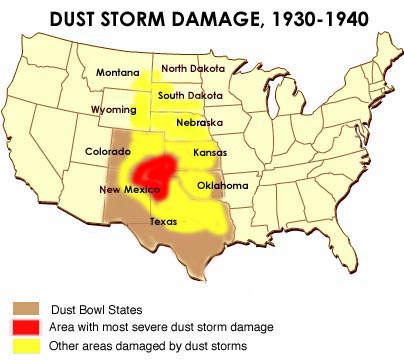
The map above shows how much of our country was directly affected by the “Dust Bowl Climate”. The center of the storm activity was at a small farming community known as “Boise (pronounced “boys”) City, Oklahoma”. First let me relate the history of this deadly phenomenon and then I’ll draw conclusions as to my belief that it is a metaphor for humanity’s hubris developed by our being the most powerful life form on this planet.
Before people emigrated in great numbers to this area of the country it was covered with “Prairie Grass”, innumerable bison and Native American Tribes. It was a beautiful Eco-system, similar to the Russian Steppes in its fertility and in the viability of its ecosystem. “The Prairie Grass” had through eons of evolution become the hardy plant that held the rich soil together by extended roots reaching down into the plentiful moisture below, thus supplying life sustaining water to the vegetation of this relatively arid region. The millions upon millions of bison added to this ecology and it reciprocated. The Native American tribes lived with and off the “buffalo”, in a manner that befitted fauna’s interaction with an ecosystem to the mutual benefit of its ecology. The incursion of American hunters and settlers began in the 1840’s, but did not become a problem for the Native tribes until after the Civil War. “Buffalo Bill” Cody was given that nickname during the Civil War when he contracted to supply buffalo meat to the Union Army. Prior to this, treaties signed in 1834 had acknowledged that this was to be lands solely for the use of the various native tribes and it was deemed the “Indian Territory”, though reduced to a size approximating today’s Oklahoma. It was not incorporated into the United States, meaning the natives had sovereignty.
Cody’s success with supplying the highly nutritious buffalo meat had brought other hunters to the area. A thriving commercial operation started and the Native Americans seeing the slaughter of the animals increase exponentially began to attack the hunters and the few farmers that had encroached on their lands. The bison though were slaughtered almost to the point of extinction putting the Native Americans into a precarious ecological bind and thus fighting back against the incursions. This resistance led to the U.S. government sending in the U. S. Calvary and General George Armstrong Custer. You know how that wound up.
By 1889 the former “Indian Territory” had been pacified, Native Americans placed in reservations away from their former hunting grounds and then unsurprisingly:
“On March 2, 1889, Congress passed an amendment with the Indian Appropriations Act of 1889, which provided for the opening of homesteading settlements in Unassigned Lands, to be known as Oklahoma. President Grover Cleveland announced that Oklahoma would be opened on April 22 via land run. The land run was to be held at noon and was open to all people of at least 21 years of age. The Land Run of 1889, the first land run in the territory’s history, opened Oklahoma Territory to settlement on April 22, 1889. Over 50,000 people entered the lands on the first day, among them several thousand freedmen and descendants of slaves. Couch and his Boomers, now numbering some 14,000, also entered the race. Those who entered Oklahoma before the official start of the race were called Sooners. ”http://en.wikipedia.org/wiki/Oklahoma_Territory & http://en.wikipedia.org/wiki/Land_run
This was to be followed by several more “Land Runs” over the next decade as thousands came to Oklahoma to take up farming and or cattle ranching. The farming predominated and the “Prairie Grass” was being uprooted to make way for golden stalks of wheat. By the time of World War I, Oklahoma was producing immense wheat crops and empty land, some of it hardly fit for cultivation was being hawked back East to people hungry to move up in the world by owning their own land. It was your typical land boom scheme and surprisingly some of the swindles were so brazen and the land they sold so worthless, that the perpetrators actually went to jail.
When the U.S. entered World War I the price of a bushel of wheat needed for our Armed Forces doubled to two dollars. This brought it City Folk known as “Suitcase Farmers”. They would ride in by rail. Buy up land. Pay people to farm it to its limits, go back home and then return for the harvest. Their interests weren’t to live on the land, but to exploit it to its fullest potential. Plowing that used to be done by creating furrows that captured water, while limiting erosion, was replaced by a plowing method that destroyed the cohesiveness of the soils ability to fight erosion. However, this new method provided for even greater crop yields in shorter time periods. This more environmentally destructive method was also adapted by regular farmers greedy for increased profits, even though they knew that it was destructive.
After World War I the price of a bushel of wheat fell to about one dollar. To make up for the lost income, production was doubled by farmers and throughout the 1920’s the harvests became increasingly plentiful and the farmers became prosperous and land values rose. For this region the “Roaring Twenties” were the “Golden Twenties” as well. Even the start of the Great Depression in 1929 did not at first affect this region and in 1930 it was considered one of the United States’ most prosperous areas.
“The unusually wet period, which encouraged increased settlement and cultivation in the Great Plains, ended in 1930. This was the year in which an extended and severe drought began which caused crops to fail, leaving the plowed fields exposed to wind erosion. The fine soil of the Great Plains was easily eroded and carried east by strong continental winds.” http://en.wikipedia.org/wiki/Dust_Bowl .
The first great Dust Storms began in 1930 and continued to increase in frequency until April 14, 1935 when the area was hit by a storm of much greater magnitude and destructiveness than had previously occurred.


http://video.pbs.org/video/2250514396 . The effects of this storm weren’t confined to this region but spread east across the country to the Atlantic Shore. From this devastation’s wake, the entire country and the Roosevelt Administration had a vivid demonstration that this was a threat to the entire nation and not just one specific area. FDR’s administration had been targeting programs and resources into this problem from almost the beginning of his taking office in 1932. Primarily it was hunger and shelter assistance, with the provision of public works jobs through various New Deal programs like the WPA. http://en.wikipedia.org/wiki/Works_Progress_Administration The New Deal also promoted a scientific farming program that discovered how wheat could be grown with much greater care for the land and which would effectively forestall soil erosion. This was gradually adopted by farmers towards the end of the 1930’s, though not without opposition to the use of new techniques.
Often overlooked in this tale of the “Dust Bowl Era” was that since these fine particles were unavoidable to humans in this region a deadly medical phenomenon call “Dust Pneumonia” developed that caused innumerable deaths of children and adults, besides residual health effects that lasted way beyond the time of emergency:
“The prairie dust was extremely fine – smaller than the period at the end of this sentence – with high silica content, which caused a type of silicosis similar to the black lung disease seen in coal miners back east. Asthma, influenza, eye infections, sinusitis, laryngitis and bronchitis were common ailments.”
We also know of the history of migration to the West coast from these areas by people who were called “Okies”, although they didn’t just come from the specific Dust Bowl areas. Their mistreatment at the hands of the fellow citizens was brought home in John Steinbeck’s classic novel “The Grapes of Wrath” and in the songs and activism of Woody Guthrie. In the Burns film one thing that brought this ill treatment home to me were the various signs put up in California in that era that proclaimed: “No Ni**ers or Okies” allowed. The brutality with which these migrants were treated at the California and other Western States borders was indeed the equal of “Jim Crow” excesses in the South.
With the end of the Dust Storms and the beginning of World War II and the need to feed the Armed Forces, this areas area again prospered and the “Suitcase Farmers” returned, this time though in the guise of huge Agra-business firms. Although the end purpose of those who live on the land as farmers and the Agra-Business industry are the same aim of making a profit, those who live on the land see themselves as stewards simply because they are trying to create a future for their children.
The land therefore is their “heritage” to be nurtured and continued through generations. Agra-Business views the “land” through “corporate eyes” as a resource and profit center to be used to extract the greatest amount of return o their investment. While the lessons of proper plowing were indeed learned, the persistence of drought in these areas, caused the search for new ways of irrigation. Thus the huge Ogallala Aquifer is now being tapped to maintain a constant water supply.
“The Ogallala Aquifer, part of the High Plains Aquifer System, is a vast yet shallow underground water table aquifer located beneath the Great Plains in the United States. One of the world’s largest aquifers, it covers an area of approximately 174,000 mi² (450,000 km²) in portions of the eight states of South Dakota, Nebraska, Wyoming, Colorado, Kansas, Oklahoma, New Mexico, and Texas. It was named in 1898 by N.H. Darton from its type locality near the town of Ogallala, Nebraska. About 27 percent of the irrigated land in the United States overlies this aquifer system, which yields about 30 percent of the nation’s ground water used for irrigation. In addition, the aquifer system provides drinking water to 82 percent of the people who live within the aquifer boundary” http://en.wikipedia.org/wiki/Oglala_Aquifer#Environmental_controversies
Many environmentalists have commented on the drop of the water levels throughout this hugely important water source. This is only a finite source of water and the ever growing usage and depletion of it portends a future where fresh water, the essence of life, becomes a sought after and ever decreasing commodity. Many predict that the Wars of the future will be fought over fresh water supply. So while for now this region has conquered the problem of the “drought cycle”, In the future this solution appears to again be threatened by the depletion of the Aquifer and our belief in our human ability to conquer all adversity and thus only think in the ego gratifying short term, will again merely be a manifestation of our hubris.
I felt I needed to go into the Dust Bowl in depth in order to give the reader background the essential thought, these two documentary programs brought to mind. Humanity has for thousands of years preened itself with the concept that we are “Masters of the Earth”. Many of our religious traditions posit that this supremacy is a “gift” that God has bestowed upon us. With this “gift” we are risen above our environment and it is not a place where we live, but is our realm, to do with as we please. When we see a natural calamity like “Super-Storm Sandy” wreak havoc on perhaps the most infrastructure intensive area in the nation, our horror boils up, but in truth these are important lessons that get quickly forgotten as the clamor for progress, profits and proliferation echoes with a steady drumbeat.
This is in effect the Hubris of Humanity. We ignore the truth that we are but advanced animals, technologically proficient, but still able to be laid low by the catastrophic and uncontrollable forces of nature. We don’t just ignore our place as part of an environment, we disdain it with the belief that we are so powerful an entity, so unique, that we can overcome the mere demands of the ecology we live in. This to me is the definition of Hubris and it is a fault of humanity and not just the United States. The desire for land, status and profits motivated those masses coming into the territory that became the “Dust Bowl”. I don’t fault them for their desire to make their way to a better life for themselves and their children. I do fault them for not understanding the forces they unleashed and how their pride in their accomplishments could so easily be made naught because of their unwarranted belief that their environmental conditions would always be the same. Their success led them to believe they were capable of overcoming anything as individuals only responsible to themselves and their families.
The idea of intelligent farming, husbanding the land, is perhaps ten thousand years old. For many humans the tradition of farming has been handed down for generations and with it the knowledge of the need for humans to be humble before nature. Simply the understanding that Nature is far more powerful than we. Humans that forget this truth are doomed by their Hubris and in its throes doom us, as the Greeks well understood more than 2,000 years ago.
Submitted by: Mike Spindell, guest Blogger
These are the links to the two-part Ken Burns documentary “The Dust Bowl”.
Bill McW
Both Mike and the film address administration efforts to improve farming and soil conditions. You might have heard of the program: the WPA.
For additioal perspective, I suggest reading:
http://www.garynorth.com/public/10354.cfm
@Dredd: There is no scientific evidence proving any species, alien or not, is more intelligent than man; to our best knowledge we ARE the most intelligent species in the cosmos.
That fact doesn’t mean we cannot make mistakes, but we are the only species of any kind that makes conscious plans and predictions for events beyond our own lifetimes that actually get executed and / or come to pass. I presume you will now, like all ideologues, just redefine the word “intelligence” to suit yourself. Proceed.
It appears that the author is uninterested in any role the government might have played to alleviate the situation, just as a somewhat analogous situation has been unfolding, especially in the past 30 years, with illegal immigration – which has the blessings of the Volvo crowd as well as corporate America — with the middle and lower classes paying a larger percentage of their income taxes for programs that virtually guarantee things will only get worse. But hey, Obama says he is going to give us immigration reform (sic).
THE LIVING GOD 1, November 24, 2012 at 1:53 pm
ever notice that some times you just can’t tell anyone something? you must let them fail.
…
==============================================
The Senator from that area, James Mountain Inhofe has said that the notion of global warming is the greatest hoax ever fostered on the public.
Learning cannot be done without the ability to do critical thinking.
Mike – I saw the shows. The kids do now 80 years later but the farmers (many at least) certainly did not get that they caused the problem. Assuming our grandkids live another 80 years in the hellscape we are building they may recognize the disaster was our fault but it is obvious the people who could actually prevent the looming nightmare are blind to anything but their own profits and power
ever notice that some times you just can’t tell anyone something? you must let them fail.
the photograph of the family reminds ME of MY childhood.
I followed up with Frontline’s “Poor Kids”, a contemporary look at struggling families. It didn’t make for a merry holiday.
The shots of crops being irrigated by water from the ogalala were appalling. We should be insisting on conserving drip systems, not a system that wastes 50% due to evaporation.
Link to Poor Kids:
http://video.pbs.org/video/2306814133
“truth be told, after seeing Part 1, it was hard to bring myself to even watch Part 2, the bleakness of it being that great. I think the worst part of all of it was at the end, when it was noted that the aquifer is now at 50%.”
Maxcat07,
Yes Part I was hard too watch and my emotions ran from extreme sadness to anger. What kept me going through Part 2 though was that early in Part 1, I knew I wanted to write about this, seeing the hubris that brought it about. The other impetus was that I truly knew little more than the basics about that era, in that region and so wanted to learn more. The pictures and the music too held my interest, keeping me along for the ride.
Spot on Mike S:
Much of that hubris comes from thinking that we are the most intelligent species in the cosmos.
There is mounting research information to counter that faith, including the type your guest post today reflects about the collective hubris of our species.
You mentioned “eons of evolution” of biological entities which followed a far greater amount of time when abiotic evolution was the only evolution going on.
It was during that time of abiotic evolution which preceded biotic evolution that the nature of stars and planets evolved a mechanism which ensures human hubris will not survive but instead will become extinct.
But there is a choice for our species: either we make hubris extinct or our Sun will.
I watched the documentary as well, though, truth be told, after seeing Part 1, it was hard to bring myself to even watch Part 2, the bleakness of it being that great. I think the worst part of all of it was at the end, when it was noted that the aquifer is now at 50%. With climate change and, what I think are generally near desert conditions in the best of times, there is a very finite length of time remaining for the “farmers” (generally big agra). Most of the human race today seems to focus on today only, and immediate gain (witness Black Friday), and then they balk at limitations on logging, fishing, farming, or being told what they can do by the “gubment”. It doesn’t bode well for the future. As much as one might yearn for one’s youth, most times I’m glad I’m in my 60s and childless.
“The Greeks had it right about humanity in general, in that as we have become masters of this planet, so many of us have so often been laid low by the hubris of thinking ourselves completely in control of our world and immune to the effects of nature.”
Yep. Earth could shake us off like a bad habit and keep on keeping on. Nature is a self-correcting system that seeks equilibrium . . .
“We ignore the truth that we are but advanced animals, technologically proficient, but still able to be laid low by the catastrophic and uncontrollable forces of nature. We don’t just ignore our place as part of an environment, we disdain it with the belief that we are so powerful an entity, so unique, that we can overcome the mere demands of the ecology we live in. This to me is the definition of Hubris and it is a fault of humanity and not just the United States.”
and we are the only creature that despite our “intelligence” seems to fail to understand the importance of maintaining that equilibrium. It’s a truth we keep forgetting. Treebeard lamented in “The Two Towers” that “Nobody cares about the forests anymore.” In many ways, Tolkien’s books are not just a commentary on war, loss and human nature, but a commentary on man’s hubris regarding nature – especially the parts dealing with Saruman. Complex life, including humans, didn’t arise because some magical sky daddy wished us into being but because of hundreds of thousands of years of evolution in a relatively stable environment. No good can come from destroying that balance.
Excellent job, Mike.
Mike,
I agree that hubris is common to all world citizens, but especially so here at home. The “suitcase farmers” that you described above sound a lot like the Bain Capital mentality.
“The farmers in the dust bowl region never really understood THEY were the ones that caused their problems.”
Frankly,
Actually in the documentary there were clips of a few who lived through the times who did understand it was their fault. However, I think today that those in power and the rest of the populace there have conveniently forgotten that fact.
Darren,
Thank you for “getting” my more global point. Hubris seems endemic to us humans and I say that as one who has himself suffered from it at times. One of the hardest, yet most necessary tasks we have in life is constant re-examination of our own behavior and its effects. Without that self awareness hubris infects us.
Xerxes whipped the sea!
Read an interesting bit about genetically modified corn this morning. Completely surprising to nobody that stayed awake through High School Biology, the pests have developed defenses against the insecticides ‘built in’ to the corn. But don’t worry your pretty little head, Monsanto and a couple of others have a new, “this time we can’t miss” GM that will solve the problem. H-U-B-R-I-S
Then, in the second section of the paper, was an article about the deaths of bees that keepers are starting to think might have something to do with the GM crops & insecticides.
The farmers in the dust bowl region never really understood THEY were the ones that caused their problems. But we are so much smarter now, right?
Mike:
It seems that the structure of what you applied to natural resource plundering being hubris is the same structure which gets people, organizations, gov’ts, etc into the same trap in other systems or environments. Now it seems to me at least here in the US with our elected officials the same thing. An effect of this is to allow problems grow to crisis levels before anything is done about it and the solution is often so extreme it causes another set of problems.
I watched the Dust Bowl series on PBS a few days ago. The more people accept your writings and this documentary as self evident truths the less the world will have to endure the hardships.
“One point of view which i heard several times in Oklahoma, is that many of their low lifes left during the dust bowl and moved to California. And they say good riddance. They who remained do not like the glorification of those folks who left.”
CaptRatty,
One of the things about Hubris in people is that even after going through great tragedy, some never learn the lesson which is that our faults lie within us and it is so easy to cast aspersions on others, to not see ourselves. Oklahoma is today one of the most conservative states in the nation. They have forgotten that were it not for the efforts of the “New Deal” their land would be desert today. Many in FDR’s administration and many Republicans of the time believed the “Dust Bowl” should not be aided and the land should be allowed to become a desert akin to the Sahara. FDR refused to give up on it.
One point of view which i heard several times in Oklahoma, is that many of their low lifes left during the dust bowl and moved to California. And they say good riddance. They who remained do not like the glorification of those folks who left.
Mike,
Saw an interesting segment on CBS this morning about evolution and the dumbing down of humans…… Just had an experience of dealing with a rather dumb or misinformed individual today….. Stupidly of human is inevitable…..